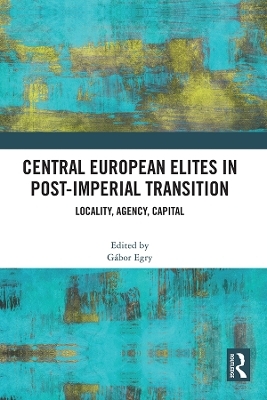
Central European Elites in Post-Imperial Transition
Routledge (Verlag)
978-1-041-24043-3 (ISBN)
- Lieferbar (Termin unbekannt)
- Versandkostenfrei
- Auch auf Rechnung
- Artikel merken
Through detailed case studies of Catholic priests from Tyrol, postmen and teachers in Czechoslovakia, a vocational school director from Southern Moravia, a forestry magnate from Romania, and bank and industrial managers and politicians from Transylvania, this book reveals how these elites successfully navigated the transition from empire to nation-state. The analysis traces how they leveraged material and social resources accumulated before 1918, converting capital from one form to another as they moved from local elite positions in the old empire to new elite roles in emerging states. In doing so, they knowingly or unintentionally strengthened the very states that had initially threatened their existence, leading these new governments to relax their homogenizing efforts in exchange.
This book will appeal to historians specializing in Central and Eastern European history, scholars of empire and nationalism, and researchers interested in elite studies and social mobility. It contributes to the broader fields of Habsburg studies, post-imperial transitions, state formation, and the sociology of elites, making it valuable for both academic researchers and advanced students in history, political science, and sociology.
The chapters in this book were originally published as a special issue of European Review of History.
Gábor Egry is a historian of modern Central and Eastern Europe, who held visiting positions among others at Columbia, Stanford, European University Institute, Wissenschaftskolleg zu Berlin. His research focuses on nationalism, economic history, postimperial transitions and politics of memory. In 2018–2023 he was Principal Investigator of the ERC Nepostrans project.
Introduction – Central European elites in post-imperial transition: locality, agency, capital 1. Between Lower Austria and Moravia: displaced local elites and the Feldsberg/Valtice agricultural school 2. A Hungarian count’s business in Romania: the strange survival of Tișița (1907–40) 3. Former Hungarian civil servants on the territory of Slovakia amid the first years of the Czechoslovak Republic, 1919–24: a case study on the status regulation of teachers and postal employees 4. ‘For everything, the local priest is a helper in adversity’: Catholic clergy and the new order in post-Habsburg Tyrol 5. The rise of Titans? Economic transition and local elites in post-1918 Banat and Transylvania
| Erscheinungsdatum | 16.12.2025 |
|---|---|
| Verlagsort | London |
| Sprache | englisch |
| Maße | 174 x 246 mm |
| Themenwelt | Geschichte ► Allgemeine Geschichte ► Neuzeit (bis 1918) |
| Geisteswissenschaften ► Geschichte ► Regional- / Ländergeschichte | |
| Geschichte ► Teilgebiete der Geschichte ► Wirtschaftsgeschichte | |
| ISBN-10 | 1-041-24043-0 / 1041240430 |
| ISBN-13 | 978-1-041-24043-3 / 9781041240433 |
| Zustand | Neuware |
| Informationen gemäß Produktsicherheitsverordnung (GPSR) | |
| Haben Sie eine Frage zum Produkt? |
aus dem Bereich