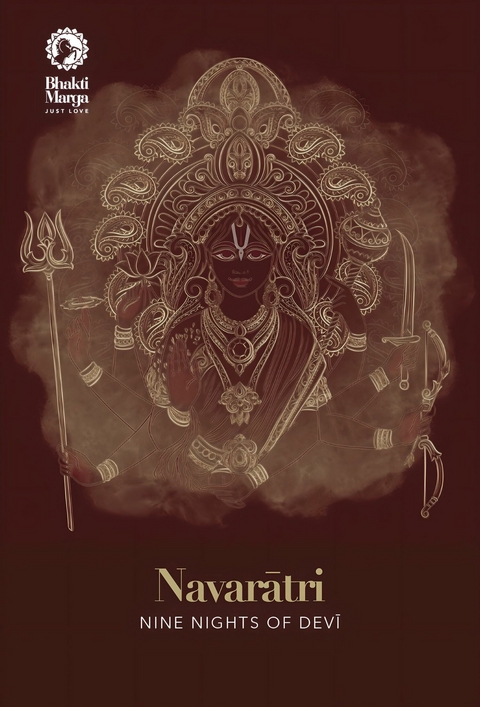
Navarātri (eBook)
128 Seiten
Bhakti Marga Publications (Verlag)
9783963431258 (ISBN)
This book, inspired by the teachings of Paramahamsa Vishwananda, offers an immersion into Devī's nature and the profound, transformative journey she leads us on during the nine nights of Navarātri.
Navarātri at a Glance
THE NINE NIGHTS OF THE DIVINE MOTHER
Navarātri is a sacred celebration in praise of the Divine Mother. “Nava” means nine and “rātri” means nights, during which different aspects of Devī Durgā are venerated. These Navadurgā, or nine forms of Durgā-devī, are understood as different manifestations of the same Mother, each representing a distinct quality while originating from the same divine essence. In the Hari Bhakta Sampradāya, this essence is praised as Mahā-Lakṣmī, regarded as the Primordial Mother and foundation of the Devī-tattva,1 of whom the nine forms of Durgā are considered an aspect.
Who is Devī?
Devī as the Cosmic Mother is a partial manifestation, or aṁśāvatāra, of Śrī Hari. As an embodiment of His śakti,2 She originates from His innermost nature, sharing His omnipresence and opulence. The word “Devī” is derived from the Sanskrit verbal root “div” meaning “to shine, to illuminate.” More concretely, “Devī” simply means “goddess.” She is great beyond description, and as the aspect of the Mother who is a warrior and protector, Durgā-devī claims her victory over powerful demons that torment the earth and the demigods. Embodying different aspects and playing various roles, metaphoric of the inner qualities that we, as spiritual seekers, need to evolve through and transcend, she is seen bearing glorious weapons. Each of these carries a designated spiritual significance, which marks her divine power and authority.
“The Divine Mother is the expansion of Bhagavan into a myriad of forms, there are endless ways She takes form to help everyone reach His Lotus Feet. Divine Mother is the tangible force of Bhagavan’s Love. She is His love manifest into simpler things that we can see, understand, and connect with easily, which help one to make one’s efforts to reach the Lotus Feet of Bhagavan. […] The path itself is Divine Mother. As She holds and nurtures the child back to Bhagavan. He takes form in this beautiful way, as the Divine Mother, so that the bhaktas can easily connect with the Universal Energy. It is simple and sweet to connect with a loving mother, and this is what the expansion of Bhagavan as Divine Mother bestows on everyone.”
- Paramahamsa Vishwananda’s Writings, October 3, 2024
Devī as Māyā-śakti
In Hinduism, the Mother holds a primordial presence, carrying and sustaining creation. Through Her name “Śrī,” denoting auspiciousness, She is honored first: it is invoked as a mark of exaltation before the chanting of certain Vedic mantras. Sharing the nature of jñāna (consciousness) and ānanda (bliss) of the Lord, the Divine Mother shares similarity with Him in nearly all of His aspects, while preserving a distinct role and function in relation to His devotees and cosmic creation. She is the personification of the principle of cosmic manifestation, known as māyā-śakti,3 the effect of Śrī Hari, defined as the dynamic energy responsible for the manifestation of the perceivable universe. The term “śakti” is usually translated as “power” or “energy” and refers to the inherent capacity within a causal substance to manifest a particular effect. She is one of the most potent receptacles of Śrī Hari’s nature, and while not of absolute equivalence to the Lord, She is the secondary cause of creation, the dynamic and personal principle operating entirely under Śrī Hari’s direction.
Also venerated as Vaiṣṇavī, her role is in purifying and elevating those devoted to the Supreme Lord, seeking to exalt their bhakti.4 She is a mediatrix between the devotees and the Lord as she sanctifies them so that they are prepared to approach His Lotus Feet. She is the Cosmic Mother with whom we can have a direct and personal relationship. Devī dwells in her own realm of Ānandaloka, a realm beyond the material creation which undergoes cycles of creation and destruction. While described as a realm beyond suffering, the realm of Devī is incomparable with the Supreme Abode of Śrī Hari, which is the ultimate destination of the ātmā. Inevitably, she prepares us to take up the path of devotion toward Bhagavān Himself.
Durgā-devī
Although Durgā-devī is known as the fierce and fear-invoking aspect of the Divine Mother, to those who sincerely seek inner transformation and devotion to the Lord, she is a sweet and beloved Mother and the greatest caretaker. As the Mother of all mothers, she sees no distinction between her children, seeking to bring all to surrender to the Lotus Feet of Śrī Hari.
Known as the sister of Bhagavān, Yoga-māyā, her role is to delude us from recognizing the Lord when He is on earth enacting His divine play. However, as Mahā-māyā, she holds the function of causing spiritual elevation through knowledge, or, on the other hand, delusion and bondage through her power of concealment and her power of distraction. In this sense, she serves Śrī Hari by acting under His command to delude the embodied souls who do not seek His refuge. By showing the futility of pursuing desires in this world, she helps one advance.
The Nine Nights
The number nine symbolizes fullness: the nine months that a mother carries a child, the nine aspects of Devī, which each represent one of the nine forms of bhakti, as well as the nine days of battle before her triumph. During the nine nights of singing, dancing, and praising Śakti, we are carried from ignorance into spiritual awareness. During Navarātri, she is invoked and her presence is enlivened through prāṇa-pratiṣṭhā,5 which brings the deity to life. Although this is happening externally on the altar, it simultaneously reflects inside of us, sparking her divine presence within.
The Observance of Navarātri
This festivity is marked four times a year, at the turn of each season. Śārdīya Navarātri occurs in the fall and is the most widely celebrated of the four Navarātris. Each of the four starts on the day after a new moon,6 with planetary alignments that have transformative effects on the mind. The intention of prayer is always loka-saṅgraha,7 and although we go through inner transformation on a personal level, it serves as a ripple effect and has the potential to positively influence society at large. The Navarātri celebrations are traditionally observed at night, as the sages have observed them so for millennia. After the late evening festivities, their energy remains active within us and continues to be assimilated while we sleep. During these nine days, it is recommended to observe fasting, to deepen one’s sādhanā, to practice japa, participate in the rituals, and to avoid meaningless chatter in order to purify the body and mind. Most importantly, although external worship is certainly part of the festival, the drawing inwards of our awareness to cultivate bhakti is key.
During Navarātri, we are reminded that Mā Bhagavatī is not a distant being but the very essence of nature, Prakṛti-devī. Out of her majesty, she is humble, seated inside of our hearts in the form of love and kindling our longing and yearning for Bhagavān. She is compassionate and caring, making herself accessible to all without distinction. If one is sincere, it is easy to receive her grace and be blessed with transformation. Her wish is that all should attain the Lord; this is why it is said that whoever sincerely turns to the Mother will find transformation. In the Hari Bhakta Sampradāya, we understand that it is through the satguru that we receive her grace, and that in turn, she helps us to grow closer in devotion to the satguru.
Devī and the Satguru
In the Hari Bhakta Sampradāya, the satguru holds a prime place. Capable of granting God-realization at will, he carries Bhagavān’s grace of liberating the jīvas, the embodied living beings, from the cycle of repeated birth and death. The nature of the satguru is not dissimilar to that of Devī. Both are the living manifestation of His nature. Whereas the Divine Mother embodies the Lord’s mercy, the satguru is the personification of His grace, known as anugraha-śakti. Their dynamic reconnects the jīva with the Divine Mother, who in turn purifies us so that the relationship with the satguru is thus empowered. In this way, their grace and blessing mutually guide our personal devotional relationship with Śrī Hari.
“That Love exchange between the Satguru, Devi Ma and Bhagavan for the benefits of the sadhak is amazing. All three work together: When a person is ready, Bhagavan sends the Satguru. The Satguru reconnects us with Divine Mother. She helps us purify ourselves, and in that way makes our connection with the Satguru stronger and deeper. Both, Ma and Satguru, want us to reach Bhagavan, and Bhagavan again reveals Satguru’s and Maa glory. Actually, we are so protected and everything is ensured for us. We just need to dare, decide, and persist and persevere till the end of the spiritual process. Actually we are so blessed.”
- Paramahamsa Vishwananda’s Writings, October 5, 2024
“You are Vaiṣṇava, why do you pray to the Divine Mother?” If Bhagavān Himself, before incarnating on earth, has asked Devī to manifest, and is using her to delude His creation, it means that she has a big role to play. As you have come to her feet, as you know your aim, ask her to remove all of the obstacles from your path and from your mind....
| Erscheint lt. Verlag | 20.9.2025 |
|---|---|
| Sprache | englisch |
| Themenwelt | Geisteswissenschaften ► Religion / Theologie ► Hinduismus |
| Schlagworte | bhakti devi mother goddess hinduism shakta • navaratri durga lakshmi sri vidya |
| ISBN-13 | 9783963431258 / 9783963431258 |
| Informationen gemäß Produktsicherheitsverordnung (GPSR) | |
| Haben Sie eine Frage zum Produkt? |
 EPUB (Ohne DRM)
Digital Rights Management: ohne DRM
Dieses eBook enthält kein DRM oder Kopierschutz. Eine Weitergabe an Dritte ist jedoch rechtlich nicht zulässig, weil Sie beim Kauf nur die Rechte an der persönlichen Nutzung erwerben.
Dateiformat: EPUB (Electronic Publication)
EPUB ist ein offener Standard für eBooks und eignet sich besonders zur Darstellung von Belletristik und Sachbüchern. Der Fließtext wird dynamisch an die Display- und Schriftgröße angepasst. Auch für mobile Lesegeräte ist EPUB daher gut geeignet.
Systemvoraussetzungen:
PC/Mac: Mit einem PC oder Mac können Sie dieses eBook lesen. Sie benötigen dafür die kostenlose Software Adobe Digital Editions.
eReader: Dieses eBook kann mit (fast) allen eBook-Readern gelesen werden. Mit dem amazon-Kindle ist es aber nicht kompatibel.
Smartphone/Tablet: Egal ob Apple oder Android, dieses eBook können Sie lesen. Sie benötigen dafür eine kostenlose App.
Geräteliste und zusätzliche Hinweise
Buying eBooks from abroad
For tax law reasons we can sell eBooks just within Germany and Switzerland. Regrettably we cannot fulfill eBook-orders from other countries.
aus dem Bereich