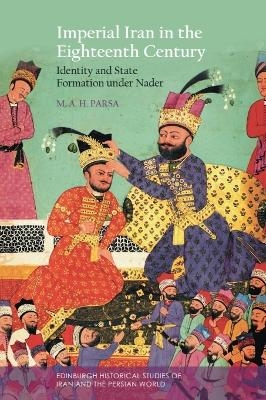
Imperial Iran in the Eighteenth Century
Edinburgh University Press (Verlag)
978-1-3995-5333-9 (ISBN)
- Noch nicht erschienen (ca. Juni 2026)
- Versandkostenfrei
- Auch auf Rechnung
- Artikel merken
The 18th-century ‘interregnum’ between the Safavid and Qajar dynasties remains woefully understudied in Iranian history, regarded as a turbulent and inconsequential gap between two major dynastic periods. This book, however, argues that this period saw the emergence of the idea of Iran as the foundation for collective identity and state formation. It traces the development of a sacralised territorial identity that fused an irredentist notion of Iran-realm (Iranzamin) with Shiʿism, culminating in an unprecedented political idea: that of an ‘Iranian state’ (dowlat-e Irān), supposedly formed by the unanimous consensus of the ‘Iranian people’ (ahl-e Irān). The book then covers how this state, under Nader Shah (Nāder-e Irān), subjugated non-Iranian realms to form a new universal Islamic empire.
This is the first monograph to offer an integrated understanding of state formation in post-Safavid Iran (c.1720 – 1750), demonstrating how politico-cultural, military, administrative and ecclesiastic developments related to one another. Drawing on a wide range of neglected primary sources in Arabic, Turkish (both Ajami and Ottoman) and Kurdish (Hawrami), as well as Persian and European sources, the book sheds light on Iran in its last iteration as a great power.
Dr M. A. H. Parsa is an Assistant Professor of Imperial and World History at Ashoka University in India. His primary focus is on the post-Mongol empires and the Turco-Persianate world. Currently, he’s working on the emergence of popular sovereignty in eighteenth-century Iran, rooted in the Turco-Mongol tradition of consultative rule and Perso-Islamic mystical thought. He has published several articles on Nader Shah’s imperial inscriptions in ‘Ajami/Qizilbash Turkic. He completed his PhD at SOAS University of London in 2022 on the post-Safavid and Naderid history of Iran. He was a lecturer at NYU London and the University of St Andrews in Scotland before taking up his current position at Ashoka University.
Acknowledgments
Transliteration System and Pronunciation Guide
Maps and Figures
Key Personalities and Sources
Introduction: Iran, State, and Empire in Eighteenth-Century History and Historiography
1. Iranianness and Otherness 1722-1732
2. Nāder, the Unoriginal Saviour 1726-1736
3. Nāder Shāh and the ‘Iranian State’ 1736-1746
4. Shāh of Iran, Shāhanshāh of the World 1736-1746
5. Nāder as the Enemy of Iran and a Traitor to the Iranians 1740-1750
Conclusions and Reflections on Eighteenth-Century Imperial Iran
Bibliography
Index
| Erscheint lt. Verlag | 30.6.2026 |
|---|---|
| Reihe/Serie | Edinburgh Historical Studies of Iran and the Persian World |
| Zusatzinfo | 2 b/w illustrations, 1 table and 4 b/w maps |
| Verlagsort | Edinburgh |
| Sprache | englisch |
| Maße | 156 x 234 mm |
| Themenwelt | Geschichte ► Allgemeine Geschichte ► Neuzeit (bis 1918) |
| Geisteswissenschaften ► Geschichte ► Regional- / Ländergeschichte | |
| ISBN-10 | 1-3995-5333-X / 139955333X |
| ISBN-13 | 978-1-3995-5333-9 / 9781399553339 |
| Zustand | Neuware |
| Informationen gemäß Produktsicherheitsverordnung (GPSR) | |
| Haben Sie eine Frage zum Produkt? |
aus dem Bereich