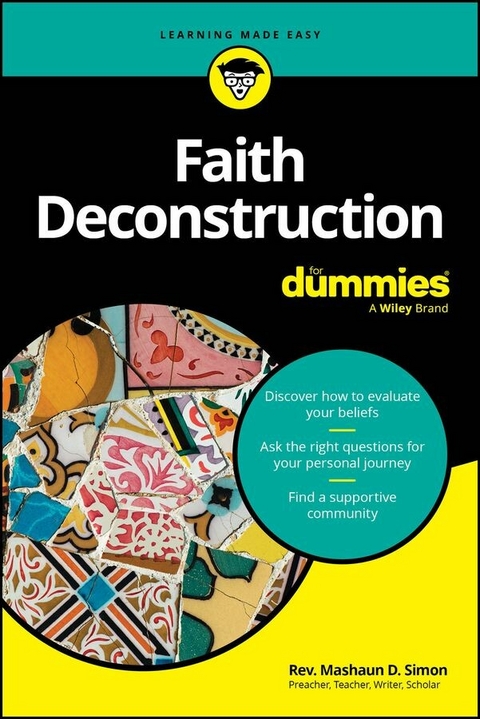
Faith Deconstruction For Dummies (eBook)
329 Seiten
For Dummies (Verlag)
978-1-394-33139-0 (ISBN)
Get support and guidance as you navigate reexamining your faith and finding your own way to the truth
Faith Deconstruction For Dummies helps you through the process of thinking critically about your beliefs by unlearning, processing, and considering new ways of thinking. This unbiased book walks you through your options as you begin the faith deconstruction process, and it provides advice and suggestions to assist you on your journey. You'll learn about the origins of deconstruction, its causes and effects, and what to expect during the process of reevaluating your belief system. Shed the baggage of belief systems, craft your own investigative process, and discover tools and resources that will help you map out your path. Those who deconstruct their faith may end up departing from organized religion, while others may develop a closer relationship with God. Find answers to your heart's deepest questions with this compassionate Dummies guide.
- Dissect your beliefs, reevaluate traditions and rituals, and find the practices that feel right for you
- Get answers to questions like: Who am I? What do I believe? What is my relationship to my faith?
- Find safe spaces where you can explore your options and build community through the deconstruction process
- Evaluate your spirituality in the face of skepticism, curiosity, trauma, loss, or simply a desire to question
Faith Deconstruction For Dummies is a guide for readers from all walks of life who are sitting with complicated questions regarding what they have been taught versus what they have begun to believe.
Mashaun D. Simon is an award-winning writer, preacher, and thought leader who centers his preaching, scholarship, and storytelling on cultural competency and awareness, communal care, and belonging. His byline has appeared in the Atlanta Journal-Constitution, NBC News, Black Enterprise, Bloomberg News, Ebony Magazine, and ESSENCE Magazine.
Get support and guidance as you navigate reexamining your faith and finding your own way to the truth Faith Deconstruction For Dummies helps you through the process of thinking critically about your beliefs by unlearning, processing, and considering new ways of thinking. This unbiased book walks you through your options as you begin the faith deconstruction process, and it provides advice and suggestions to assist you on your journey. You'll learn about the origins of deconstruction, its causes and effects, and what to expect during the process of reevaluating your belief system. Shed the baggage of belief systems, craft your own investigative process, and discover tools and resources that will help you map out your path. Those who deconstruct their faith may end up departing from organized religion, while others may develop a closer relationship with God. Find answers to your heart's deepest questions with this compassionate Dummies guide. Dissect your beliefs, reevaluate traditions and rituals, and find the practices that feel right for you Get answers to questions like: Who am I? What do I believe? What is my relationship to my faith? Find safe spaces where you can explore your options and build community through the deconstruction process Evaluate your spirituality in the face of skepticism, curiosity, trauma, loss, or simply a desire to question Faith Deconstruction For Dummies is a guide for readers from all walks of life who are sitting with complicated questions regarding what they have been taught versus what they have begun to believe.
Chapter 1
Deconstruction 101
IN THIS CHAPTER
Defining faith deconstruction
Working through some common questions and misunderstandings
Beginning your deconstruction journey
I might as well acknowledge the elephant in the room. Faith deconstruction isn’t exactly the sexiest topic to talk about, which is a problem. Or at least it should be. Thinking critically about faith and religious beliefs should be something that everyone is open to and willing to do. But most people are sensitive about their faith, their beliefs, and the religious institutions they attend.
How a person identifies in relation to their faith is important even if they’re a nonbeliever. Being a nonbeliever is a big part of a person’s identity, whether they want to admit it or not. Beliefs — and disbeliefs — influence everything.
As a reader of this book, you likely have some questions. I’m pretty sure one question has something to do with what you once believed about God. Maybe you aren’t sure you believe what you were once taught. Or maybe you have a few questions and are looking for something or someone to offer you support, guidance, and answers. You’re in the right place. But first, let me assure you of something: You’re not losing your mind. You’re not crazy. And God isn’t going to punish you for having questions.
This chapter lays the groundwork for what you’ll encounter in the rest of this book. Here you’ll get a minor overview of faith deconstruction and some thoughts on what makes deconstructing your faith necessary and beneficial in the grand scheme.
Defining Faith Deconstruction
As I was writing this book, I selectively had a few conversations with people I trust about the project. During one of them, a friend asked me, “How are you defining faith deconstruction?” The question caught me off guard. At that point, no one had inquired as such, and I hadn’t expected anyone to do so. I hesitated briefly. I wasn’t prepared to give them an answer. I didn’t have an answer. I didn’t know how I was defining deconstruction.
In the back of my mind, I assumed everyone familiar with faith deconstruction understood what it was. I also assumed each of them was working off the same definition. And because of those assumptions, I hadn’t formulated a definition or description for myself. I knew what I knew about deconstruction. I knew what I believed about deconstruction. But this question was different. He wasn’t asking me what I knew. He was asking me how I planned to define it. In the same way I’d assumed, he’d assumed. He assumed I’d already formulated a working definition and that the definition I’d formulated was informing this project.
But I didn’t know. Not at that point at least. Now, isn’t that something? The person writing an entire book on faith deconstruction and presenting it as a help guide for others experiencing it didn’t have an answer.
I also realized in that conversation that the definition of faith deconstruction has variations. At the core is a universal understanding. Universal tenets inform the definition for some. Proponents of faith deconstruction also use a version of the definition. And a version is informed by the opinions and perspectives of those who oppose faith deconstruction. This section addresses some of those binaries, as well as insight on how I understand and define deconstruction today.
What is faith deconstruction?
So, then, what is faith deconstruction? Well, it really depends on who you ask and what their position is on the topic. Those who are critical of faith deconstruction and would, potentially, consider themselves opponents, define faith deconstruction as the process of someone walking away from God or from their faith. Other opponents often describe faith deconstruction as trendy and a threat to Christianity or faith overall. They perceive deconstruction to be damaging to traditional, doctrinal Christianity.
One essay I read on faith deconstruction declared that faith deconstruction lacks any trace of true Christianity. It was written by a woman who grew up a devout Christian, experienced a deconstructive journey of her own, and eventually returned to what she described as a “historically Christian understanding of the gospel.” She shared that she was introduced to deconstruction by a former pastor, accusing him of being on a mission to “propel” the congregation into deconstruction so he could “convert them to progressive Christianity.”
I found her claim that faith deconstruction lacked any trace of true Christianity, and her challenge that faith deconstruction has completely abandoned any connection to scripture, to be dangerously inauthentic and misleading. Much of her influence and approach to those who have deconstructed is informed by her relationship to and reverence for scripture. That reverence and her interpretations of said texts inform her faith.
Proponents of faith deconstruction have an entirely different perspective and definition of faith deconstruction. For some, faith deconstruction is a critical examination of their faith and theology. It’s about more than doubt. As they define it, faith deconstruction is an investment. Some deconstructionists describe faith deconstructing as weeding. When they deconstruct their faith, they take a deep look at not just their faith, but the influences of their faith understanding and what they’ve been taught about God. Reexamining doctrines, traditions, and tenets of religious systems is part of that process of evaluating.
While opponents suggest faith deconstruction is solely motivated to tear down doctrine, proponents see the work differently. Some have used the phrase “breaking apart.” But I think there may be another way to describe it that’s possibly more accessible: diagnostic. Take, for example, the work that mechanics must do when working on an automobile. Before they can do any actual work, most mechanics first perform a diagnostic inspection. They check everything, externally and internally, to assess what needs repair and what doesn’t. In some instances, they’ll get an inkling to a problem and do more investigating. They’ll check every part of the car from under the hood to beneath the body of the car, including breaks and electrical systems.
Faith deconstruction is a lot like the work of a mechanic. There may be alerts and sensors that will communicate the need for repair or at least some attention. But you really can’t get to the root of the problem without investigating, running tests, and getting under the hood.
That’s how I see faith deconstruction. Especially now. Nuance is important. I didn’t always have access to nuance, or the information/knowledge needed to acknowledge what makes nuance so important. Before I knew anything about faith deconstruction, I paralleled those who were questioning their faith as atheists. If at any time it seemed like someone had any kind of doubt about what they believed or what anything meant biblically, I immediately lumped them into the category of atheist. I didn’t really know what atheist meant either. It just seemed like the most appropriate way to understand and label critical thinkers. Part of this is because I was taught implicitly and explicitly to never question God or anyone of religious authority. Things were what they were because God said, and that was all there was to it.
I also held that anyone who no longer believed was destined for hell. It’s what I was taught and conditioned for years. I also felt this way about anyone who didn’t believe in and profess Jesus Christ as their Lord and Savior. That meant anyone who lived in a faith outside of Christianity, whether they were Jewish, Muslim, or anything else, was outside of the will of God. Jesus was “the way, the truth and the life” (John 14:6). Jesus was the only way. I had these concerns for others, and they manifested within me.
Now, I was never one of those Bible-thumping believers. But quietly and internally, my heart ached for anyone who was outside of Christianity. And my heart ached for myself, struggling with my own humanity, identity, and spirituality. I allowed the messaging I was exposed to in church and in the media to inform much of that heartache. I even fell in love once with someone who considered themselves an atheist. Initially, I ignored what my mind told me was wrong as we spent time together. But eventually I feared what would happen if I allowed myself to love them more than I did because we were “unequally yoked” (2 Corinthians 6:14). I’ve come a long way since then.
What does it mean to “deconstruct” your faith?
When I began accepting that I was deconstructing, which I share more about in Chapters 2 and 15, I looked at the process more like taking a puzzle apart and putting it back together. Or, in the examples I use in later chapters, taking ingredients from a beloved meal and putting them together, but in a different way — like deconstructing an apple pie. Faith deconstruction for me in 2022 and 2023 was more about making something I considered beloved, using the same ingredients, and being surprised that the outcome didn’t look the way I expected it to. Looking back, I don’t think that was the most accurate example simply because some of what I was doing included not...
| Erscheint lt. Verlag | 13.10.2025 |
|---|---|
| Sprache | englisch |
| Themenwelt | Geisteswissenschaften ► Philosophie ► Allgemeines / Lexika |
| Geisteswissenschaften ► Religion / Theologie | |
| Schlagworte | Christianity questioning • Christianity skepticism • Deconstruction Christianity • deconstruction Christianity book • Faith Deconstruction • faith doubt • faith questioning book • finding faith • Finding Your Faith • questioning belief • questioning faith |
| ISBN-10 | 1-394-33139-8 / 1394331398 |
| ISBN-13 | 978-1-394-33139-0 / 9781394331390 |
| Informationen gemäß Produktsicherheitsverordnung (GPSR) | |
| Haben Sie eine Frage zum Produkt? |
 EPUB (Adobe DRM)
Kopierschutz: Adobe-DRM
Adobe-DRM ist ein Kopierschutz, der das eBook vor Mißbrauch schützen soll. Dabei wird das eBook bereits beim Download auf Ihre persönliche Adobe-ID autorisiert. Lesen können Sie das eBook dann nur auf den Geräten, welche ebenfalls auf Ihre Adobe-ID registriert sind.
Details zum Adobe-DRM
Dateiformat: EPUB (Electronic Publication)
EPUB ist ein offener Standard für eBooks und eignet sich besonders zur Darstellung von Belletristik und Sachbüchern. Der Fließtext wird dynamisch an die Display- und Schriftgröße angepasst. Auch für mobile Lesegeräte ist EPUB daher gut geeignet.
Systemvoraussetzungen:
PC/Mac: Mit einem PC oder Mac können Sie dieses eBook lesen. Sie benötigen eine
eReader: Dieses eBook kann mit (fast) allen eBook-Readern gelesen werden. Mit dem amazon-Kindle ist es aber nicht kompatibel.
Smartphone/Tablet: Egal ob Apple oder Android, dieses eBook können Sie lesen. Sie benötigen eine
Geräteliste und zusätzliche Hinweise
Buying eBooks from abroad
For tax law reasons we can sell eBooks just within Germany and Switzerland. Regrettably we cannot fulfill eBook-orders from other countries.
aus dem Bereich