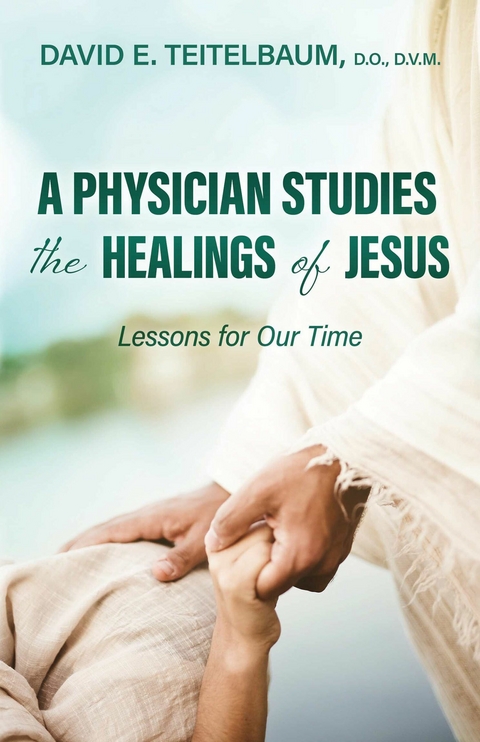
Physician Studies the Healings of Jesus (eBook)
140 Seiten
Bookbaby (Verlag)
979-8-3178-1653-7 (ISBN)
Dr. David Teitelbaum received his Doctorate of Veterinary Medicine from Texas A&M University in 1976, and his Doctorate of Osteopathic Medicine from the University of North Texas Health Science Center in 1984. He has practiced integrative Osteopathic medicine in Ft. Worth for over 40 years, where he lives with his wife, Melinda. They have 3 sons. Born and raised Jewish, he became a follower of Christ at age 19. In this book, Dr Teitelbaum has combined his extensive medical education with his passion for studying the life of Jesus.
The manuscript is divided into eight distinct parts:1. Part I: Few Christians have made a study of the twenty six healings of Jesus detailed in the Gospels. This section introduces the healings, and provides an explanation of the Biblical model of health. Additionally, introductory information for Christians involved in healing ministry is provided. 2. Part II: Healings Involving Faith. Six healings are focused on the faith of the supplicant. It becomes evident from the responses of Jesus to these supplicants how He uses the opportunity to grow their faith. 3. Part III: Healings During the Sabbath. Sabbath healings became a repetitive source of conflict with the conservative Jewish authorities. The discussion of the four healings in this section reveal why they were so contentious, and that Jesus deliberately performed them in full knowledge of the consequences. 4. Part IV: Healings Involving Demons. Demon possession was commonly accepted as a source of illness in the time of Jesus, and He was able to heal many who were tormented by them. Demonology is reviewed here through five healings, and specific lessons concerning the interaction of Jesus with these creatures are presented. 5. Part V: Healings Involving Sin and Disease. The Bible does present sin as a source of disease, but Jesus clearly taught it was not the only source. In the four presented healings, Jesus explains the connection between sin and disease. 6. Part VI: Healings of Blindness and Deafness. Physical blindness and its metaphoric connection to spiritual blindness is revealed in the four healings of this section. Jesus employed His saliva in two of these, and possible explanations are presented. 7. Part VII: Raising from the Dead. Jesus raised three people from the dead. As part of the Trinity, it is arguable that He also raised Himself, bringing the total to four. In addition to providing a study of the three healings, the foundational importance of resurrection to Christianity is discussed. 8. Part VIII: Two Appendices: My Morning Prayers and Healing Prayers for My Patients. These two appendices provide model prayers for readers involved in Christian healing.
Chapter 1
Healings Involving Faith
The Woman with an Infirmity of Eighteen Years, James Tissot, ca. 1886–1896, opaque watercolor over graphite on gray wove paper; image 9 ½ × 7 1⁄8 in. (24.1 × 18.1 cm). Brooklyn Museum, Accession 00.159.144. Purchased by public subscription.
Faith is foundational not only to Christian healing but Christianity itself. In the Christian Bible, we find the phrase, “Without faith it is impossible to please God, because anyone who comes to him must believe that he exists and that he rewards those who earnestly seek him” (Hebrews 11:6).
It is through faith that individuals come to know God and experience His presence. For Christians, faith includes not only believing in God but also coming to have a relationship with Jesus and recognizing Him as the source of being made righteous and receiving eternal life. Followers of Christ believe this is achieved only by the grace of God and cannot be earned by human efforts: “For it is by grace you have been saved, through faith—and this is not from yourself, it is the gift of God—not by works, so that no one can boast” (Ephesians 2:8–9).
Christians are called to lives that demonstrate their faith, turning to God in both good times and bad. The bad times can include periods of illness, during which followers of Christ turn to God for healing. Out of faith in His love for us and His power to control all aspects of the physical world, He can mercifully alleviate disease and suffering. Yet, this same faith leads believers to accept that God acts according to His plan and timing for the world, and can therefore require the patience and endurance which strong faith can provide.
Jesus said, “Have faith in God. Truly I tell you, if anyone says to this mountain, ‘Go throw yourself into the sea,’ and does not doubt in their heart but believes that what they say will happen, it will be done for them. Therefore I tell you, whatever you ask for in prayer, believe that you have received it, and it will be yours.”
Jesus emphasized the importance of faith in healing many times, as this chapter will demonstrate.
Healing a Royal Official’s Son
(John: 4:46–53)
“When he arrived in Galilee, the Galileans welcomed him. They had seen all that he had done in Jerusalem at the Passover Festival, for they also had been there.
Once more he visited Cana in Galilee, where he had turned the water into wine. And there was a certain royal official whose son lay sick at Capernaum. When this man heard that Jesus had arrived in Galilee from Judea, he went to him and begged him to come and heal his son, who was close to death.
‘Unless you people see signs and wonders,’ Jesus told him, ‘you will never believe.’
The royal official said, ‘Sir, come down before my child dies.’
‘Go,’ Jesus replied, ‘your son will live.’
The man took Jesus at his word and departed. While he was still on the way, his servants met him with the news that his boy was living. When he inquired as to the time when his son got better, they said to him, ‘Yesterday, at one in the afternoon, the fever left him.’
Then the father realized that this was the exact time at which Jesus had said to him, ‘Your son will live.’ So he and his whole household believed.”
General Comments:
The mission of Jesus was to preach about the Kingdom of God, inviting all who would believe in Him to enter it. Yet, He recognizes the need of people to grow their faith through seeing proof of His Divinity. The healings provide that proof but are secondary to His mission. His statement, “Unless you people see signs and wonders, you will never believe” should not be seen as a condemnation. Rather, He knows us and recognizes our human need to see some tangible proof before stepping out further through faith.
While becoming a follower of Christ always involves the component of faith, it is common for this to follow some demonstration of God’s power made evident to the potential believer. This may take the form of seeing or hearing about the power of God working in the lives of others, or the Holy Spirit acting in some other recognizable fashion. Thus, it is recognized that becoming a follower of Christ involves a step of faith but not necessarily a leap of faith.
The Healing and Narrative:
The healing occurred over distance without Jesus ever seeing the child.
The faith of the royal official is evident first in his coming to Jesus for healing. The strength of his faith is revealed when he “took Jesus at His Word,” and further enhanced upon learning that the time of the healing coincided with Jesus’ words.
His faith is then proved by the action of leading his whole household to believe.
The news to the royal official from his servants confirms that the healing was instantaneous and complete.
Lessons:
Faith plays an important role in healing. Whether it is faith of the afflicted person, or one who cares about them, using that faith to come to Jesus can result in healing.
Once one has faith in God, He wants us to bring others to know Him. Jesus prophetically tells the royal official: “Unless you people see signs and wonders, you will never believe.” The official fulfills these words when he sees his son healed, then leads his entire household to become believers. Encouraging others to believe in Jesus is the expected faithful response upon recognizing who He is.
Humility is essential for relationship with God. The royal official could have viewed Jesus in a similar fashion to the Pharisees—as an uncredentialed, backwater troublemaker who made outrageous claims. Instead, he humbles himself to beg Jesus to come to his aid. Receiving blessings from God often requires an individual to first humble himself.
Jesus has Divine Authority in this world. Bringing a complete cure to someone He never met, from a distance, is proof that Jesus was Divine. Only God has the power to do this.
Conclusion:
The healing of the nobleman’s son demonstrates the Divine Authority of Jesus in response to a man humbling himself and demonstrating his faith. This faith leads the official to the grateful and appropriate response of leading others to Jesus as well.
Healing a Man with Leprosy
(Mark 1:40–45)
Also found in Matthew 8:1–4 and Luke 5:12–16
“A man with leprosy came to him and begged him on his knees, ‘If you are willing, you can make me clean.’
Jesus was filled with compassion. He reached out his hand and touched the man. ‘I am willing,’ he said. ‘Be clean!’ Immediately the leprosy left him and he was cleansed.
Jesus sent him away at once with a strong warning: ‘See that you don’t tell this to anyone. But go, show yourself to the priest and offer the sacrifices that Moses commanded for your cleansing, as a testimony to them.’ Instead he went out and began to talk freely, spreading the news. As a result, Jesus could no longer enter a town openly but stayed outside in lonely places. Yet the people still came to him from everywhere.”
General comments:
In ancient times, leprosy was not just a terrible disease but a social stigma. It was believed to be highly contagious, so people who had it were forced to warn anyone who approached that they were “unclean.” Not surprisingly, they lived isolated lives of rejection and exclusion from society. To make matters even worse for the victims, it was widely believed that many diseases were punishments from God for sin, so the diseased person was assumed to have done something wicked to deserve such a fate.
The Healing and Narrative:
The leper was revealing his faith in Jesus in two ways. The first is his statement “If you are willing . . .” In saying this, he is declaring steadfast belief in the ability of Jesus to heal him, with no doubt that He had the power to make it happen, while recognizing that Jesus might be unwilling to grant his request. The second showing of faith is revealed by his posture, as he approaches Jesus on his knees. This is a position of supplication, and a recognition of Jesus being worthy of worship.
Jesus was filled with compassion for this poor soul, consistent with His many statements directing His followers to love others. He proves this love by not hesitating to touch the man, in spite of the widely accepted belief that the disease was highly contagious.
The completeness of the healing is proved by the leper being immediately cleansed.
Jesus’ instruction to the leper to not tell anyone about the healing had to do with the plan for His ministry. We read the result of the leper’s testimony in the last line of this episode, where we find that Jesus is no longer able to enter any town openly, thereby somewhat limiting His mission of widely preaching the Kingdom of God.
The...
| Erscheint lt. Verlag | 15.10.2025 |
|---|---|
| Sprache | englisch |
| Themenwelt | Geisteswissenschaften ► Religion / Theologie ► Christentum |
| ISBN-13 | 979-8-3178-1653-7 / 9798317816537 |
| Informationen gemäß Produktsicherheitsverordnung (GPSR) | |
| Haben Sie eine Frage zum Produkt? |
 EPUB (Ohne DRM)
Größe: 1,9 MB
Digital Rights Management: ohne DRM
Dieses eBook enthält kein DRM oder Kopierschutz. Eine Weitergabe an Dritte ist jedoch rechtlich nicht zulässig, weil Sie beim Kauf nur die Rechte an der persönlichen Nutzung erwerben.
Dateiformat: EPUB (Electronic Publication)
EPUB ist ein offener Standard für eBooks und eignet sich besonders zur Darstellung von Belletristik und Sachbüchern. Der Fließtext wird dynamisch an die Display- und Schriftgröße angepasst. Auch für mobile Lesegeräte ist EPUB daher gut geeignet.
Systemvoraussetzungen:
PC/Mac: Mit einem PC oder Mac können Sie dieses eBook lesen. Sie benötigen dafür die kostenlose Software Adobe Digital Editions.
eReader: Dieses eBook kann mit (fast) allen eBook-Readern gelesen werden. Mit dem amazon-Kindle ist es aber nicht kompatibel.
Smartphone/Tablet: Egal ob Apple oder Android, dieses eBook können Sie lesen. Sie benötigen dafür eine kostenlose App.
Geräteliste und zusätzliche Hinweise
Buying eBooks from abroad
For tax law reasons we can sell eBooks just within Germany and Switzerland. Regrettably we cannot fulfill eBook-orders from other countries.
aus dem Bereich