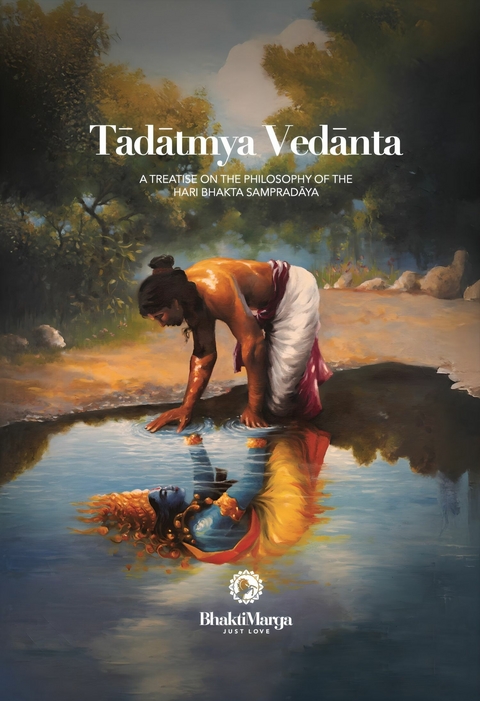
Tādātmya Vedānta (eBook)
400 Seiten
Bhakti Marga Publications (Verlag)
9783963431265 (ISBN)

This work presents Tādātmya Vedānta, the philosophy of the Hari Bhakta Sampradāya, founded by Paramahamsa Vishwananda. It explores the building blocks of reality and their connection, the ultimate pinnacle of spiritual attainment, as well as the path to reach it. Both a philosophical treatise and devotional offering, it is an invitation to Just Love.
1 A New Sampradāya
CONTEXT AND THE NEED FOR SIDDHĀNTA
This work presents Tādātmya Vedānta, the constitutional philosophical conclusion (siddhānta) of the Hari Bhakta Sampradāya, based on the teachings of Paramahamsa Vishwananda.
A sampradāya is a spiritual lineage within Sanātana-dharma that transmits a distinct set of teachings and practices, aimed at preserving both the teachings and grace of its founder across generations. Central to a sampradāya is a siddhānta, literally “perfect conclusion.” A siddhānta distills a sampradāya’s core philosophical teachings, which articulate the nature of God, the soul, the material world, liberation, and the path to attain liberation.
It is commonly believed that ācāryas objectively assess śāstra and thus derive an unbiased conclusion from it. However, a sampradāya with its respective siddhānta, is ultimately based upon the experience and reasoning of the founding ācāryas, who ground their insights within the divine revelations of śāstra, as will be discussed in the upcoming chapters.
1.1 A Primer on Sanātana-dharma
Before one can understand sampradāya, one should appreciate the wider religious context in which it is situated. It is indeed quite difficult to pin down a precise definition of Sanātana-dharma.1 It is both a religion as well as a spiritual culture that houses numerous sub-traditions. It is rooted in eternal wisdom, yet actively evolves with the times. It contains diametrically opposed doctrines and extremely diverse practices. Depending on how broadly one wishes to stretch the umbrella of Sanātana-dharma, this commonwealth of movements can arguably be bound by a few key principles:
-
Ātmā: The individual, eternal, conscious, and blissful Self, distinct from the body-mind complex and yet infusing life into it.
-
Brahman: The eternal ultimate reality, transcendent to this material world.
-
Karma: Action and its consequential reaction that binds the ātmā to further action in prakṛti.
-
Prakṛti: The primordial, ever-changing material principle that is continuously projected out and withdrawn.
-
Dharma: The concept of an inherent cosmic order where each component has a specific purpose.
-
Saṁsāra: The cycle of repeated birth and death in which the embodied ātmā undergoes an existence bound in prakṛti.
-
Mokṣa: The state of being permanently liberated from saṁsāra.
Even with these loosely unifying principles, the exact understanding of each one can vary drastically. The famously quoted verse from the Ṛg Veda encapsulates this well: “ekaṁ sad viprā bahudhā vadanti,”2-“The Truth is one, but the wise speak of it in many ways.” Central to Sanātana-dharma are those who have direct experience of the Supreme Absolute. In this regard, the Bhagavad Gītā states:
Learn such wisdom by submission, extensive inquiry, and service from a spiritual master. Such realized beings will impart it to you, for they directly perceive the Truth.3
- Bhagavad Gītā, 4.34
These great personalities have pierced through the material reality and live in constant union with the Divine. Based on their direct realization, they develop existing teachings by adjusting them according to time and place. Over millennia, countless spiritual traditions have sprung up and enriched the culture of Sanātana-dharma in this way. Through a lineage of realized teachers who transmit spiritual knowledge and experience from master to disciple, these traditions, also known as sampradāyas, ensure that both knowledge and realization are meticulously passed down from generation to generation. Through initiation (dīkṣā), one gains access to the grace of the lineage and pledges exclusive commitment to it.
Regarding the etymological meaning of sampradāya, “sam” means fully, “pra” means forward, and “da” means giving. In other words, a sampradāya provides a complete pathway to the Supreme Absolute. Within it, seekers find everything they need to attain their spiritual aspirations.
The initiation process is not just a commitment. It is an opportunity to receive the blessings of the entire lineage. There is a current of grace stemming from the original founder, through all the great ācāryas, to the new initiate. This spiritual potency is of paramount importance. While the mantra, or practice, may have its own merit, it takes on an entirely different potency when given as part of the initiation process. In this way, the great divine personalities over time have poured their grace into innumerable pathways which have become the epicenters of Sanātana-dharma.
1.2 The Hari Bhakta Sampradāya
The Hari Bhakta Sampradāya was founded in July 2021 and serves as the vessel that carries Paramahamsa Vishwananda’s grace and teachings. Since early childhood, His extraordinary nature as a lover of God has been evident. As a side effect of His spiritual realization, mystical visions of deities, miraculous healings, and displays of continuous omniscience have been observed by thousands of people throughout the years.
Above all, He has worked tirelessly to awaken the hearts of the many who have sought His spiritual guidance since His teenage years. His personality has instilled faith and inspired people to devote their lives in service to God. In Paramahamsa Vishwananda, they have encountered a presence that is undeniably divine. Some may label Him a mystic, a great yogī, or a saint. To His devotees, He is the satguru, their divine guide capable of granting the immediate realization of God.
The teachings of bhakti-yoga4 are at the heart of Paramahamsa Vishwananda’s message. All techniques, practices, and philosophies are driven toward intensifying one’s attachment and devotional surrender to the Supreme Lord Śrī Hari.
At the request of Mahāvatāra Bābājī,5 Paramahamsa Vishwananda entered the Śrī Sampradāya in 2008. Taking the formal initiation of pañca-saṁskāra,6 He became part of the Teṅkaḷai branch of the lineage. While devotion to Śrī Hari has always been the foundation of His mission, this was His first step into orthodox Vaiṣṇavism.
Rāmānujācārya, the founding ācārya of the Śrī Sampradāya, played a primary role in protecting and propagating bhakti to Śrīman Nārāyaṇa. Following in the footsteps of Yāmunācārya, his predecessor, he established the doctrine of the Vaiṣṇava Āgamas7 in accordance with the Vedic revelation. He resurrected the doctrine of grace and propagated surrender (śaraṇāgati) as a means to reach the Supreme. In doing so, he made Vaikuṇṭha far more accessible to humanity.
Rāmānujācārya’s philosophy, known as Viśiṣṭādvaita Vedānta can be regarded as the foundation of all Vaiṣṇava Vedānta, since it identifies three eternal and real tattvas:8 Īśvara,9 cit,10 and acit.11 All Vaiṣṇava ācāryas who came after Rāmānuja and presented their own philosophical conclusions accept a supreme Īśvara who is always perfectly pure and who controls both cit and acit. Likewise, they all agree that in order to become liberated, one must completely take shelter of Īśvara. Upon reaching mokṣa,12 an emancipated jīva eternally serves the Lord in His supreme domain of Vaikuṇṭha.
While agreeing with these philosophical fundamentals common to all schools of Vaiṣṇava Vedānta, Paramahamsa Vishwananda reveals the Supreme in an altogether unique way, which has led to the formulation of His own spiritual lineage—the Hari Bhakta Sampradāya.
1.3 Siddhānta in Modern Times
Siddhānta is necessary to govern the presiding philosophy of a sampradāya. It provides an essential framework that unites devotees walking the same path of bhakti under the shelter of the satguru. It grants coherence when reading śāstra and an important level of clarity when approaching the Lord. However, there is a delicate balance to be struck between having a philosophical system that nourishes devotional feeling and one that confines the devotee within mental constructs.
By offering an official siddhānta that accommodates a variety of perspectives, the devotee is naturally inclined to hold knowledge in a constructive manner. Rather than being a distraction, indoctrinating the mind into fanaticism and narrow-mindedness, it becomes an important tool to deepen one’s relationship with Śrī Hari.
The Hari Bhakta Sampradāya has been formed in the twenty-first century in a post-enlightenment, globalized, and increasingly digitalized world. The field of thought and reasoning today is radically different from the medieval period in which earlier sampradāyas were formed by the great ācāryas of the past.
During these earlier epochs, masters such as Śaṅkara, Rāmānuja, and Madhva all accepted a platform of debate which was radically different from today’s...
| Erscheint lt. Verlag | 4.10.2025 |
|---|---|
| Sprache | englisch |
| Themenwelt | Geisteswissenschaften ► Philosophie |
| Geisteswissenschaften ► Religion / Theologie ► Hinduismus | |
| Schlagworte | Bhakti • Hari • Krishna • Philosophy • Sampradaya • Vaishnava • Vedanta |
| ISBN-13 | 9783963431265 / 9783963431265 |
| Informationen gemäß Produktsicherheitsverordnung (GPSR) | |
| Haben Sie eine Frage zum Produkt? |
 EPUB (Ohne DRM)
Digital Rights Management: ohne DRM
Dieses eBook enthält kein DRM oder Kopierschutz. Eine Weitergabe an Dritte ist jedoch rechtlich nicht zulässig, weil Sie beim Kauf nur die Rechte an der persönlichen Nutzung erwerben.
Dateiformat: EPUB (Electronic Publication)
EPUB ist ein offener Standard für eBooks und eignet sich besonders zur Darstellung von Belletristik und Sachbüchern. Der Fließtext wird dynamisch an die Display- und Schriftgröße angepasst. Auch für mobile Lesegeräte ist EPUB daher gut geeignet.
Systemvoraussetzungen:
PC/Mac: Mit einem PC oder Mac können Sie dieses eBook lesen. Sie benötigen dafür die kostenlose Software Adobe Digital Editions.
eReader: Dieses eBook kann mit (fast) allen eBook-Readern gelesen werden. Mit dem amazon-Kindle ist es aber nicht kompatibel.
Smartphone/Tablet: Egal ob Apple oder Android, dieses eBook können Sie lesen. Sie benötigen dafür eine kostenlose App.
Geräteliste und zusätzliche Hinweise
Buying eBooks from abroad
For tax law reasons we can sell eBooks just within Germany and Switzerland. Regrettably we cannot fulfill eBook-orders from other countries.
aus dem Bereich