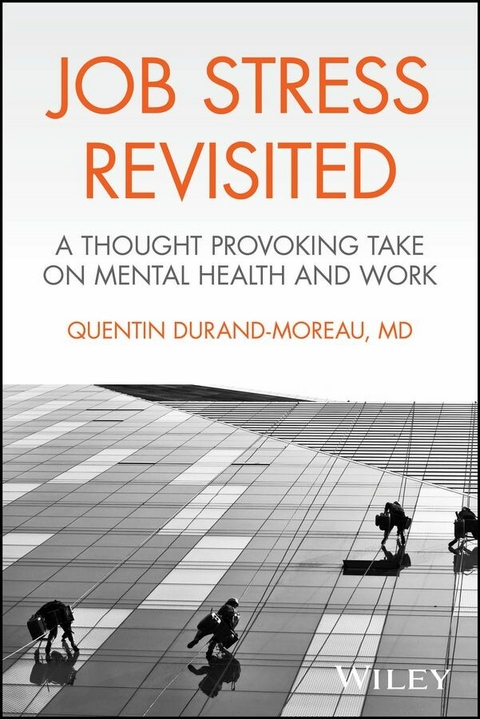
Job Stress Revisited (eBook)
357 Seiten
Wiley (Verlag)
978-1-394-26829-0 (ISBN)
Provides a comprehensive framework for understanding mental health in the workplace
Job Stress Revisited: A Thought Provoking Take on Mental Health and Work offers a critical and much-needed re-evaluation of how job stress is understood, addressed, and managed in modern workplaces. In contrast to popular narratives that individualize stress and recommend surface-level interventions, this resource challenges these assumptions by locating job stress within the very structure and nature of work itself. Drawing on more than a decade of clinical and academic experience, the author underscores how workplace environments and policies-not personal shortcomings-are often the true sources of stress-related mental health issues.
Empowering readers to become informed advocates for lasting change, the book offers a multi-dimensional exploration of job stress, informed by biological, epidemiological, and activity-centered approaches. A structured three-part format builds from foundational concepts to actionable solutions, first clearly defining essential concepts-work, health, and their intersections-before delving into critical issues such as burnout, harassment, toxic workplace dynamics, and substance use. In the final section, Durand-Moreau calls for systemic change, advocating for robust policies, workplace inspections, and structural reform rather than temporary fixes.
A practical guide for those who seek to make work environments healthier and more equitable, Job Stress Revisited: A Thought Provoking Take on Mental Health and Work:
- Challenges prevailing wellness narratives by shifting focus from individuals to systemic workplace factors
- Integrates clinical insights from over 400 work-related mental health cases
- Offers a comparative international perspective, especially from Canadian and French occupational health systems
- Combines theoretical analysis with practical case studies to enhance accessibility
- Explores lesser-addressed topics such as doping at work
With vivid case studies and accessible illustrations throughout, Job Stress Revisited: A Thought Provoking Take on Mental Health and Work is essential reading for graduate and professional-level courses such as Occupational Health, Work Psychology, Organizational Behavior, and Public Health Policy. It is ideal for degree programs in Occupational Medicine, Human Resources, Public Health, and Industrial-Organizational Psychology as well as working professionals like union reps, HR, and any worker interested in this topic.
Quentin Durand-Moreau is Associate Professor of Occupational Medicine at the University of Alberta and Director of the Occupational Medicine residency program. He has practiced in both France and Canada, overseeing clinics focused on work-related mental health. He is an active member of international occupational health organizations and serves on editorial boards for key journals in the field. His research and clinical work center on occupational medicine, job stress, workplace mental health.
Provides a comprehensive framework for understanding mental health in the workplace Job Stress Revisited: A Thought Provoking Take on Mental Health and Work offers a critical and much-needed re-evaluation of how job stress is understood, addressed, and managed in modern workplaces. In contrast to popular narratives that individualize stress and recommend surface-level interventions, this resource challenges these assumptions by locating job stress within the very structure and nature of work itself. Drawing on more than a decade of clinical and academic experience, the author underscores how workplace environments and policies not personal shortcomings are often the true sources of stress-related mental health issues. Empowering readers to become informed advocates for lasting change, the book offers a multi-dimensional exploration of job stress, informed by biological, epidemiological, and activity-centered approaches. A structured three-part format builds from foundational concepts to actionable solutions, first clearly defining essential concepts work, health, and their intersections before delving into critical issues such as burnout, harassment, toxic workplace dynamics, and substance use. In the final section, Durand-Moreau calls for systemic change, advocating for robust policies, workplace inspections, and structural reform rather than temporary fixes. A practical guide for those who seek to make work environments healthier and more equitable, Job Stress Revisited: A Thought Provoking Take on Mental Health and Work: Challenges prevailing wellness narratives by shifting focus from individuals to systemic workplace factors Integrates clinical insights from over 400 work-related mental health cases Offers a comparative international perspective, especially from Canadian and French occupational health systems Combines theoretical analysis with practical case studies to enhance accessibility Explores lesser-addressed topics such as doping at work With vivid case studies and accessible illustrations throughout, Job Stress Revisited: A Thought Provoking Take on Mental Health and Work is essential reading for graduate and professional-level courses such as Occupational Health, Work Psychology, Organizational Behavior, and Public Health Policy. It is ideal for degree programs in Occupational Medicine, Human Resources, Public Health, and Industrial-Organizational Psychology as well as working professionals like union reps, HR, and any worker interested in this topic.
Introduction
Several years ago, a company decided to assess the level of stress in their workforce. They distributed questionnaires to workers. People responded massively. The results were concerning. Most workers were highly stressed. That's a pretty common situation.
What's less common is how this company was willing to address it. Would they provide relaxation workshops? Increase staffing to reduce the workload?
Certainly not. Instead, they aimed to fire every single worker who admitted to being stressed, thus solving the company's job stress issue. Efficiency at its finest.
This half‐fictional story is inspired by true events. In reality, no workers were actually terminated, but the company had a lot to do to mitigate what became a public relations disaster. Some workers had a hard time understanding that this was some sort of April fool's joke.
You can probably relate to this story. First and foremost because it is about workers, and you either currently have a job, are looking for a job, are getting trained for a job, have retired from the workforce, or are job‐deprived (whether that is because you have lost your job, or because no workplace is accommodating your specific needs). Virtually all of us, at some point, have some sort of work relationship. And this relationship affects us. We have good experiences at work, but also terrible ones. Work can help us thrive, but it can also be destructive. It can be both positive and negative for our health, and our mental health in particular.
Work can be a stressful experience indeed. According to Statistics Canada, 21.2% of all employed people reported high or very high levels of work‐related stress in 2023.1 The American Psychological Association conducted a survey in 2023 showing that 77% of workers reported work‐related stress in the last month.2 Overall, it is more likely than not that you have personally experienced job stress. This also means that you certainly have developed some knowledge about that, or strategies to deal with it.
Many of you can also relate to that employee survey story because you may have already filled out an employee satisfaction survey yourself. You may have thought of some questions about it. Was it safe to fill out this questionnaire? Was my information really kept anonymous? If so, why have I received a personal reminder from my supervisor telling me “by the way, I can see you have not filled out the anonymous survey”? Are these surveys going to change anything in my working conditions? Are they worth my time?
The topic of job stress should be of interest to everyone. However, I have rarely been satisfied with how this topic is dealt with. Simplistic solutions (e.g., pizza parties, mandatory 7 am relaxation workshops, or e‐learning modules on harassment) are more common than the identification and correction of systemic root causes of job stress, residing in work issues. Victim blaming is too common (“these workers have personal problems”). This often comes along with the traditional paternalistic educational approach of teaching them good practices (whether it is conflict resolution or leadership skills training). Naturally, if workers are feeling so bad in workplaces, it is because of some sort of personal deficiency, a lack of knowledge, or a skill that needs further development. Nothing that a good training session with a coach will not address, right?
None of this is exciting to me, and I suspect that many of you feel exactly the same: bored and frustrated with the way we address job stress in workplaces.
That's why I thought it may be time to revisit this topic: let's revisit job stress together.
I would like to spend a bit of time explaining to you why my experience could be relevant in this context.
I am an occupational medicine specialist, practicing for more than 10 years now.
Most people do not know what occupational medicine is. And among the few who think they know, many would confuse us with occupational therapists! But it's not the same. Occupational medicine specialists are physicians. Basically, our area of expertise is any connection between work and health. We help workers with health issues to enable them to stay at work, or return to work, by designing the right accommodations for them. We can also help them find whether their health problem is work‐related, and help them obtain workers' compensation coverage. At that stage, you might think that we deal with asbestos, benzene, silica, or repetitive strain injuries (or musculoskeletal disorders) and you would be right. However, occupational medicine specialists also look at the psychological side of health. Health is not a topic that should be split into physical versus psychological. Instead, dealing with work‐related mental health problems is a core skill that all occupational medicine specialists are trained in.
I started my independent practice in France, at the University Hospital of Brest, providing occupational medicine services for the hospital staff, and practicing at the Occupational Disease Center, an outpatient clinic for workers referred by other occupational medicine specialists in the community, looking for expert opinions. I was the director of this center between 2018 and 2019. My activity included a lot of work‐related mental health assessments. In fact, 40% of my total work time was dedicated to this topic from 2013 to 2019. I have assessed more than 400 patients, mostly to determine their fitness for work in the context of a mental health illness, or whether their mental health condition was work‐related, in which case I helped them obtain workers' compensation.
During that period, I decided to gain additional skills on top of my occupational medicine specialty training. I completed a number of courses in work psychology provided by the Conservatoire National des Arts et Métiers (CNAM), based in Paris.
While I was working in France, I wrote a number of publications concerning work‐related mental health issues and spoke at a number of conferences. I became an expert in work‐related mental health. I was interviewed by the French National Assembly about burnout in 2016.3 I have been one of the experts writing the guidelines on burnout for the French National Authority for Health (Haute Autorité de Santé)4 and a member of the group working on the permanent clinical impairment adjudication guide for occupational mental diseases for the French Social Security.5
From 2018 to 2024 I have been one of the co‐chairs of the scientific committee dedicated to the study of psychosocial factors and risks (Work Organization and Psychosocial Factors, WOPS) at the International Commission on Occupational Health (ICOH). In 2024, I was elected a board member of the ICOH. In 2022, with my colleague Gérard Lasfargues, emeritus professor of occupational medicine at Université Paris‐Est‐Créteil (France), I coordinated a collective book specifically on the links between management and occupational health issues.6
In 2019, I took a position as assistant professor of occupational medicine and residency program director at the University of Alberta in Edmonton (Canada), more than 6800 km from France. Since then, I have been practicing as an occupational medicine specialist at the Occupational and Environmental Medicine Clinic at the Kaye Edmonton Clinic, on top of my other academic activities for the university.
As I arrived in a new continent, a new country, a new province, I realized that the approach to work‐related mental health issues in North America, and in Canada in particular, was totally different than what I had experienced in France. France is literally obsessed with work. There are dozens (not to say hundreds) of academics specialized in work‐related mental health issues. Comparatively, this topic is of lower interest in North America. Additionally, I realized that most of the references I had been trained with, and that helped me shape my vision of work‐related mental health issues, were in French, and not available at all in English. There have been a lot of extremely interesting and valuable contributions published over 70 years in this field: it is too bad that not many of them are shared with English‐speaking readers. Finally, as I have reached more than 10 years of practice in the field of occupational medicine and gathered a lot of knowledge and experience in bits and pieces from many different places, I thought it was a good time for me to sit, pause, reflect, summarize, and make sense of what I have learnt so far.
This book is the result of the journey I undertook to try to better understand the links between mental health and work. I would like to share these reflections with you. Rather than asking you to necessarily agree with all my positions (some of which are quite controversial), I would like you to take this book as an opportunity to stimulate your critical thinking. To see things from a different perspective, a new angle, and ask yourself new questions. I am hopeful that it will help you be more critical, and hopefully a great advocate, so we can collectively make significant progress in this regard.
This book is not going to give you any ready‐made or one‐size‐fits‐all miracle cure to solve the problem of job stress. If that is what you were looking for while you are scanning the first few pages in the bookstore or the library, maybe it is not too...
| Erscheint lt. Verlag | 9.10.2025 |
|---|---|
| Sprache | englisch |
| Themenwelt | Geisteswissenschaften ► Psychologie ► Allgemeines / Lexika |
| Schlagworte | employee wellbeing • job stress interventions • job stress mitigation • job stress prevention • Occupational Health • organizational psychology • workplace burnout • workplace mental health • workplace well-being • workplace wellness • Work Psychology |
| ISBN-10 | 1-394-26829-7 / 1394268297 |
| ISBN-13 | 978-1-394-26829-0 / 9781394268290 |
| Informationen gemäß Produktsicherheitsverordnung (GPSR) | |
| Haben Sie eine Frage zum Produkt? |
 EPUB (Adobe DRM)
Kopierschutz: Adobe-DRM
Adobe-DRM ist ein Kopierschutz, der das eBook vor Mißbrauch schützen soll. Dabei wird das eBook bereits beim Download auf Ihre persönliche Adobe-ID autorisiert. Lesen können Sie das eBook dann nur auf den Geräten, welche ebenfalls auf Ihre Adobe-ID registriert sind.
Details zum Adobe-DRM
Dateiformat: EPUB (Electronic Publication)
EPUB ist ein offener Standard für eBooks und eignet sich besonders zur Darstellung von Belletristik und Sachbüchern. Der Fließtext wird dynamisch an die Display- und Schriftgröße angepasst. Auch für mobile Lesegeräte ist EPUB daher gut geeignet.
Systemvoraussetzungen:
PC/Mac: Mit einem PC oder Mac können Sie dieses eBook lesen. Sie benötigen eine
eReader: Dieses eBook kann mit (fast) allen eBook-Readern gelesen werden. Mit dem amazon-Kindle ist es aber nicht kompatibel.
Smartphone/Tablet: Egal ob Apple oder Android, dieses eBook können Sie lesen. Sie benötigen eine
Geräteliste und zusätzliche Hinweise
Buying eBooks from abroad
For tax law reasons we can sell eBooks just within Germany and Switzerland. Regrettably we cannot fulfill eBook-orders from other countries.
aus dem Bereich