


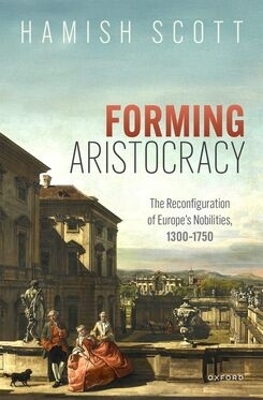
Forming Aristocracy
The Reconfiguration of Europe's Nobilities, 1300–1750
Seiten
2026
Oxford University Press (Verlag)
978-0-19-927459-8 (ISBN)
Oxford University Press (Verlag)
978-0-19-927459-8 (ISBN)
- Noch nicht erschienen (ca. September 2026)
- Versandkostenfrei
- Auch auf Rechnung
- Artikel merken
The deeds and misdeeds of aristocrats, past and present, never lose their appeal, whether on screen or in real life. But who are they, and why do they matter? This ground-breaking book explores the origins and development of early-modern elites, revealing the similarities between the organization and behaviour of leading families all over Europe.
The deeds (and misdeeds) of aristocrats, past and present, never lose their appeal, whether on our screens or in real life. But who are they, and why do they matter?
Forming Aristocracy is the story of the great aristocratic lineages of Europe: families such as the Salisbury in England, the Campbell in Scotland, the Radziwill in Poland-Lithuania, the Liechtenstein in the Austrian Habsburg Monarchy, the Condé in France, and the Medina Sidonia in Spain. They combined exceptional social standing and economic power with great political and cultural influence; in many countries their dominance endured until the opening decades of the twentieth century.
This ground-breaking book is the first to explore the origins and development of this elite and to reveal as never before the similarities between the organization and behaviour of leading families in Britain and all over Europe. Forming Aristocracy examines one central development in Europe's modern history on a truly comparative basis. Extending from Ireland and the British Isles in the west to Russia in the east, and from Sweden in the Baltic to Andalusia in southern Spain, Hamish Scott explains how the aristocracy's dominant position came to be created and sustained. Their success rested upon the adoption of a rigorously imposed strategy, in which every family member had a precise role, which secured the fragile succession to the lands, other resources, and titles on which each lineage's position rested. The book also emphasizes the aristocracy's dominant public role as the principal source of the military commanders, ministers, and administrators who facilitated the emergence of the modern State and, even into the twentieth century, exercised local authority on its behalf.
With exceptional range, leading historian Hamish Scott here brings to life aristocrats both famous and obscure to offer the first integrated explanation for the enduring importance of the social elite over five centuries of Europe's past.
The deeds (and misdeeds) of aristocrats, past and present, never lose their appeal, whether on our screens or in real life. But who are they, and why do they matter?
Forming Aristocracy is the story of the great aristocratic lineages of Europe: families such as the Salisbury in England, the Campbell in Scotland, the Radziwill in Poland-Lithuania, the Liechtenstein in the Austrian Habsburg Monarchy, the Condé in France, and the Medina Sidonia in Spain. They combined exceptional social standing and economic power with great political and cultural influence; in many countries their dominance endured until the opening decades of the twentieth century.
This ground-breaking book is the first to explore the origins and development of this elite and to reveal as never before the similarities between the organization and behaviour of leading families in Britain and all over Europe. Forming Aristocracy examines one central development in Europe's modern history on a truly comparative basis. Extending from Ireland and the British Isles in the west to Russia in the east, and from Sweden in the Baltic to Andalusia in southern Spain, Hamish Scott explains how the aristocracy's dominant position came to be created and sustained. Their success rested upon the adoption of a rigorously imposed strategy, in which every family member had a precise role, which secured the fragile succession to the lands, other resources, and titles on which each lineage's position rested. The book also emphasizes the aristocracy's dominant public role as the principal source of the military commanders, ministers, and administrators who facilitated the emergence of the modern State and, even into the twentieth century, exercised local authority on its behalf.
With exceptional range, leading historian Hamish Scott here brings to life aristocrats both famous and obscure to offer the first integrated explanation for the enduring importance of the social elite over five centuries of Europe's past.
Hamish Scott was educated at George Heriot's School, Edinburgh, the University of Edinburgh, and the London School of Economics. He taught at the University of Birmingham (1970-1978) and then at the University of St Andrews (1979-2009), retiring as Wardlaw Professor of International History. He became a Senior Research Fellow in History at Jesus College, Oxford in 2017, and held positions in the British Academy, the Royal Society of Edinburgh, and the European Academy until his death in 2022.
| Erscheint lt. Verlag | 4.9.2026 |
|---|---|
| Zusatzinfo | 32 page colour plate section |
| Verlagsort | Oxford |
| Sprache | englisch |
| Maße | 156 x 234 mm |
| Themenwelt | Geschichte ► Allgemeine Geschichte ► Mittelalter |
| Geschichte ► Allgemeine Geschichte ► Neuzeit (bis 1918) | |
| Geisteswissenschaften ► Geschichte ► Regional- / Ländergeschichte | |
| ISBN-10 | 0-19-927459-2 / 0199274592 |
| ISBN-13 | 978-0-19-927459-8 / 9780199274598 |
| Zustand | Neuware |
| Informationen gemäß Produktsicherheitsverordnung (GPSR) | |
| Haben Sie eine Frage zum Produkt? |
Mehr entdecken
aus dem Bereich


aus dem Bereich
Geschichte einer Augsburger Familie (1367-1650)
Buch | Softcover (2024)
Kohlhammer (Verlag)
CHF 47,60


