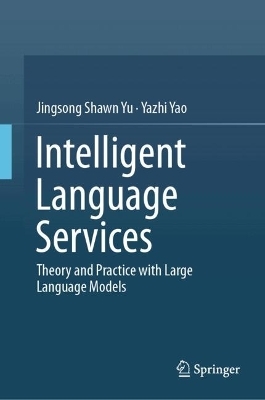
Intelligent Language Services
Springer Verlag, Singapore
978-981-95-4631-2 (ISBN)
- Titel nicht im Sortiment
- Artikel merken
With practical case studies and cutting-edge insights, the book covers key topics such as human-AI collaboration in translation workflows, prompt engineering for large models, and the emerging role of AI-powered agents in content creation. The author examines not only the technical foundations of LLMs and NLP but also their impact on language services management, quality assurance, and compliance in the digital age. Chapters also delve into the nuances of fine-tuning models for translation services, designing intelligent workflows, and navigating the ethical responsibilities in AI-driven language operations.
Ideal for both classroom study and professional development, Intelligent Language Services empowers readers to understand and implement the most innovative AI technologies shaping the future of language services. Whether you're a linguist, AI expert, or language service provider, this book provides the tools, strategies, and knowledge needed to excel in an AI-enhanced world.
Jingsong Shawn Yu, Ph.D., is a Professor in the School of Software and Microelectronics at Peking University. He received his academic training at Zhejiang University, Peking University, and the University of Pittsburgh. After joining Peking University in August 2005, he founded the Language Information Engineering program and has since guided its strategic direction—designing its curriculum framework, building laboratory and data infrastructure, and overseeing day‑to‑day academic governance. His earlier professional experience as a programmer, development project manager, and systems librarian at the University of Pittsburgh fostered a cross‑disciplinary perspective that links software engineering, information management, and language technologies. He authored and teaches one of Peking University’s earliest massive open online courses, Principles and Practice of Computer-Aided Translation, available on edX, Coursera, and XuetangX, with cumulative global enrollments surpassing 80,000 learners. His research spans artificial intelligence, natural language processing, and digital humanities, with current focal areas including adaptive language instruction, optical character recognition for historical and classical texts, and computational processing of Classical Chinese. Collectively, his teaching, program building, and research contribute to advancing the integration of AI within modern language services and cultural heritage resources. Dr. Yazhi YAO is an Associate Professor in the School of Languages and Communication Studies at Beijing Jiaotong University and a supervisor of Master’s students. With over 15 years of experience teaching translation technology, her scholarship focuses on Translation Studies and the evolving language services industry. She has published several highly cited articles in these fields and authored a research monograph on the governance of adverse selection in China’s language services market. She has also produced multiple published book-length translations. Dr. Yao has contributed to the development of both a national standard and an industry standard in the language services sector. She brings more than two decades of professional translation practice covering railway engineering and technology as well as United Nations documentation. She was selected for the national multilingual translation talent pool at the Academy of Translation and Interpretation under the China International Communications Group. She serves as a translation review expert for national standards under agencies affiliated with the Ministry of Housing and Urban-Rural Development, the Ministry of Transport, and the Ministry of Public Security, and acts as Senior Translation Reviewer for Urban Rail Transit. Her integrated record of research, professional practice, and standardization work underscores a sustained commitment to advancing technology-enabled language services.
"1: Introduction".- ".2: Unit 1 Fundamentals of Information Technology and Natural Language Processing".- "3: Unit 2 Information Technology Used for Information Verification in Translation Practice".- "4: Unit 3 Computer-aided Translation Tools in a Narrow Sense: Translation Memory and Terminology Management".- "5: Unit 4 Computer-aided Translation Tools in a Broader Sense".- "6: Unit 5 Machine Translation and the Age of Artificial Intelligence".- "7: Unit 6 Localization and Internationalization Engineering".- "8: Unit 7 Translation Team and Translation Project Management". - "9: Unit 8 Use of Information Technology for Language and Translation Teaching".
| Erscheinungsdatum | 29.11.2025 |
|---|---|
| Zusatzinfo | Approx. 320 p. |
| Verlagsort | Singapore |
| Sprache | englisch |
| Maße | 155 x 235 mm |
| Themenwelt | Geisteswissenschaften ► Sprach- / Literaturwissenschaft ► Sprachwissenschaft |
| Informatik ► Theorie / Studium ► Künstliche Intelligenz / Robotik | |
| Naturwissenschaften ► Biologie ► Genetik / Molekularbiologie | |
| Schlagworte | Computer-aided translation • Localization • Machine Translation • terminology management • Translation Management • Translation Quality Assurance • translation technology |
| ISBN-10 | 981-95-4631-1 / 9819546311 |
| ISBN-13 | 978-981-95-4631-2 / 9789819546312 |
| Zustand | Neuware |
| Informationen gemäß Produktsicherheitsverordnung (GPSR) | |
| Haben Sie eine Frage zum Produkt? |
aus dem Bereich