Dopamine Hijack (eBook)
138 Seiten
Publishdrive (Verlag)
978-0-00-106765-3 (ISBN)
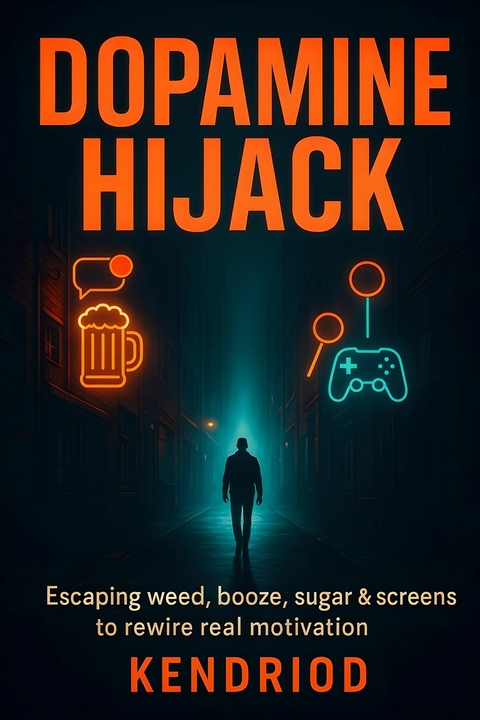
Dopamine Hijack: Escaping weed, booze, sugar & screens to rewire real motivation
Why do we lose focus, sabotage our goals, and keep chasing habits that leave us empty? In Dopamine Hijack, Kendriod blends a gripping personal story with the science of dopamine to reveal how weed, alcohol, sugar, and endless scrolling trick the brain's reward system.
Through relatable storytelling and neuroscience-backed strategies, this book shows how to reset your brain, escape 'cheap highs,' and rebuild true motivation. With practical tools like a 14-day dopamine reset and hacks for cravings, you'll discover how to swap quick fixes for real accomplishments-and finally enjoy the clarity, energy, and drive you've been missing.
Whether you're a student, professional, or anyone tired of feeling stuck, Dopamine Hijack is your guide to breaking free from distraction and reclaiming control of your mind, health, and future.
Chapter 2
Dopamine 101 (The Invisible Puppeteer)
The Curtain Pulls Back
The Monday after my first high, I sat in a crowded lecture hall pretending to listen as the professor’s voice washed over me like soft rain. I was half-dreaming about the weekend. Not the homework I’d finished, not the people I’d met—just that floating feeling from Friday night. And then, out of nowhere, a familiar smell drifted in from the open window: a faint skunky note from somebody smoking outside.
It was like a finger snapped next to my ear. My attention locked on the smell. The room sharpened, my heart nudged faster, and a tiny urge stirred: wouldn’t it be nice to feel like that again? No decision. No plan. Just a pull.
That pull had a name I barely understood then: dopamine. It wasn’t exactly “pleasure.” It was the lean-forward signal, the invisible puppeteer tugging the strings of attention and desire. In that instant I realized something important: the high wasn’t only in what I had done; it was also in what my brain had learned.
This chapter is where we pull the curtain back. If Chapter 1 was the spark, this is the oxygen around it—the quiet, invisible rules that make small sparks turn into bonfires.
What Dopamine Really Does
Let’s keep it simple: dopamine is a messenger in the brain. When it speaks, you feel a push toward something—food, achievement, novelty, a text notification, a joint. It’s not the emotion of bliss itself (that’s more complicated and involves other systems too). Dopamine is the arrow that says, Go get it. It marks things as important and teaches your brain to remember: That mattered. Do it again.
Think of your day as a field full of possible paths. Dopamine paints certain paths in bright neon. Suddenly those paths feel more interesting and worth doing. That’s why some tasks feel magnetic while others feel like wading through mud.
A few ground rules make dopamine easier to understand:
- Two Speeds: Baseline and Bursts
You carry a baseline level of dopamine all day—your “idle engine.” When something promising happens (or might happen), your brain sends a burst (a spike). The burst says, That’s good—pay attention—repeat. If the baseline dips too low (from stress, overstimulation, low sleep, or constant quick hits), life feels gray and unmotivating. - Learning by Surprise
Dopamine is obsessed with prediction. If you expect a cookie and get it, your brain nods: As predicted. If you expected nothing and suddenly get a cookie, boom—bigger spike. If you expected a cookie and don’t get it? Dip. Those little better/worse than expected moments teach your brain what to chase next time. - Desire Pleasure
We mistake dopamine for happiness, but it’s mostly wanting, not liking. That’s why you can crave something, get it, and then feel oddly empty. The wanting was louder than the liking. - Context is King
Dopamine tags context: sights, smells, people, places, playlists, the wrapper of a snack, the time of day. Your brain ties the feeling to the surroundings. Later, those surroundings act like buttons. Press one (smell the smell, hear the song), and desire wakes up.
The Loop: Cue → Craving → Action → Relief
Here’s the loop that started forming in me after that first night:
- Cue: dorm room lamplight, music, friends’ laughter, the smell of weed
- Craving: little mental itch—let’s feel that again
- Action: find a reason to hang out, ask if anyone “has anything,” light up
- Relief/Reward: wave of good feeling, social ease, snacks taste better, stress fades
- Learning: brain tags everything as meaningful, priming the next loop
Repeat that enough times and the cue alone starts to feel like a promise. The promise is sometimes louder than the pleasure that follows. That’s the trapdoor of habit: the anticipation becomes the hero, and real life becomes a series of chasing moments.
The Map: Your Brain’s Reward Circuit (Plain English Edition)
You don’t need a lab coat to understand the key players:
- VTA (Ventral Tegmental Area): Where many dopamine neurons live. Picture it as the “broadcast booth.”
- Nucleus Accumbens: The “that’s-interesting” hub. When dopamine hits here, things feel compelling.
- Prefrontal Cortex: The planner. Helps you hold goals in mind, weigh consequences, press the brakes.
- Hippocampus: Memory librarian. Files all the context: who, where, when.
- Amygdala: The tagger for emotion—this mattered, good or bad.
- Dorsal Striatum: Where repeated actions become automatic. When this area takes over, you’re doing it without thinking much—good for useful routines, dangerous for bad ones.
On my first high, the broadcast booth (VTA) sent a loud message: This is important. The nucleus accumbens lit up; the world felt interesting and rewarding. The hippocampus filed the smells, songs, faces. My prefrontal cortex should have been the wise chaperone—Cool down, think long-term—but dopamine temporarily made the party more persuasive than the chaperone. Over time, with repetition, the dorsal striatum begins to automate the loop. That’s how “every Friday night” becomes every night it’s stressful, “only at parties” becomes whenever I’m bored, and choice becomes default.
Why Easy Highs Bend the System
Earned rewards—finishing an essay, grinding through a workout, learning a skill—usually deliver smaller dopamine spikes, delayed in time but rich in meaning. They come with competence, identity, and real progress. Your brain learns: effort → reward. That’s a sturdy pathway.
Cheap highs—weed, alcohol, junk-sugar, endless scrolling—deliver fast spikes with little effort. They teach a different lesson: shortcut → reward. The brain’s prediction system notices the speed and intensity, and it starts prioritizing shortcuts. Overuse does a few sneaky things:
- Tolerance Drift
Big, frequent spikes can nudge your baseline down. Your engine idles lower. Ordinary life feels flat, so you chase bigger spikes just to feel “normal.” This is why yesterday’s amount doesn’t hit as hard today. - Cue Takeover
Because dopamine tags context, your world fills with tripwires: that corridor outside the dorm, that playlist, that friend who “always has something.” You walk through your day stepping on buttons you installed yourself. - Wanting Outruns Liking
You end up wanting more than you like. You remember the promise and keep chasing it, even if the payoff keeps shrinking. - The Cost of the Shortcut
Shortcuts steal from the future. A quick hit tonight robs tomorrow’s baseline a little. Earned rewards do the opposite: they raise the baseline slowly by making ordinary life feel more meaningful.
The “Thermostat” Analogy
Imagine your pleasure system as a home thermostat. Healthy living keeps the temperature comfortable. A cheap high is like opening a window to a blast of hot air—wonderful for a minute, but your thermostat reacts. To compensate, the system cools the house down. If you open that window every day, the house resets colder and colder. Then you need the window wide open just to feel warm. Close the window (quit the shortcut), and the house feels freezing for a while. But give it time, and the thermostat recalibrates.
That recalibration is the hope of this whole book.
Why You Can’t “Just Be Strong”
People love to say, “Just use willpower.” I tried. Here’s why it’s not that simple:
- Dopamine is faster than thought. The cue lights up your attention before you’ve even decided to notice it.
- Stress weakens the brakes. The prefrontal cortex—the part that says no—tires easily under stress, lack of sleep, and constant stimulation.
- Your brain is doing its job. It’s supposed to learn from pleasure and steer you back to it. It’s adaptive, not malicious.
Willpower matters, but you also need structure that reduces cues, replacements that give healthier spikes, and time for the thermostat to reset.
Social Dopamine: Why Parties (and Phones) Hook You
That first night wasn’t just THC. It was friends, music, laughter, and a feeling of belonging. Social rewards are powerful dopamine drivers. Combine that with a substance, and the brain learns a super-association: this group + this ritual = I feel amazing. Later, being with that group can tug you toward the ritual even if you swore you wouldn’t.
Phones do a quieter version of this. Variable notifications—sometimes there, sometimes not—are like tiny slot machines. The maybe of a reward drives more checking than a guaranteed reward ever could. It’s the surprise that trains the habit.
My First Lab Notebook (How I Started Noticing)
Around week three of freshman year, I started a silly little experiment: a pocket “dopamine log.” Every time I felt that magnetic pull, I scribbled three things:
- What’s the...
| Erscheint lt. Verlag | 26.9.2025 |
|---|---|
| Sprache | englisch |
| Themenwelt | Geisteswissenschaften ► Psychologie ► Sucht / Drogen |
| ISBN-10 | 0-00-106765-6 / 0001067656 |
| ISBN-13 | 978-0-00-106765-3 / 9780001067653 |
| Informationen gemäß Produktsicherheitsverordnung (GPSR) | |
| Haben Sie eine Frage zum Produkt? |
 EPUB (Adobe DRM)
Größe: 2,7 MB
Kopierschutz: Adobe-DRM
Adobe-DRM ist ein Kopierschutz, der das eBook vor Mißbrauch schützen soll. Dabei wird das eBook bereits beim Download auf Ihre persönliche Adobe-ID autorisiert. Lesen können Sie das eBook dann nur auf den Geräten, welche ebenfalls auf Ihre Adobe-ID registriert sind.
Details zum Adobe-DRM
Dateiformat: EPUB (Electronic Publication)
EPUB ist ein offener Standard für eBooks und eignet sich besonders zur Darstellung von Belletristik und Sachbüchern. Der Fließtext wird dynamisch an die Display- und Schriftgröße angepasst. Auch für mobile Lesegeräte ist EPUB daher gut geeignet.
Systemvoraussetzungen:
PC/Mac: Mit einem PC oder Mac können Sie dieses eBook lesen. Sie benötigen eine
eReader: Dieses eBook kann mit (fast) allen eBook-Readern gelesen werden. Mit dem amazon-Kindle ist es aber nicht kompatibel.
Smartphone/Tablet: Egal ob Apple oder Android, dieses eBook können Sie lesen. Sie benötigen eine
Geräteliste und zusätzliche Hinweise
Buying eBooks from abroad
For tax law reasons we can sell eBooks just within Germany and Switzerland. Regrettably we cannot fulfill eBook-orders from other countries.
aus dem Bereich