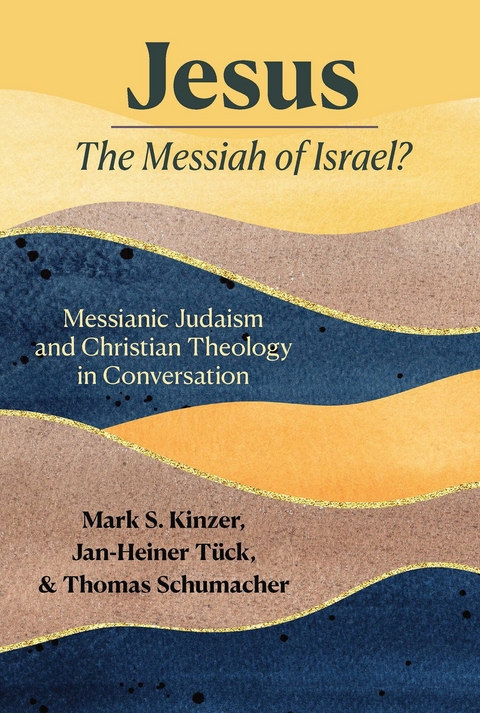
Jesus — the Messiah of Israel? (eBook)
426 Seiten
Crossroad Publishing (Verlag)
978-0-8245-0772-5 (ISBN)
This volume addresses this gap. It documents an international symposium on the dialogue between Messianic Judaism and Christian theology, which took place in 2022 at the University of Vienna (Austria) under the patronage of Cardinal Christoph Schönborn. The contributions highlight the history and diversity of Messianic Judaism and explore Christological, ecclesiological and eschatological questions: What does the Jewish identity of Jesus mean for Christology? How should the surprising return of Jews who believe in Christ be interpreted? Can the return of many Jews to the land of Israel and the growing number of Messianic Jews be interpreted as signs of the end times?''
The Messianic Jews—A “Sign Pointing Forward”
An Interview
Cardinal Walter Kasper / Jan-Heiner Tück
A conference on the dialogue between Christian theology and Messianic Judaism has just taken place at the University of Vienna. The dialogue is delicate, since there is a sense in which Messianic Jews fall between the chairs. Official representatives of Judaism deny that they are Jews because they believe in Jesus the Messiah. The Christian Churches remain guarded because they do not wish to jeopardize the achievements of the Jewish–Christian dialogue. Even the Pontifical Commission for Special Relations with Judaism, if I understand correctly, has until now made no official contacts. Why is this?
Cardinal Kasper: It is as you rightly say. In the decade from 1999 to 2010 I was president of the Pontifical Commission for Religious Relations with the Jews. It was the most exciting and most challenging time of my entire professional life.1 After much debate, the Second Vatican Council (1962–1965) with the declaration Nostra Aetate (1965) had achieved one of the most astounding new orientations in relations between Jews and Christians in the 2,000-year history of the Church and had condemned all forms of antisemitism past and present.
According to Erich Przywara, the separation between Jews and Christians is the “original schism” of Church history; in the words of Cardinal Christoph Schönborn, it is “the deepest wound in the body of Christ.” The schism became a centuries-long estrangement, even contempt, oppression, and persecution. They reached their lowest point during the Second World War (1939–1945) in the Shoah, the attempt to annihilate European Jewry that was planned, organized, and carried out in cold blood by the National Socialist state, in which some six million Jews fell victim. After 1945, the shock over this egregious crime led to a fundamental change of thinking (metanoia) and to a deep repentance (teshuva) in almost all Churches.2
The Commission for Religious Relations with the Jews, founded in 1974 by Pope Paul VI, was tasked with coming to terms with the burden of a centuries-long, largely dark history, and with promoting a new cooperation between Jews and Christians on the foundation laid by the Council. The construction of a new, sincere dialogue and a trustful collaboration required, especially from us Christians, consideration and sensitivity for the Jewish partners. We agreed to respect each other’s differences but in the discussions to start from what we have in common: belief in the one God and Creator as well as the Ten Words (Ten Commandments) and their significance for the joint engagement for a better and more humane world. Despite certain difficulties, we made good progress overall. From Pope John Paul II, who was on April 13, 1986, the first pope to visit the Great Synagogue of Rome, we found powerful support. Friendly encounters and dialogues between Jews and Christians at all levels worldwide are now part of everyday life in most Christian Churches. Enemies became friends.
One can only be thankful for this development—and after the history of “befriending” and alienation, the recollection of common ground continues to be important. Nonetheless, the real conversation begins to falter when differences remain bracketed out for the sake of peace. The Jewish hesitance to tackle theological questions of doctrine and the Christian vote for a “forgoing of Christological possessions” are challenged by Messianic Jews who openly confess Christ. This is indeed a theological provocation for the ongoing conversation, is it not?
Cardinal Kasper: Yes, the fundamental question that divides us was not touched with the focus on what is held in common. For the Orthodox and Conservative Jewish partners close to the Jewish World Congress, the “no” to the messiahship of Jesus belonged to Jewish identity; for Christians by contrast, the faith conviction that Jesus is the Christ—that is, the expected Messiah, the Son of God, and the salvation of the world—was and remains constitutive. For the Jewish self-understanding, a Messianic Judaism therefore could not exist. Even more, since the memory of earlier compulsory catechesis is still fresh in Jewish consciousness, many Jews suspected that the dialogue might be nothing more than missionizing or proselytizing using other methods. This danger seemed to many Jews even more dangerous than the Shoah. The Shoah threatened to extinguish the physical existence of the Jewish people; the dialogue over Jesus’ messiahship and even more so Messianic Judaism was and still is, in part, perceived by many Jews as a danger to the religious and cultural identity of the Jewish people as the chosen people of God and thus as a danger of a new type of Holocaust.
Because of the very pronounced sensitivity of Judaism, the Papal Commission for the dialogue with the Jews was not able to have direct contact with Messianic Jews. But that could not mean a general ban on conversation. Since I knew that Cardinal Christoph Schönborn was carrying on an informal dialogue with Messianic Jews, I kept myself informed about this younger branch of Judaism through one of his coworkers without in any way being active myself. Everything has and needs its time.
How would you position the dialogue with Messianic Jews today within the panorama of the changed relations with Judaism? Should the Catholic Church consider setting up an official dialogue format?
Cardinal Kasper: As I now know, it is a relatively small, but growing, internally pluralistic group of Jews who are to be taken seriously. They are convinced of the special election of the Jewish people and hold fast to the Torah, the Jewish law, but believe in Jesus as the expected Messiah and Savior of the world. Statistically it is not easy to compute their numbers, but it is estimated that there are between 150,000 and 250,000 members.3
At all times there have been Jews who have let themselves be baptized and become Christians. But this type of convert is not what is happening with Messianic Jews. They adhere to the Jewish Sabbath and holy day praxis as well as to Jewish law. Nor should they be equated with the Jewish Christianity of the first centuries, who are usually referred to as Ebionites (literally: the poor) and who were opposed by the Church Fathers because of their adoptionist Christology and their legalistic way of life that was oriented to the Jewish Torah. Messianic Christians emerged first in the nineteenth century from the evangelical mission to the Jews, and after the Second World War mostly in an evangelical context or as “newborns” from a secular context.
Through the Second Vatican Council and the declaration Nostra Aetate (NA 4), which was already prepared for by the constitution on the Church (Lumen Gentium [LG] 16), the dialogue situation from the Catholic side has improved considerably. The Catholic Church recognizes the election and the special salvation-historical position of the Jewish people. Although the majority of Jews did not accept the gospel of Jesus as the Christ, that is, the Messiah, Israel is still God’s chosen and loved people: “His gifts of grace and his calling are irrevocable.” The majority of theologians have abandoned the theory of supersessionism developed by the Church Fathers, according to which Israel, because of its unbelief in Jesus as the Messiah, lost her original election, which then passed over to the Church, making the Church the new Israel, the new people of God.
Thus, there is a broad foundation for dialogue about the fundamental concerns of Messianic Christians. Joseph Ratzinger and Christoph Schönborn recall the word of the Apostle Paul that in the end all Israel will come to faith and be saved (Rom 11:12, 26), and place the Messianic Jews in an eschatological context. They view them as a creative work of the Holy Spirit. So are they, as it were, a vanguard of the eschatological pilgrimage of the nations to Zion promised by the prophets (cf. Isa 2:2−5; Mic 4:1−3)? Even if one should be careful with such historical-theological interpretations, one will regard the Messianic Jews as a pleasing sign of the time, which is worth further reflection.
The growing movement of Messianic Jews is pluriform. Despite all of its diversity, though, Messianic Jews are united by their profession of Jesus as the Messiah. The question is, of course, what they mean by “messianic”? Quite different things are associated with terms like “Messiah,” “messianic,” “messianic movement.”
Cardinal Kasper: Indeed, the crucial question is: What does “messianic” mean to the Messianic Jews? “Messiah” and “messianic” are multilayered terms both in the Bible and in today’s parlance, terms that promise good things but that can also give rise to fears of bad things. There are false prophets, about whom Jesus explicitly warns. They come across as harmless sheep, but in reality they are ravening wolves (Matt 7:15). Messiah figures appear mostly in crisis situations. They have visionary ideas and are seen as charismatic leaders and deliverers. They inspire enthusiasm and carry along the masses. But to where? As...
| Erscheint lt. Verlag | 1.10.2025 |
|---|---|
| Sprache | englisch |
| Themenwelt | Geisteswissenschaften ► Religion / Theologie ► Judentum |
| Schlagworte | Catholic • Church • Faith |
| ISBN-10 | 0-8245-0772-X / 082450772X |
| ISBN-13 | 978-0-8245-0772-5 / 9780824507725 |
| Informationen gemäß Produktsicherheitsverordnung (GPSR) | |
| Haben Sie eine Frage zum Produkt? |
 EPUB (Ohne DRM)
Digital Rights Management: ohne DRM
Dieses eBook enthält kein DRM oder Kopierschutz. Eine Weitergabe an Dritte ist jedoch rechtlich nicht zulässig, weil Sie beim Kauf nur die Rechte an der persönlichen Nutzung erwerben.
Dateiformat: EPUB (Electronic Publication)
EPUB ist ein offener Standard für eBooks und eignet sich besonders zur Darstellung von Belletristik und Sachbüchern. Der Fließtext wird dynamisch an die Display- und Schriftgröße angepasst. Auch für mobile Lesegeräte ist EPUB daher gut geeignet.
Systemvoraussetzungen:
PC/Mac: Mit einem PC oder Mac können Sie dieses eBook lesen. Sie benötigen dafür die kostenlose Software Adobe Digital Editions.
eReader: Dieses eBook kann mit (fast) allen eBook-Readern gelesen werden. Mit dem amazon-Kindle ist es aber nicht kompatibel.
Smartphone/Tablet: Egal ob Apple oder Android, dieses eBook können Sie lesen. Sie benötigen dafür eine kostenlose App.
Geräteliste und zusätzliche Hinweise
Buying eBooks from abroad
For tax law reasons we can sell eBooks just within Germany and Switzerland. Regrettably we cannot fulfill eBook-orders from other countries.
aus dem Bereich