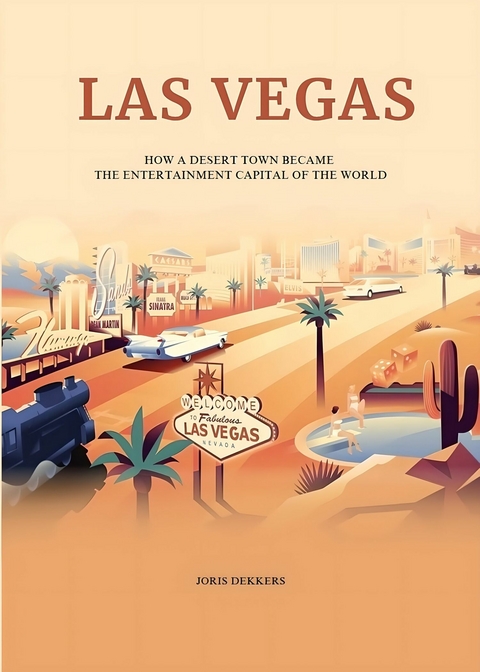
Las Vegas (eBook)
268 Seiten
Publishdrive (Verlag)
978-94-6526-372-4 (ISBN)
Author Joris Dekkers takes you on a rollercoaster ride through the history of the Las Vegas Strip. The Mob Funded Hotel Casinos, Frank Sinatra at the Sands, Jay Sarno's Caesars Palace, to the Mega Resort era and Steve Wynn. The Book finishes with a warning, as Las Vegas continues to corporatize.
Author Joris Dekkers takes you on a rollercoaster ride through the history of the Las Vegas Strip. The Mob Funded Hotel Casinos, Frank Sinatra at the Sands, Jay Sarno's Caesars Palace, to the Mega Resort era and Steve Wynn. The Book finishes with a warning, as Las Vegas continues to corporatize.
Chapter 4
The Arrival Of Organized Crime In Las Vegas
"WE ARE GONNA BUILD A GARDEN OF EDEN IN THE DESERT! A HOTEL! BUT NOT A HOTEL. YOU KNOW WHAT IT IS? IT’S AN OASIS! IT’S AN OASIS WITH A CASINO."
— Bugsy Siegel, who finished and opened The Flamingo on the Las Vegas Strip.
A
s Nevada was one of the few States that offered legalized gambling and an advantageous tax climate for businesses, it pulled many people—especially those with shady backgrounds—into its clutches.
Las Vegas’s embrace of Wild Western values — gambling, drinking, and prostitution — made it an ideal destination for East Coast organized crime. In many cases, the mob didn’t invade the city; they were invited. Struggling casino founders, desperate for financing and experience, often reached out for help. These early owners formed a mixed group: ex-bookmakers, bingo hall operators, and self-styled entrepreneurs from across the country, all trying to ignite a spark in their career. Many operated on the edge of legality. For both the founders and the mobsters—often unwelcome and ousted throughout the country—here, in Las Vegas, they finally found home.
The story of how the Mob infiltrated Vegas isn’t like in the movies, but it’s still fascinating. Rather than operating in plain sight, they worked through front men—often veterans of the nightlife and entertainment world—who took on the day-to-day management and became the respectable faces of glitzy new resorts. By acquiring hidden “points” (stakes) in many of the Strip’s casino properties, the Syndicates were soon able to skim untaxed revenues directly from the counting rooms. Historians have found that the amount of mob-extracted money during the 1950s and 1960s easily exceeded the ten million dollar mark. Perhaps less proven, but just as well known, was the other side of the coin. One where Nevada politicians eagerly accepted large campaign contributions from the hoodlums. In this way, a “circle of gold” was drawn in the sand, completely unnoticed by the eyes of the gambling patrons.
In Las Vegas, tourism was to be protected, by all means necessary.
Benjamin ‘Bugsy’ Siegel and The Flamingo
Throughout the early 1940s, El Rancho Las Vegas had reigned as the undisputed king of Highway 91, drawing gamblers and high-rollers to the heart of the desert. The resort set the standard by luring guests with top-tier entertainment from the likes of Jimmy Durante, Nat King Cole, and Dean Martin.
But prestige didn’t equal stability. Deep in financial trouble, El Rancho became one of the first Strip resorts to turn to the underworld for help—and no one was more eager to answer than Benjamin “Bugsy” Siegel. After failed attempts to establish himself in downtown Las Vegas, where local businesses wanted nothing to do with him, Siegel set his sights on El Rancho. He made a play to acquire it, but was swiftly shut out. Opportunity came knocking elsewhere. Billy Wilkerson, a Sunset Strip nightclub owner with grand ambitions, was well on his way launching a direct competitor: The Flamingo . Wilkerson’s goal was simple—to outshine El Rancho in every way. He didn’t just want to build another casino—he reimagined the entire concept. Instead of making the casino an afterthought, he placed it at the center of the hotel, creating the blueprint for the modern Strip resort.
There was one problem. Wilkerson was a notorious gambler, buried in debt to the mob. As he sank deeper, the East Coast Syndicate smelled blood and sent Siegel to take control. After resuming construction in 1945, Siegel had quickly decided he had no use for Wilkerson anymore. One night, with a gun pressed to his face, the founder was given a choice—sell or die. Billy Wilkerson chose to live, signing away his remaining shares and eventually fleeing to Europe on the first available charter.
On December 26, 1946, The Flamingo finally opened its doors. Siegel had realized his dream at last. It transformed The Strip overnight, introducing an era of sophistication, excess, and unparalleled luxury. Yet Siegel’s unlimited ambition would come at a price. The daring crook had overspent on everything, making reckless deals and draining the project’s budget. Unfortunately, for Siegel, the person he answered to wasn’t known for his patience. The moment the Syndicate turned against one of its own, there was no way back.
"LAS VEGAS IS A MISERABLE, DINKY LITTLE OASIS TOWN. ONCE YOU GOT THE TOURISTS THERE, AFTER THEY HAD EATEN AND DRUNK ALL THEY COULD, THERE WAS ONLY ONE THING LEFT— TO GO GAMBLING."
— a quote by Meyer Lansky
The Syndicate Leader
The man who everyone feared in the underworld, including Bugsy Siegel, wasn’t raised in America. Originally born as Maier Suchowljansky in Belarus, a ‘reinvented’ Meyer Lansky was now on his way to becoming one of the most influential gangsters in the pre- war United States. Exploiting his mathematical talent and political (bribery) savvy, he forged a global gaming empire that by 1936 had already established operations in Florida, London, New Orleans, the Bahamas, and Cuba.
By universal agreement, Meyer Lansky is seen as one of the most influential master- skimmers and money launderers of the early 20th century. Owning stakes in many of the early casinos on the Las Vegas Strip, the mobster had quickly learned that the only way to win was to control the game. Yet Lansky had no particular liking for Las Vegas. He therefore installed front men such as Siegel to run his operations. In doing so, he became the ultimate puppet master—one who not only controlled the game, but owned everything associated with it. Lansky had a special relationship with Siegel, as the two once ran the violent “Bugs and Meyer Gang” in New York. Meyer had always been more interested in business, while Bugsy was the more glamorous of the two.
Now, there was trouble. Siegel had wanted his Flamingo to be the best place on Earth but found himself stuck with a debt in excess of $6 million. Half a year after a temporary closure, The Flamingo reopened its doors on March 1, 1947. Yet for Siegel, it was too late. The Syndicate, by order of the notorious “Lucky” Luciano, had already given the “go” for Siegel’s cold-blooded murder. He should have remembered the words Lansky once said to him in New York: “This is the life we have chosen. It has consequences, good and bad.” Following the good old practice, it just had to happen far outside the city of Las Vegas.
In classic Hollywood fashion, on June 20, 1947, Bugsy Siegel was gunned down in the Beverly Hills home he had rented for his mistress, Virginia Hill. They had found his body lying in a pool of blood on her living room floor. In this particular assassination, one can find two marks of the Mob—there was no such thing as a brotherhood for life, and executions never took place on location. They simply didn’t want to scare customers or attract the attention of local authorities.
Within twenty minutes, two men entered the Flamingo and declared, “Siegel is dead — we’re in charge now.” They were Moe Sedway and Gus Greenbaum, operatives sent by the Syndicate to assume control.
Greenbaum, a well-known mobster, was a close associate of Meyer Lansky—as they all were. A man with unabashed exuberance and posture, Greenbaum and Sedway had a much better track record with casino operations than Siegel, and The Flamingo profited from the change. By no means would the murder of Siegel mark a downfall of organized crime in Las Vegas. The Syndicate had only just ignited what would become a long-lasting reign.
Moe Dalitz
In the same year that Siegel was killed (1947), Reno craps dealer Wilbur Clark unveiled his plans to build The Desert Inn with $250,000 in starting capital. He had sold his holdings in both The Monte Carlo in downtown Reno and in El Rancho Las Vegas. Clark was a firm believer that the tourism and leisure sector would vastly profit from the end of World War II. Yet due to the wartime shortage of supplies, prices had spiked—and he was running short on money to finish the costly Desert Inn.
It didn’t take long before the founder was approached by another Lansky associate—Moe Dalitz, head of the notorious Cleveland Syndicate. Dalitz invested $1.3 million into the hotel, acquiring 74% of the shares. The Desert Inn was now really upping the ante, including the unveiling of a golf resort amid the hot, sandy plains. Its grand opening in 1950 was the most majestic event witnessed so far in Las Vegas. But the Desert Inn wouldn’t be Dalitz’s only project. In 1958, he opened The Stardust , superseding the competition in sheer size and glitz. With 1,100 rooms and a 700-seat showroom, it was the most pretentious resort ever seen—at the time even the largest hotel in the world, setting a precedent for what was coming next.
Its showroom had been built for a revue from Paris and was therefore named “Lido de Paris.” Dalitz would continue to play an integral role in building posh casinos that would set the tone for many of the higher-end hotels of the future. Despite his background in illegal bootlegging operations during the Prohibition era, Dalitz was able to control many smaller casinos, from which he skimmed profits and reinvested those funds into The Desert Inn. He could do no wrong in the eyes of Senator Paul Laxalt, who once said: “He’s been a good citizen, and his dealings with gaming authorities over the years, they too have been favorable.”
It was becoming clear to people that if you were valuable to the community’s progress, the State of Nevada would not dig too deep into your affairs—let alone take a moral stance. And truth be told, Dalitz...
| Erscheint lt. Verlag | 1.10.2025 |
|---|---|
| Sprache | englisch |
| Themenwelt | Sachbuch/Ratgeber ► Geschichte / Politik ► 20. Jahrhundert bis 1945 |
| Geisteswissenschaften ► Geschichte ► Regional- / Ländergeschichte | |
| Schlagworte | Las Vegas • Las Vegas Strip • Vegas • vegas history |
| ISBN-10 | 94-6526-372-9 / 9465263729 |
| ISBN-13 | 978-94-6526-372-4 / 9789465263724 |
| Informationen gemäß Produktsicherheitsverordnung (GPSR) | |
| Haben Sie eine Frage zum Produkt? |
 EPUB (Ohne DRM)
Digital Rights Management: ohne DRM
Dieses eBook enthält kein DRM oder Kopierschutz. Eine Weitergabe an Dritte ist jedoch rechtlich nicht zulässig, weil Sie beim Kauf nur die Rechte an der persönlichen Nutzung erwerben.
Dateiformat: EPUB (Electronic Publication)
EPUB ist ein offener Standard für eBooks und eignet sich besonders zur Darstellung von Belletristik und Sachbüchern. Der Fließtext wird dynamisch an die Display- und Schriftgröße angepasst. Auch für mobile Lesegeräte ist EPUB daher gut geeignet.
Systemvoraussetzungen:
PC/Mac: Mit einem PC oder Mac können Sie dieses eBook lesen. Sie benötigen dafür die kostenlose Software Adobe Digital Editions.
eReader: Dieses eBook kann mit (fast) allen eBook-Readern gelesen werden. Mit dem amazon-Kindle ist es aber nicht kompatibel.
Smartphone/Tablet: Egal ob Apple oder Android, dieses eBook können Sie lesen. Sie benötigen dafür eine kostenlose App.
Geräteliste und zusätzliche Hinweise
Buying eBooks from abroad
For tax law reasons we can sell eBooks just within Germany and Switzerland. Regrettably we cannot fulfill eBook-orders from other countries.
aus dem Bereich