


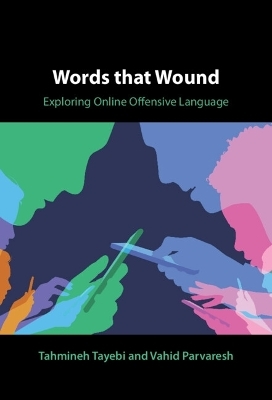
Words that Wound
Cambridge University Press (Verlag)
978-1-316-51749-9 (ISBN)
- Noch nicht erschienen (ca. April 2026)
- Versandkostenfrei
- Auch auf Rechnung
- Artikel merken
How and why do words cause people to take offence online? This book explores the complex nature of offence, examining how the structure of language – from individual words to broader linguistic patterns – can be employed to construct offensive meanings. It demonstrates that offence is not a universal concept but a subjective experience shaped by the perspective of the target. Through a multi-layered analysis of words, meanings and context, the book offers a deeper understanding of how offence is creatively constructed, conveyed, understood and experienced on social media. By investigating the continuum between explicitly and implicitly offensive language, it reveals how even subtle language choices can have significant consequences. This work serves as a valuable resource for anyone interested in language, communication and the social dynamics of offence. It will appeal to scholars and students in linguistics, communication studies, the social sciences as well as law and computer science.
Tahmineh Tayebi is a Senior Lecturer in Forensic Linguistics at Aston University, UK. Her research interests lie at the intersection of pragmatics, (im)politeness theory, corpus linguistics and forensic linguistics. She specialises in online offensive language, abuse and hate speech, with a particular focus on how language is used to cause harm and the broader legal and social implications of such communication. Vahid Parvaresh is Associate Professor of Linguistics at Anglia Ruskin University, UK. His research focuses on language aggression, hate speech and impoliteness. His work is rooted in pragmatics, with a particular emphasis on how meaning is both shaped by and shapes what is said, alongside its social, moral and contextual foundations.
Introduction; 1. Setting the scene: the dynamics of online offensive language; 2. Understanding offence; 3. Data and methodological considerations; 4. Navigating the landscape of offensive discourse; 5. Semantic domains of offensive language; 6. Patterns of offensive language usage; 7. Less explicitly offensive language; 8. Creativity and offence; Conclusion.
| Erscheint lt. Verlag | 30.4.2026 |
|---|---|
| Zusatzinfo | Worked examples or Exercises |
| Verlagsort | Cambridge |
| Sprache | englisch |
| Themenwelt | Geisteswissenschaften ► Sprach- / Literaturwissenschaft ► Sprachwissenschaft |
| ISBN-10 | 1-316-51749-7 / 1316517497 |
| ISBN-13 | 978-1-316-51749-9 / 9781316517499 |
| Zustand | Neuware |
| Informationen gemäß Produktsicherheitsverordnung (GPSR) | |
| Haben Sie eine Frage zum Produkt? |
aus dem Bereich


