


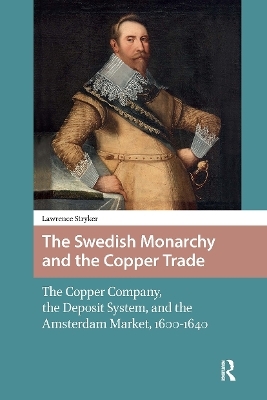
The Swedish Monarchy and the Copper Trade
The Copper Company, the Deposit System, and the Amsterdam Market, 1600-1640
Seiten
2025
Routledge (Verlag)
978-1-041-18919-0 (ISBN)
Routledge (Verlag)
978-1-041-18919-0 (ISBN)
This is the story of Gustav II Adolf’s efforts to improve efficiencies at the Stora Kopparberg, the largest copper mine in Europe and control the marketing of its bounty.
In 1611, the seventeen-year-old Gustav Adolf ascended the throne of Sweden. Before the new king could sit on his throne, however, he faced a disastrous war against Denmark, another conflict in Russia, and a rebellious nobility at home. Plus, Sweden itself had an arctic climate and a short growing season. Clearly Gustav II Adolf faced great difficulties even to survive. Yet by the end of the next decade, Gustav II Adolf’s Sweden was a leading military power in continental Europe. In 1630 the king invaded the Holy Roman Empire and joined the Thirty Years War to defend the Protestant cause. How was this possible? Sweden had one major asset, the Stora Kopparberg, the largest copper mine in Europe. The king exploited the mine and used the revenue to finance his political and military ambitions. This is the story of Gustav II Adolf’s efforts to improve efficiencies at the mine and control the marketing of its bounty.
In 1611, the seventeen-year-old Gustav Adolf ascended the throne of Sweden. Before the new king could sit on his throne, however, he faced a disastrous war against Denmark, another conflict in Russia, and a rebellious nobility at home. Plus, Sweden itself had an arctic climate and a short growing season. Clearly Gustav II Adolf faced great difficulties even to survive. Yet by the end of the next decade, Gustav II Adolf’s Sweden was a leading military power in continental Europe. In 1630 the king invaded the Holy Roman Empire and joined the Thirty Years War to defend the Protestant cause. How was this possible? Sweden had one major asset, the Stora Kopparberg, the largest copper mine in Europe. The king exploited the mine and used the revenue to finance his political and military ambitions. This is the story of Gustav II Adolf’s efforts to improve efficiencies at the mine and control the marketing of its bounty.
Lawrence Stryker studied European History at the University of Virginia where he earned a PhD before entering work as a metal commodities trader in New York City. He has been active as a trader for the last thirty-eight years and is currently the head of trading at DBlock Metals, LLC based in North Carolina.
Preliminary Notes, Introduction, Chapter One: The Stora Kopparberg, Chapter Two: The Älvsborg Ransom, Chapter Three: The Copper Company in the Early Years, Chapter Four: The Copper Company: The Years of Decline, Chapter Five: The Deposit System, Chapter Six: After the King, Conclusion, Appendix A, Appendix B, Appendix C, Appendix D, Appendix E, List of Illustrations, Bibliography, Index.
| Erscheinungsdatum | 22.11.2025 |
|---|---|
| Reihe/Serie | Entanglements, Interactions, and Economies in the Early Modern World |
| Verlagsort | London |
| Sprache | englisch |
| Maße | 156 x 234 mm |
| Gewicht | 550 g |
| Themenwelt | Geschichte ► Allgemeine Geschichte ► Neuzeit (bis 1918) |
| Geisteswissenschaften ► Geschichte ► Regional- / Ländergeschichte | |
| ISBN-10 | 1-041-18919-2 / 1041189192 |
| ISBN-13 | 978-1-041-18919-0 / 9781041189190 |
| Zustand | Neuware |
| Informationen gemäß Produktsicherheitsverordnung (GPSR) | |
| Haben Sie eine Frage zum Produkt? |
Mehr entdecken
aus dem Bereich
aus dem Bereich
Geschichte einer wilden Handlung
Buch | Hardcover (2024)
C.H.Beck (Verlag)
CHF 47,60


