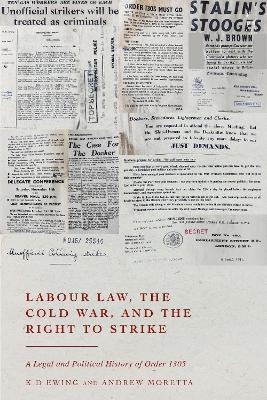
Labour Law, the Cold War, and the Right to Strike
Hart Publishing (Verlag)
978-1-5099-8316-2 (ISBN)
- Noch nicht erschienen (ca. Mai 2026)
- Versandkostenfrei
- Auch auf Rechnung
- Artikel merken
This book examines the origins, deployment, and legacy of Order 1305, a measure introduced in 1940 to make it a criminal offence to take part in a strike.
Surprisingly, the prohibition on the right to strike was retained by the Attlee administration after the Second World War, and was transformed to become a weapon of government during the Cold War to deal with what were wrongly claimed by ministers to be Communist-inspired strikes engineered for subversive purposes.
In a deep analysis of Order 1305, the authors provide a reassessment of the role of the State in industrial relations. Challenging much contemporary learning in labour law, the book is informed by a very detailed engagement with Cabinet and ministerial papers, which highlight the contradictions on the part of government in simultaneously promoting and containing trade union power. These sources also highlight the extent to which trade unions both relied on and were co-opted by the State.
The main focus of the book, however, is the role of Order 1305 in the control of trade union activists. Allegations of Communist-inspired strikes and the role of the criminal law provided an important function in post-war industrial relations for MI5 and Special Branch. Material unearthed at the National Archives demonstrates unequivocally not only that trade unions were deeply penetrated, but also that trade union activists were the subject of extensive surveillance, as the authors fully reveal.
K D Ewing is Professor of Public Law at King’s College London, UK. Andrew Moretta is Postdoctoral Researcher at Queen Mary University of London, UK.
Part I: Introduction
1. Introduction
Part II: Order 1305 in Wartime
2. Order 1305 and the Right to Strike: England and Wales
3. Order 1305 and the Right to Strike: Scotland and Northern Ireland
Part III: Retention of Order 1305: The Labour Government after the War
4. Creating the Legal Framework: Retention of Order 1305
5. Containing Trade Union Power: Collective Bargaining and the Wage Restraint Bargain
6. Controlling Trade Union Activists: MI5 and Special Branch
Part IV: Revival of Order 1305: Unofficial Action as Economic and Political Subversion
7. The Re-Emergence of Order 1305
8. Preparing for Prosecution: Surveillance and Co-ordination
9. London Gas-workers: An Unexpected Prosecution
10. Prosecution Over-reached: The Gas-workers’ Appeal
Part V: Revocation of Order 1305: Victory for the Port Workers' Committee
11. Order 1305 and the Cabinet: Legal and Political Pressures
12. The Cabinet Review of Order 1305: Irreconcilable Ministerial Tensions
13. Prosecuting the Port Workers' Committee: The Trial Collapses
14. Revocation and Legacy of Order 1305
Part VI: Conclusion
15. Conclusion
| Erscheint lt. Verlag | 14.5.2026 |
|---|---|
| Verlagsort | Oxford |
| Sprache | englisch |
| Maße | 156 x 234 mm |
| Themenwelt | Geschichte ► Teilgebiete der Geschichte ► Militärgeschichte |
| Recht / Steuern ► Arbeits- / Sozialrecht ► Arbeitsrecht | |
| Recht / Steuern ► EU / Internationales Recht | |
| Recht / Steuern ► Öffentliches Recht ► Verfassungsrecht | |
| Recht / Steuern ► Rechtsgeschichte | |
| ISBN-10 | 1-5099-8316-3 / 1509983163 |
| ISBN-13 | 978-1-5099-8316-2 / 9781509983162 |
| Zustand | Neuware |
| Informationen gemäß Produktsicherheitsverordnung (GPSR) | |
| Haben Sie eine Frage zum Produkt? |
aus dem Bereich