


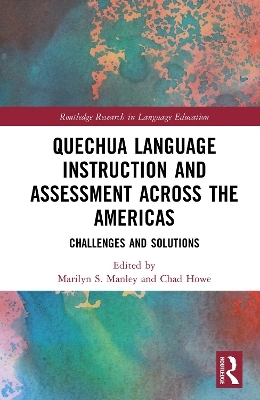
Quechua Language Instruction and Assessment Across the Americas
Routledge (Verlag)
9781032741789 (ISBN)
- Noch nicht erschienen (ca. März 2026)
- Versandkostenfrei
- Auch auf Rechnung
- Artikel merken
The volume describes barriers to effective Quechua language instruction and assessment, such as the problematic implementation of Intercultural Bilingual Education (IBE) in Peru and Ecuador, ineffective Quechua language learning materials, and inadequate Quechua language assessment instruments. To address these challenges, this work offers three primary solutions: expanding the target audience for Quechua language instruction and language learning materials, creating communicative language learning materials that reflect culturally-appropriate, real-life situations and include nativized grammatical descriptions, and making necessary modifications to language proficiency assessment instruments. As such, it provides a blueprint for pushing Quechua language instruction and assessment beyond its current status and into a future in which instructors and students are offered high-quality, culturally grounded classroom experiences. These solutions may also apply to other LCTLs and, in particular, to other Indigenous languages of the Americas and beyond.
This timely volume, which responds to UNESCO's Global Call for Action in declaring 2022-2032 as the International Decade of Indigenous Languages, is essential reading for scholars, faculty, and students with interests in Indigenous languages, language acquisition (L1/L2), language pedagogy, language policy, sociolinguistics, linguistic anthropology, and decolonizing approaches to education.
Marilyn S. Manley is a Professor of Spanish and Chairperson of the Department of World Languages at Rowan University, where she teaches Quechua. She is the co-editor of Quechua expressions of stance and deixis, in Brill’s Studies in the Indigenous Languages of the Americas book series, 11, Leiden: Brill (2015). Chad Howe is Professor of Spanish and Director of the Latin American and Caribbean Studies Institute at the University of Georgia. He is the author of The Spanish Perfects (2013, Palgrave Macmillan) and co-editor of Lingüística de Corpus / The Routledge Handbook of Spanish Corpus Linguistics (2022, Routledge).
Part I: Looking to the future of Quechua language instruction
Chapter 1: Introduction: Looking to the future for Quechua language instruction and assessment
Marilyn S. Manley and Chad Howe
Chapter 2: Quechua beyond the Andes: Teaching and learning Indigenous languages in the United States
Américo Mendoza-Mori
Chapter 3: The history and development of intercultural bilingual education in Ancash, Peru
Félix Julca-Guerrero and Laura Nivin-Vargas
Part II: Decolonizing Quechua language teaching and proficiency testing
Chapter 4: De-Westernizing grammar in the Quechua language classroom
Chad Howe and Bethany Bateman
Chapter 5: On Speaking Amazonian Kichwa authentically: Dilemmas for IRIS and ACTFL evaluative tools
Janis B. Nuckolls and Tod Swanson
Chapter 6: Assessing Quechua by its own standards: Adapting the ACTFL OPI Proficiency Guidelines
Elvia Andía Grágeda and Marilyn S. Manley
Part III: Authenticity vs. standardization in Quechua language learning materials
Chapter 7: Which Kichwa? Teaching Indigenous languages and working with and against dominant language ideologies in a small-scale textbook in Ecuador
Nicholas Limerick
Chapter 8: Heritage learners count: A Focus on language instruction for the revitalization of Southern Quechua
Marilyn S. Manley, Carlos Molina-Vital, and Alana DeLoge
Part IV: Conclusion
Chapter 9: Reflections
Pedro Ovio Plaza Martínez
| Erscheint lt. Verlag | 3.3.2026 |
|---|---|
| Reihe/Serie | Routledge Research in Language Education |
| Zusatzinfo | 10 Tables, black and white; 3 Halftones, black and white; 3 Illustrations, black and white |
| Verlagsort | London |
| Sprache | englisch |
| Maße | 152 x 229 mm |
| Gewicht | 453 g |
| Themenwelt | Geisteswissenschaften ► Sprach- / Literaturwissenschaft ► Sprachwissenschaft |
| Sozialwissenschaften ► Pädagogik | |
| ISBN-13 | 9781032741789 / 9781032741789 |
| Zustand | Neuware |
| Informationen gemäß Produktsicherheitsverordnung (GPSR) | |
| Haben Sie eine Frage zum Produkt? |
aus dem Bereich


