


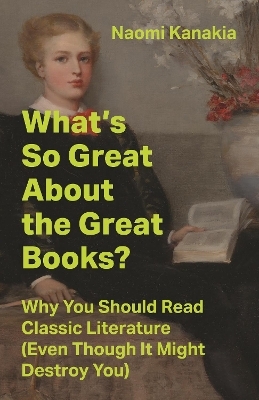
What's So Great About the Great Books?
Why You Should Read Classic Literature (Even Though It Might Destroy You)
Seiten
2026
Princeton University Press (Verlag)
978-0-691-25192-9 (ISBN)
Princeton University Press (Verlag)
978-0-691-25192-9 (ISBN)
- Noch nicht erschienen (ca. Mai 2026)
- Portofrei ab CHF 40
- Auch auf Rechnung
- Artikel merken
A popular novelist and literary blogger answers those who claim the classics are too difficult, too problematic, and too white—and explains what we gain by reading them
When she was in her early twenties, then-aspiring writer Naomi Kanakia set out to read the Great Books—humankind’s most highly regarded literary classics, representing “the best that human beings have thought or said,” as determined by the two elderly intellectuals who’d written the guidebook she consulted. After twenty years, she has made her way through about two-thirds of these books, and she’s found reading them to be an immensely pleasurable and insightful activity. Plato, Milton, Tolstoy, Proust, all those dead guys—their books have stood the test of time.
But since beginning her journey, Kanakia has found that although reading the Great Books is part of a longstanding tradition of engaging with the thought of previous generations, it is also a highly contingent activity that arose out of a specific time and place, the brainchild of a small group of early twentieth-century popularizers associated with Columbia University and the University of Chicago. And people have always been skeptical about the idea of reading the Great Books, asking if this is truly a realistic or even desirable goal for the ordinary person. A more recent and growing group of Great Books skeptics asks if these works are too problematic, reactionary, and irrelevant to bother reading. Kanakia, a self-described “left-of-center person,” grapples with these objections, attempting to restore context for the Great Books even as she sticks up for them. Because books that expose us to fundamental truths about the nature of beauty and reality are worth fighting for.
When she was in her early twenties, then-aspiring writer Naomi Kanakia set out to read the Great Books—humankind’s most highly regarded literary classics, representing “the best that human beings have thought or said,” as determined by the two elderly intellectuals who’d written the guidebook she consulted. After twenty years, she has made her way through about two-thirds of these books, and she’s found reading them to be an immensely pleasurable and insightful activity. Plato, Milton, Tolstoy, Proust, all those dead guys—their books have stood the test of time.
But since beginning her journey, Kanakia has found that although reading the Great Books is part of a longstanding tradition of engaging with the thought of previous generations, it is also a highly contingent activity that arose out of a specific time and place, the brainchild of a small group of early twentieth-century popularizers associated with Columbia University and the University of Chicago. And people have always been skeptical about the idea of reading the Great Books, asking if this is truly a realistic or even desirable goal for the ordinary person. A more recent and growing group of Great Books skeptics asks if these works are too problematic, reactionary, and irrelevant to bother reading. Kanakia, a self-described “left-of-center person,” grapples with these objections, attempting to restore context for the Great Books even as she sticks up for them. Because books that expose us to fundamental truths about the nature of beauty and reality are worth fighting for.
Naomi Kanakia writes a popular literary blog, Woman of Letters, that’s been praised by The New Yorker, Vox, and New York Magazine. She is also the author of three YA novels and a literary novel for adults.
| Erscheint lt. Verlag | 19.5.2026 |
|---|---|
| Zusatzinfo | 1 table. |
| Verlagsort | New Jersey |
| Sprache | englisch |
| Maße | 140 x 216 mm |
| Themenwelt | Geisteswissenschaften ► Sprach- / Literaturwissenschaft ► Anglistik / Amerikanistik |
| Geisteswissenschaften ► Sprach- / Literaturwissenschaft ► Literaturwissenschaft | |
| Sozialwissenschaften ► Pädagogik ► Allgemeines / Lexika | |
| Sozialwissenschaften ► Pädagogik ► Bildungstheorie | |
| Sozialwissenschaften ► Pädagogik ► Erwachsenenbildung | |
| ISBN-10 | 0-691-25192-4 / 0691251924 |
| ISBN-13 | 978-0-691-25192-9 / 9780691251929 |
| Zustand | Neuware |
| Informationen gemäß Produktsicherheitsverordnung (GPSR) | |
| Haben Sie eine Frage zum Produkt? |
Mehr entdecken
aus dem Bereich


aus dem Bereich
Poetik eines sozialen Urteils
Buch | Hardcover (2023)
De Gruyter (Verlag)
CHF 83,90


