


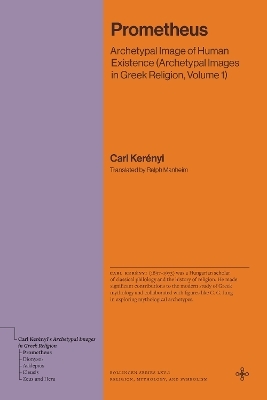
Prometheus
Archetypal Image of Human Existence (Archetypal Images in Greek Religion, Volume 1)
Seiten
2026
Princeton University Press (Verlag)
978-0-691-28175-9 (ISBN)
Princeton University Press (Verlag)
978-0-691-28175-9 (ISBN)
- Noch nicht erschienen (ca. April 2026)
- Portofrei ab CHF 40
- Auch auf Rechnung
- Artikel merken
A landmark account of the Prometheus story as myth and archetype
The god Prometheus stole fire from heaven and bestowed it on humans. In punishment, Zeus chained him to a rock, where an eagle clawed unceasingly at his liver until Herakles freed him. For the Greeks, the myth of Prometheus’s release reflected a primordial law of existence and the fate of humankind. Carl Kerényi examines the story of Prometheus and the very process of mythmaking as a reflection of the archetypal function and seeks to discover how this primitive tale was invested with a universal fatality, first in the Greek imagination and then in the Western tradition of Romantic poetry. Kerényi traces the evolving myth from Hesiod and Aeschylus, and in its epic treatment by Goethe and Shelley. He goes on to consider the myth from the perspective of Jungian psychology as the archetype of human daring signifying the transformation of suffering into the mystery of the sacrifice.
The god Prometheus stole fire from heaven and bestowed it on humans. In punishment, Zeus chained him to a rock, where an eagle clawed unceasingly at his liver until Herakles freed him. For the Greeks, the myth of Prometheus’s release reflected a primordial law of existence and the fate of humankind. Carl Kerényi examines the story of Prometheus and the very process of mythmaking as a reflection of the archetypal function and seeks to discover how this primitive tale was invested with a universal fatality, first in the Greek imagination and then in the Western tradition of Romantic poetry. Kerényi traces the evolving myth from Hesiod and Aeschylus, and in its epic treatment by Goethe and Shelley. He goes on to consider the myth from the perspective of Jungian psychology as the archetype of human daring signifying the transformation of suffering into the mystery of the sacrifice.
Carl Kerényi (1897–1973) was a Hungarian scholar of classical philology and the history of religion. He made significant contributions to the modern study of Greek mythology and collaborated with figures like C. G. Jung in exploring mythological archetypes.
| Erscheint lt. Verlag | 14.4.2026 |
|---|---|
| Übersetzer | Ralph Manheim |
| Zusatzinfo | 18 b/w illus. |
| Verlagsort | New Jersey |
| Sprache | englisch |
| Maße | 156 x 235 mm |
| Themenwelt | Geschichte ► Allgemeine Geschichte ► Vor- und Frühgeschichte |
| Geschichte ► Allgemeine Geschichte ► Altertum / Antike | |
| Geisteswissenschaften ► Psychologie ► Psychoanalyse / Tiefenpsychologie | |
| ISBN-10 | 0-691-28175-0 / 0691281750 |
| ISBN-13 | 978-0-691-28175-9 / 9780691281759 |
| Zustand | Neuware |
| Informationen gemäß Produktsicherheitsverordnung (GPSR) | |
| Haben Sie eine Frage zum Produkt? |
Mehr entdecken
aus dem Bereich



aus dem Bereich
Konzepte – Methoden – Theorien
Buch | Softcover (2024)
UTB (Verlag)
CHF 55,85
auf den Spuren der frühen Zivilisationen
Buch | Hardcover (2023)
C.H.Beck (Verlag)
CHF 27,95


