


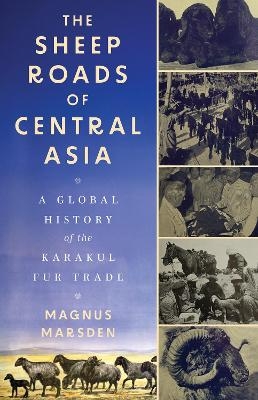
The Sheep Roads of Central Asia
A Global History of the Karakul Fur Trade
Seiten
2026
C Hurst & Co Publishers Ltd (Verlag)
978-1-80526-582-5 (ISBN)
C Hurst & Co Publishers Ltd (Verlag)
978-1-80526-582-5 (ISBN)
- Noch nicht erschienen (ca. August 2026)
- Versandkostenfrei
- Auch auf Rechnung
- Artikel merken
A history of the fur trade originating on the Karakul sheep–raising steppe, and of the merchants who took the pelts to markets worldwide.
Indigenous to Central Asia, Karakul sheep can thrive in the region’s arid environment. For centuries, men across Muslim Asia and Russia wore hats made from the sheep’s fur, which often symbolised status and masculine power. In the late nineteenth century, the thirst for furs among fashionable women in Europe and America saw millions of Karakul lambskins change hands annually, in Leipzig, London and New York. In the early twentieth century, the Russian Revolution led shepherds and merchants to flee Central Asia for Afghanistan; over the following decades, the trade in Karakul lambskins—initially referred to in the West as ‘Persian Lamb’ or ‘Astrakhan fur’—became a central element of Afghanistan’s economy.
In this unique book, Magnus Marsden illuminates Karakul’s role in the region’s globalisation, drawing on rich archives, three decades of research in Afghanistan, Pakistan and Central Asia, and interviews with fur traders and their families. He discovers that Jewish and Muslim Central Asian merchants played a pivotal role in the trade’s international expansion, demonstrating remarkable resilience in an environment growing ever more hostile to the long-distance commercial networks which they formed.
Indigenous to Central Asia, Karakul sheep can thrive in the region’s arid environment. For centuries, men across Muslim Asia and Russia wore hats made from the sheep’s fur, which often symbolised status and masculine power. In the late nineteenth century, the thirst for furs among fashionable women in Europe and America saw millions of Karakul lambskins change hands annually, in Leipzig, London and New York. In the early twentieth century, the Russian Revolution led shepherds and merchants to flee Central Asia for Afghanistan; over the following decades, the trade in Karakul lambskins—initially referred to in the West as ‘Persian Lamb’ or ‘Astrakhan fur’—became a central element of Afghanistan’s economy.
In this unique book, Magnus Marsden illuminates Karakul’s role in the region’s globalisation, drawing on rich archives, three decades of research in Afghanistan, Pakistan and Central Asia, and interviews with fur traders and their families. He discovers that Jewish and Muslim Central Asian merchants played a pivotal role in the trade’s international expansion, demonstrating remarkable resilience in an environment growing ever more hostile to the long-distance commercial networks which they formed.
Magnus Marsden is Professor of Social Anthropology and Director of the Asia Centre, University of Sussex. He has conducted decades of research in Afghanistan, Pakistan and Central Asia. His books include Trading Worlds: Afghan Merchants Across Modern Frontiers, and Beyond Swat (co-edited with Benjamin D. Hopkins)—both published by Hurst.
| Erscheint lt. Verlag | 13.8.2026 |
|---|---|
| Zusatzinfo | 24 Illustrations, black and white |
| Verlagsort | London |
| Sprache | englisch |
| Maße | 138 x 216 mm |
| Themenwelt | Geisteswissenschaften ► Geschichte ► Allgemeine Geschichte |
| Geisteswissenschaften ► Geschichte ► Regional- / Ländergeschichte | |
| ISBN-10 | 1-80526-582-2 / 1805265822 |
| ISBN-13 | 978-1-80526-582-5 / 9781805265825 |
| Zustand | Neuware |
| Informationen gemäß Produktsicherheitsverordnung (GPSR) | |
| Haben Sie eine Frage zum Produkt? |
Mehr entdecken
aus dem Bereich


aus dem Bereich
Siedler, Händler, Philosophen : eine globale Geschichte vom …
Buch | Hardcover (2024)
DVA (Verlag)
CHF 58,75
eine Reise um die Welt zu außergewöhnlichen Persönlichkeiten, …
Buch | Softcover (2023)
Piper (Verlag)
CHF 25,20


