


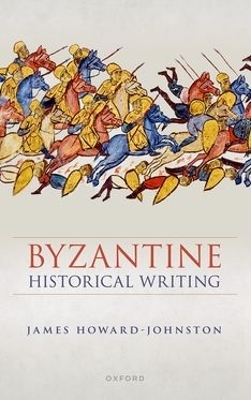
Byzantine Historical Writing
Seiten
2026
Oxford University Press (Verlag)
978-0-19-893899-6 (ISBN)
Oxford University Press (Verlag)
978-0-19-893899-6 (ISBN)
- Noch nicht erschienen (ca. März 2026)
- Versandkostenfrei
- Auch auf Rechnung
- Artikel merken
Historical writing is important in order to understand past societies, by giving us their own views of their past, recent and not so recent. In the case of Byzantium, we are fortunate that a plethora of histories and chronicles have survived. In this collection of essays, James Howard-Johnston carries out the evaluation of these historical sources.
In this collection of essays, James Howard-Johnston evaluates historical sources from across the entire existence of the Byzantine empire. Byzantium was peculiarly well endowed for the writing of history, given a relatively high degree of literacy, a large governing class running a centralised state and its associated church, and its inheritance of the historical habit developed independently in classical Greece and Judaea. Historical coverage is complete save for one short period, the reign of Constans II (641–9). Unsurprisingly, in what was a thoroughly bureaucratic state, officials and ex-officials of state and church predominate among historians. The histories they wrote were of two principal sorts: compendia which might reach back to the beginning of time, succinct, concerned primarily with chronology, and written in relatively plain language; and contemporary histories presenting fuller narratives, more interested in causes and effects, and generally written in a higher style, with classical touches. They used the bureaucratic vernacular, were primarily concerned with high politics and foreign affairs, and calibrated time by financial years. Particular emphasis is put on their use of documentary sources, the surest and safest conveyors of detailed information from the past to the historian.
A small number of individual historians are singled out for closer scrutiny, because of the importance or unusual character of their works. Procopius is portrayed as an experienced military architect/engineer and born storyteller rather than a highly educated lawyer. Theophanes deserves a special place, because of the scale of the work which he wrote with his mentor George Synkellos. George, it turns out, wrote the last contemporary section of their world history. Constantine Porphyrogenitus (905–59) was responsible for a historically enriched guide to diplomacy, but most of the valuable information which it contains about the early medieval history of the Balkans, Ukrainian steppes, and Transcaucasia is attributable to his father, Leo VI. The Logothete's world chronicle is singled out because of its vitriolic attack on the first three Macedonian emperors. Finally, Anna Komnene demands attention as the first known female historian. Her Alexias, probably the finest history produced in Byzantium, is shown to contain a great deal of material drafted by her husband, Nikephoros Bryennios. This contentious view is canvassed in the last three essays.
In this collection of essays, James Howard-Johnston evaluates historical sources from across the entire existence of the Byzantine empire. Byzantium was peculiarly well endowed for the writing of history, given a relatively high degree of literacy, a large governing class running a centralised state and its associated church, and its inheritance of the historical habit developed independently in classical Greece and Judaea. Historical coverage is complete save for one short period, the reign of Constans II (641–9). Unsurprisingly, in what was a thoroughly bureaucratic state, officials and ex-officials of state and church predominate among historians. The histories they wrote were of two principal sorts: compendia which might reach back to the beginning of time, succinct, concerned primarily with chronology, and written in relatively plain language; and contemporary histories presenting fuller narratives, more interested in causes and effects, and generally written in a higher style, with classical touches. They used the bureaucratic vernacular, were primarily concerned with high politics and foreign affairs, and calibrated time by financial years. Particular emphasis is put on their use of documentary sources, the surest and safest conveyors of detailed information from the past to the historian.
A small number of individual historians are singled out for closer scrutiny, because of the importance or unusual character of their works. Procopius is portrayed as an experienced military architect/engineer and born storyteller rather than a highly educated lawyer. Theophanes deserves a special place, because of the scale of the work which he wrote with his mentor George Synkellos. George, it turns out, wrote the last contemporary section of their world history. Constantine Porphyrogenitus (905–59) was responsible for a historically enriched guide to diplomacy, but most of the valuable information which it contains about the early medieval history of the Balkans, Ukrainian steppes, and Transcaucasia is attributable to his father, Leo VI. The Logothete's world chronicle is singled out because of its vitriolic attack on the first three Macedonian emperors. Finally, Anna Komnene demands attention as the first known female historian. Her Alexias, probably the finest history produced in Byzantium, is shown to contain a great deal of material drafted by her husband, Nikephoros Bryennios. This contentious view is canvassed in the last three essays.
James Howard-Johnston was University Lecturer in Byzantine Studies and Fellow of Corpus Christi College from 1971 to 2009.
| Erscheint lt. Verlag | 12.3.2026 |
|---|---|
| Verlagsort | Oxford |
| Sprache | englisch |
| Maße | 156 x 234 mm |
| Themenwelt | Geschichte ► Allgemeine Geschichte ► Mittelalter |
| Geisteswissenschaften ► Geschichte ► Regional- / Ländergeschichte | |
| ISBN-10 | 0-19-893899-3 / 0198938993 |
| ISBN-13 | 978-0-19-893899-6 / 9780198938996 |
| Zustand | Neuware |
| Informationen gemäß Produktsicherheitsverordnung (GPSR) | |
| Haben Sie eine Frage zum Produkt? |
Mehr entdecken
aus dem Bereich


aus dem Bereich
Geschichte einer Augsburger Familie (1367-1650)
Buch | Softcover (2024)
Kohlhammer (Verlag)
CHF 47,60
der epische Kampf um das Heilige Land
Buch | Hardcover (2025)
C.H.Beck (Verlag)
CHF 49,95


