


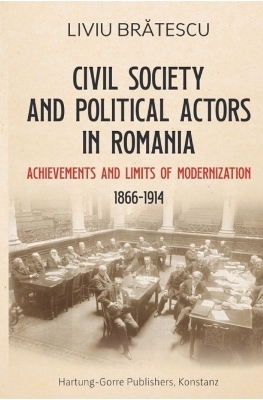
Civil Society and Political Actors in Romania (1866-1914)
Achievements and Limits of Modernization
Seiten
2025
|
2025
Hartung-Gorre (Verlag)
978-3-86628-848-5 (ISBN)
Hartung-Gorre (Verlag)
978-3-86628-848-5 (ISBN)
The first part of the research is an introductory study on the associative phenomenon and civil society, from the general (European) framework to the particular one of the Southeast European and Romanian space. After mentioning the historiographical landmarks related to the development of the concept, the introductory study also includes an overview of the general features of Romanian associationism, featuring the instruments, people, and strategies used, highlighting representative examples of associative forms from the second half of the eighteenth century. The Romanian Political Elite and the Development of Civil Society.
Objectives and Mechanisms (Late Nineteenth and Early Twentieth Century) is meant to represent an analysis of a reality of civil society also sensed at the European level, namely the intersection between the political and associative fields. The study focuses on the involvement of the modern political elite in the development of associationism to achieve objectives, reforms, or modernisation initiatives outside the institutional framework they represented. Whether we refer to liberals, conservatives, or socialists, the associations, societies, and other forms of civil organisationwhere leaders and politicians were involved, the objectives pursued through this form of sociocultural involvement, and the areas where the unleashing of civil society forces
was sensed the most in the timeframe mentioned above represent the research directions of the study.
Objectives and Mechanisms (Late Nineteenth and Early Twentieth Century) is meant to represent an analysis of a reality of civil society also sensed at the European level, namely the intersection between the political and associative fields. The study focuses on the involvement of the modern political elite in the development of associationism to achieve objectives, reforms, or modernisation initiatives outside the institutional framework they represented. Whether we refer to liberals, conservatives, or socialists, the associations, societies, and other forms of civil organisationwhere leaders and politicians were involved, the objectives pursued through this form of sociocultural involvement, and the areas where the unleashing of civil society forces
was sensed the most in the timeframe mentioned above represent the research directions of the study.
Liviu Bratescu is a researcher at the A. D. Xenopol Institute of History in Iași, Romania. A specialist in modern Romanian history, he has published numerous studies and papers on political life in the second half of the 19th century, memory and commemoration in the modern era, and Romanian foreign policy (1866-1914). His published works include: I.C. Brătianu and Romania's Foreign Policy (2013), Liberals versus Conservatives. Public Monuments and Competing Memories in Modern Romania (1866-1914) (2015), Romania at a Crossroads. The Year 1866 (2014).
| Erscheinungsdatum | 26.09.2025 |
|---|---|
| Verlagsort | Konstanz |
| Sprache | englisch |
| Maße | 130 x 200 mm |
| Gewicht | 200 g |
| Themenwelt | Geschichte ► Allgemeine Geschichte ► Neuzeit (bis 1918) |
| Geschichte ► Teilgebiete der Geschichte ► Kulturgeschichte | |
| Geschichte ► Teilgebiete der Geschichte ► Sozialgeschichte | |
| Schlagworte | achievements of modernization • Civil Society • limits of modernization • political actors • Romania (1866-1914) |
| ISBN-10 | 3-86628-848-4 / 3866288484 |
| ISBN-13 | 978-3-86628-848-5 / 9783866288485 |
| Zustand | Neuware |
| Informationen gemäß Produktsicherheitsverordnung (GPSR) | |
| Haben Sie eine Frage zum Produkt? |
Mehr entdecken
aus dem Bereich

aus dem Bereich
Geschichte einer wilden Handlung
Buch | Hardcover (2024)
C.H.Beck (Verlag)
CHF 47,60


