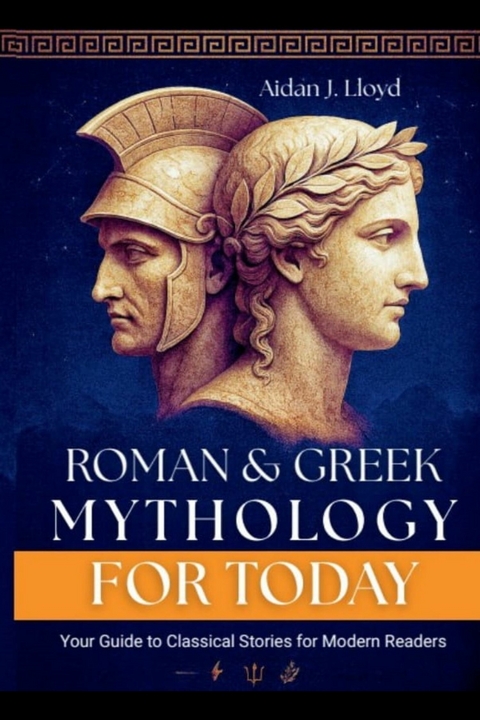
Roman and Greek Mythology for Today (eBook)
348 Seiten
Seahorse Pub (Verlag)
978-0-00-105744-9 (ISBN)
Unlock the Timeless Secrets of Gods, Heroes, and Epic Quests-Rediscovered for Your World
Dive into the electrifying world of ancient legends where thunder-wielding kings clash with monstrous titans, lovers defy fate in starlit realms, and clever mortals outwit divine wrath. In Roman and Greek Mythology for Today, Aidan J. Lloyd transforms dusty scrolls into a riveting roadmap for modern explorers, blending scholarly depth with pulse-pounding storytelling that feels like binge-watching a blockbuster saga.
From the chaotic void birthing Gaia and Uranus to Zeus's thunderous rebellion against devouring Kronos, discover how these primordial forces ignited cosmic wars and golden ages. Meet the twelve Titans ruling oceans and stars, witness Rhea's daring deception to save baby Zeus, and unravel the tragic burdens of Atlas and Prometheus-the fire-stealer who gifted humanity its spark. Journey through Aeneas's pious odyssey from Troy's ashes to Rome's foundations, where duty trumps desire in Virgil's immortal verse.
But this isn't just history-it's your backstage pass to today's cultural pulse. See Odysseus's cunning in Silicon Valley strategies, Narcissus's vanity in social media traps, and Gaia's fury echoing climate cries. Perfect for curious newcomers, mythology buffs, or parents sparking family lore, Lloyd's guide decodes Freudian complexes, superhero origins, and even brand empires through these eternal tales.
With pronunciation guides, family trees, and provocative parallels to Big Bang theories and environmental awakenings, you'll emerge wiser, entertained, and armed with insights that bridge 3,000 years. Why do these stories endure? Because they mirror our chaos, ambitions, and triumphs. Grab your passport to the ancients-your epic adventure awaits. Whether decoding a podcast reference or igniting dinner debates, Roman and Greek Mythology for Today proves: the gods never truly faded; they're just waiting for you to join the pantheon.
Chapter 1
In The Beginning - Creation and Chaos
The Void and First Beings
Before the sun blazed across morning skies, before mountains thrust toward heaven, before the first wave crashed upon a shore that did not yet exist, there was nothing. Not the gentle nothing of a quiet room or the peaceful nothing of deep sleep, but the absolute nothing that defies human understanding—a void so complete that even darkness could not exist within it, for darkness itself requires something to be dark against.
The Greeks called this primordial nothingness Chaos (KAY-oss), and from our modern perspective, we might imagine it as the ultimate vacuum, a space without matter, energy, or even the possibility of existence. Yet Chaos was not merely empty space waiting to be filled. According to Hesiod, whose Theogony remains our most complete ancient account of creation, Chaos possessed a terrible creative power—the ability to birth existence from nonexistence, to conjure being from the abyss of unbeing.
From this incomprehensible void emerged the first conscious entities, beings so fundamental that they represented the basic forces necessary for a universe to function. Gaia (GUY-ah), the Earth herself, came into being not as a planet spinning in space, but as the solid foundation upon which all future existence would rest. She was both place and person, both the ground beneath feet that did not yet exist and a divine consciousness capable of thought, desire, and terrible vengeance.
Simultaneously with Gaia arose Eros (EH-ross), not the chubby cherub of Valentine's cards, but a cosmic force of attraction and connection. This primordial Eros was the power that would draw separate beings together, the fundamental force that makes procreation, alliance, and even conflict possible. Without Eros, the universe would remain a collection of isolated entities, forever separate, forever alone.
Tartarus (TAR-tar-us) also emerged from Chaos, a realm so deep beneath the Earth that it existed as much in metaphysical space as physical reality. Tartarus was not merely an underworld prison for the wicked, but the universe's deepest foundation, the place where cosmic justice would eventually deposit those who challenged the proper order of existence.
Finally came Erebus (EH-reb-us), the personification of primordial darkness, and Nyx (NICKS), the embodiment of Night. These beings represented not the absence of light—for light did not yet exist to be absent—but the fundamental forces of concealment, mystery, and the unknown. Nyx, in particular, would prove so powerful that even Zeus, king of the gods, would learn to fear her.
The ancient storytellers understood something profound in placing these beings at the foundation of existence. They recognized that before there could be heroes and villains, gods and mortals, love stories and tragedies, there must first be the basic building blocks of reality: a place to stand (Gaia), a force to connect (Eros), a depth to contain (Tartarus), and a mystery to explore (Nyx and Erebus).
These primordial beings did not create the universe through deliberate action, as a craftsman shapes clay or an architect designs a building. Instead, they were the universe becoming conscious of itself, the first stirrings of awareness within the cosmic void. Their very existence represented the transition from absolute nothingness to the possibility of everything.
What strikes modern readers as remarkable is how this ancient creation story parallels contemporary scientific understanding in unexpected ways. Just as physicists speak of fundamental forces—gravity, electromagnetism, strong and weak nuclear forces—that govern all interactions in the universe, the Greeks identified fundamental powers that would shape all mythological narratives to come. Gaia's stability would anchor every story. Eros would drive every relationship. Tartarus would enforce cosmic justice. Nyx would preserve the mysteries that make stories worth telling.
The Greeks also understood that creation is not a neat, orderly process. Chaos gives birth not to harmony, but to forces that will immediately begin interacting, conflicting, and generating new complexities. From the moment these primordial beings came into existence, the stage was set for drama on a cosmic scale.
Pronunciation Guide for Primordial Beings:
- Chaos: KAY-oss
- Gaia: GUY-ah
- Eros: EH-ross
- Tartarus: TAR-tar-us
- Erebus: EH-reb-us
- Nyx: NICKS
Birth of Sky and Earth
Gaia, though born from nothingness, did not remain alone in her primordial solitude. As the embodiment of Earth's creative power, she possessed the ability to generate new beings from her own substance, and her first act of creation would establish the fundamental relationship that would define the cosmos for ages to come.
Without partner or external assistance, Gaia brought forth Uranus (oo-RAH-nus), the starry sky. He was not merely the blue dome that stretches overhead, but the living personification of the heavens—vast, eternal, and encompassing. Uranus emerged as Gaia's equal in size and scope, designed to cover her completely and serve as a home for the blessed gods who would eventually inhabit the celestial realm.
The relationship between Gaia and Uranus represents the first great cosmic marriage, the union of Earth and Sky that would become a fundamental pattern in mythologies worldwide. Yet this was no gentle romance between complementary forces. From the beginning, their union carried within it the seeds of conflict that would eventually tear the cosmos apart.
Uranus descended upon Gaia nightly, their coupling generating the first generation of divine beings. But unlike the primordial forces that emerged from Chaos through mysterious processes beyond explanation, these new beings were born through recognizable biological reproduction, establishing procreation as the primary method of cosmic expansion.
Their first children were the Titans (TIE-tans), twelve beings of enormous power and size. Six male Titans—Oceanus (oh-SEE-an-us), Coeus (SEE-us), Crius (KRY-us), Hyperion (high-PEER-ee-on), Iapetus (eye-AP-eh-tus), and Kronos (KRON-oss)—were balanced by six female Titans or Titanides (tie-TAN-ih-deez)—Tethys (TEE-thiss), Phoebe (FEE-bee), Theia (THEE-ah), Mnemosyne (neh-MOSS-ih-nee), Themis (THEE-miss), and Rhea (REE-ah).
Each Titan embodied specific aspects of natural and cosmic order. Oceanus represented the vast river that the ancients believed encircled the world. Hyperion personified the light that moves across the sky. Mnemosyne was the power of memory itself, without which no stories could be preserved or passed down. Themis embodied divine law and proper conduct, the force that maintains social and cosmic order.
But Gaia and Uranus's fertility did not stop with the Titans. They also produced three Cyclopes (sigh-KLOH-peez)—Brontes (BRON-teez), Steropes (ster-OH-peez), and Arges (AR-jeez)—one-eyed giants whose names meant Thunder, Lightning, and Bright. These beings would later forge the thunderbolts that Zeus would wield as weapons.
Most terrifying of all were the three Hecatoncheires (hek-ah-ton-KY-reez), the Hundred-Handed Ones—Cottus (KOT-us), Briareus (bry-AIR-ee-us), and Gyges (GUY-jeez). Each possessed fifty heads and one hundred arms, making them beings of such overwhelming power that their very existence seemed to threaten the stability of the newly formed cosmos.
Yet as soon as these mighty beings were born, Uranus made a decision that would ultimately lead to his downfall. Horrified by the monstrous appearance of the Cyclopes and Hecatoncheires, and perhaps sensing the threat they posed to his supremacy, he forced them back into Gaia's depths, imprisoning them in the dark spaces within the Earth herself.
This act of cosmic injustice caused Gaia tremendous pain, both physical and emotional. The imprisonment of her children within her own body created constant suffering, but more than that, it represented a violation of the natural order. Children should grow and flourish, not be hidden away out of fear and shame.
Gaia's anguish over her imprisoned children would drive the next phase of cosmic development. Her love for all her offspring, even the most monstrous, and her rage at their unjust punishment, would lead her to plot against her own husband and partner. The perfect union of Earth and Sky had already begun to crack, setting the stage for the first great war in heaven.
The story of Gaia and Uranus establishes patterns that will echo throughout Greek mythology: the tension between generations, the fear of being overthrown by one's children, and the way injustice creates the conditions for its own punishment. It also introduces the concept that even the gods are not free from consequence—that actions, however seemingly justified, generate reactions that can reshape the cosmos itself.
The Titans' Rise
The imprisonment of the Cyclopes and Hecatoncheires created a wound in the cosmos that could not heal while Uranus maintained his tyrannical grip on power. Gaia, bearing the weight of her children's suffering within her own body, reached the point where maternal love overcame spousal loyalty. She began to plot revolution against the Sky, but she could not act alone—she needed a champion from among her free children, the Titans.
Gaia's choice fell upon Kronos, the youngest of the male Titans, whose name connected him to time itself. Perhaps she chose...
| Erscheint lt. Verlag | 18.9.2025 |
|---|---|
| Sprache | englisch |
| Themenwelt | Geschichte ► Allgemeine Geschichte ► Vor- und Frühgeschichte |
| ISBN-10 | 0-00-105744-8 / 0001057448 |
| ISBN-13 | 978-0-00-105744-9 / 9780001057449 |
| Informationen gemäß Produktsicherheitsverordnung (GPSR) | |
| Haben Sie eine Frage zum Produkt? |
 EPUB (Adobe DRM)
Größe: 17,5 MB
Kopierschutz: Adobe-DRM
Adobe-DRM ist ein Kopierschutz, der das eBook vor Mißbrauch schützen soll. Dabei wird das eBook bereits beim Download auf Ihre persönliche Adobe-ID autorisiert. Lesen können Sie das eBook dann nur auf den Geräten, welche ebenfalls auf Ihre Adobe-ID registriert sind.
Details zum Adobe-DRM
Dateiformat: EPUB (Electronic Publication)
EPUB ist ein offener Standard für eBooks und eignet sich besonders zur Darstellung von Belletristik und Sachbüchern. Der Fließtext wird dynamisch an die Display- und Schriftgröße angepasst. Auch für mobile Lesegeräte ist EPUB daher gut geeignet.
Systemvoraussetzungen:
PC/Mac: Mit einem PC oder Mac können Sie dieses eBook lesen. Sie benötigen eine
eReader: Dieses eBook kann mit (fast) allen eBook-Readern gelesen werden. Mit dem amazon-Kindle ist es aber nicht kompatibel.
Smartphone/Tablet: Egal ob Apple oder Android, dieses eBook können Sie lesen. Sie benötigen eine
Geräteliste und zusätzliche Hinweise
Buying eBooks from abroad
For tax law reasons we can sell eBooks just within Germany and Switzerland. Regrettably we cannot fulfill eBook-orders from other countries.
aus dem Bereich