Telepoetics
Edinburgh University Press (Verlag)
978-1-3995-4317-0 (ISBN)
- Noch nicht erschienen (ca. Mai 2026)
- Versandkostenfrei
- Auch auf Rechnung
- Artikel merken
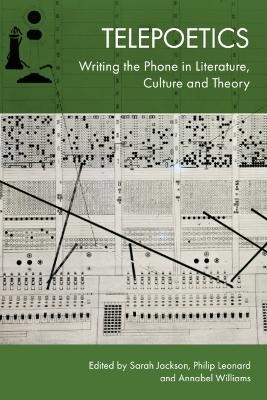
Tapping into a wide range of the protocols, practices and forms of the telephone and its extended apparatus – from analogue to digital; from corded candlestick to flat, reflective interface; and from buzzing switchboard to encrypting scrambler phone – this volume examines how the literary telephone connects, and disrupts, our relationship with such prevalent and compelling preoccupations as desire, resistance, responsibility, surveillance, political coercion and warfare. Across seventeen chapters, it brings together readings informed by literary criticism and theory, poetics, sound studies, material culture, media archaeology and cultural history. Considering areas including the modernist lyric, mid-twentieth-century fiction, contemporary drama and video games, it establishes new approaches for understanding the extensive, and mutable, relationship between literature and the telephone.
Sarah Jackson is Associate Professor in Arts and Environment and Vice Chancellor’s Fellow at Northumbria University. Working at the intersections of literature, art and technology in order to address questions of social and environmental justice, her books include Pelt (2012; awarded the Seamus Heaney Prize for Poetry 2013); Tactile Poetics: Touch and Contemporary Writing (2015); and Literature and the Telephone: Conversations on Poetics, Politics and Place (2023). Bringing together creative and critical practice, her current work focuses on geopoetics, displacement and sound. Philip Leonard is Professor of Literature and Theory at Nottingham Trent University. His research focuses on national, transnational and global writing, ecocriticism, and literature and technology. His books include Orbital Poetics: Literature, Theory, World (2019) and Literature after Globalization: Textuality, Technology, and the Nation-State (2013), and he is co-editor of Parallax special issue ‘Troubling Globalization’ (2021) and The World in Theory: Derrida, Nancy and the Ends of Globalization (forthcoming, 2026). He is currently writing a book on Earth-Space sustainability, titled Astroecologies: Cultural Narratives and Environmental Sustainability in Space. Annabel Williams is a Lecturer in Modern and Contemporary Literature at the University of St Andrews. Her research specialisms include literary modernism, mid-twentieth-century literature, travel writing and war writing, and she has published work on these areas in edited volumes and journals including Modernist Cultures, Textual Practice and Twentieth-Century Literature. Her essay ‘Fantasias on National Themes: Fantasy, Space, and Imperialism in Rebecca West’ won the Andrew J. Kappel Prize in Literary Criticism (2020). Her monograph Travel, War and Home in Late Modernist British Literature is forthcoming in 2026.
List of Figures
Acknowledgements
Notes on Contributors
Introduction: Phone Books
Sarah Jackson, Philip Leonard and Annabel Williams
Part I. Connections and Disconnections
1. ‘Rinse and Wring the Ear’: Reflections on Being in Long-Distance Conversation
Anthony V. Capildeo
2. Genres of the Telephone, 1876–1913
Richard Menke
3. Callbacks: Death and the Telephone in Modern Drama
Kevin Riordan
4. ‘Long | Distance Calls’: The Telephone as Lyric Device in Jack Spicer and W. S. Graham
Sam Buchan-Watts
Part II. Desire, Intimacy and Affect
5. The Siren Call: Gender, Telephony and Desire in Elizabeth Bowen’s To the North (1932)
Imogen Free
6. ‘Supernatural Paraphernalia’: Ford Madox Ford’s Uncanny Telepoetics
Max Saunders
7. (H)allophonies: Cixous, Derrida and Others on the Line
Laurent Milesi
Part III. Sound and Voice
8. Voicing Class and Status in Mid-Century Fiction
Lara Ehrenfried
9. ‘The board’s asunder’: Switchboards, Operators and Phoneys in Mid-Century Fiction
Annabel Williams
10. Samuel Beckett’s Intertextual Telephony: Gender on the Line
Jivitesh Vashisht
11. ‘the telephone is overloaded’: Receiving a Feminist Telepoetics
Natalie Ferris
Part IV. Intelligence, Surveillance and Power
12. Looking for a Listener: Twentieth-Century Lyric Telephony
Tyne Daile Sumner
13. Muriel Spark’s Scrambled Telephony: Precarious Lines and Affective Disconnections
Beatriz Lopez
14. The Telephone in Pain: Impossible Confessions in Viet Thanh Nguyen’s The Sympathizer
Sarah Jackson
Part V. Subjectivities, Mobilities and the Networked Self
15. Sleep Mode: Phones, Achievement-Subjects and the Sleep Crisis in Contemporary Literature
Diletta De Cristofaro
16. On Answering the Phone in The Stanley Parable: The Telephone-in-the-videogame, Identity and Play
Souvik Mukherjee
17. Cell Phone
Philip Leonard
Bibliography
Index
| Erscheint lt. Verlag | 31.5.2026 |
|---|---|
| Zusatzinfo | 3 black and white images |
| Verlagsort | Edinburgh |
| Sprache | englisch |
| Maße | 156 x 234 mm |
| Themenwelt | Geisteswissenschaften ► Sprach- / Literaturwissenschaft ► Anglistik / Amerikanistik |
| Geisteswissenschaften ► Sprach- / Literaturwissenschaft ► Literaturgeschichte | |
| Geisteswissenschaften ► Sprach- / Literaturwissenschaft ► Literaturwissenschaft | |
| ISBN-10 | 1-3995-4317-2 / 1399543172 |
| ISBN-13 | 978-1-3995-4317-0 / 9781399543170 |
| Zustand | Neuware |
| Informationen gemäß Produktsicherheitsverordnung (GPSR) | |
| Haben Sie eine Frage zum Produkt? |
aus dem Bereich