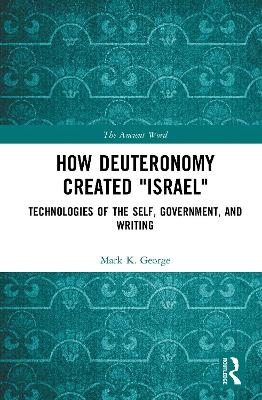
How Deuteronomy Created "Israel"
Routledge (Verlag)
978-1-032-59416-3 (ISBN)
- Noch nicht erschienen (ca. März 2026)
- Versandkostenfrei
- Auch auf Rechnung
- Artikel merken
In this book, Mark K. George argues that the goal of Deuteronomy is not merely to provide ancient Judah with another set of laws but to write “Israel” itself into existence. He reads Deuteronomy as a manual for self‑definition with two key aspects: being an Israelite means recognizing oneself as a subject under Yahweh’s control, and Deuteronomy is the handbook of techniques by which one monitors oneself to become Israel.
Scholars have acknowledged the influence of certain literary features of ancient Assyrian imperial treaties on Deuteronomy. In this book, George argues that the key to both Deuteronomy and Assyrian rituals of control is their monitoring mechanism, not only speaking to their audiences but also providing them with new ways to understand themselves and behave. He suggests that Deuteronomy redefines not only Israel but also Yahweh himself according to an Assyrian imperial model—with Israel as the subject, God as a distant imperial ruler, and the text itself as a local monitor. In showing this, he extends the insights of Michel Foucault, who urged us to view power not merely as something imposed from above by force, but as something that can entwine and shape us from below.
This book provides an invaluable exploration of Deuteronomy, of interest to scholars and students working on Deuteronomy itself and biblical studies more generally, as well as on questions of ancient politics and governmentality, Foucault studies, and the history and material culture of the Ancient Near East.
Mark K. George, Professor of Bible and Ancient Systems of Thought, taught for nearly 30 years at the Iliff School of Theology. His research focuses on the Torah and how to think differently about it. His publications include Israel’s Tabernacle as Social Space and numerous articles, essays, and other materials.
Preface viii Acknowledgments x Series Editor Foreword xii Abbreviations xiv 1 Creating Subjects 1 Introduction 1 The Subjects of the War on Poverty 1 Deuteronomy’s Subject 3 Historical Assumptions 8 Deuteronomy and Esarhaddon’s Succession Treaty (EST) 9 Political Subversion and Structuring Governing Relationships 12 Monitored Power and Governing Relationships 13 Shifting Responsibility 14 Subverting YHWH 15 “Monitor yourselves to do…” 16 The “Path” of This Book (But Turning Aside is OK!) 18 2 Thinking Differently 31 The Dynamism of Power 33 Power as Dynamic and Relational 33 Power as Pervasive throughout Society 34 Power Operates through a Network 35 Power as Productive 36 The Micro‑physics of Power 36 Knowledge 37 Knowledge and Power‑knowledge 38 Knowledge as a Dominant Idea (Savoir) 39 Knowledge as Individual Forms (Connaissance) 40 Knowledge as Truth 41 Subjects and Subjectivity 42 Governmentality 44 Analyzing Deuteronomy in Conversation with Foucault 47 3 “Monitor Your Being Intently” 60 What Is YHWH in Relation to Israel? 60 “Monitor Your Being Intently” 63 The Governing Rationality of Sovereignty: Pastoral Power 65 Brothers versus Foreigners 65 Shepherd and Sheep 66 The Governing Rationality of Imperial Power: Monitored Power 69 The Challenge of Recognizing Monitored Power 69 Ade‑oath Agreements 70 Do You Love Me? 72 Written Treaties and Oaths 73 Guard Yourself and Others 75 Witnesses as Monitors 76 The Diffusion of Monitored Power in Ancient Southwest Asia 76 Unpredictable Subordinates 78 YHWH: Sovereign or Emperor? 78 4 Conduct Becoming Israel 95 Beyond Centralization 95 Becoming “Israel” 97 Observation 102 “Observe yourself” 102 Self‑Formation through Observation 103 Self‑Government 105 Performance 106 Passover as Regimen 107 Regimenting Conduct 108 Recitation 110 Demonstrating Self‑Formation 111 Forming Others 112 Conclusion 113 5 Normalizing Judgments 123 Depersonalization 124 Attention 127 “Then all Israel will hear and be afraid…” 128 “Hear, O Israel, the statutes and ordinances…” 130 “…because you do the right thing in the eyes of YHWH” 132 Attention as a Mode of Being Israel 134 Training 134 Teaching and Discipline 135 Disciplined Defecation 136 Training Schedules 137 Training Arenas 139 Deviation 140 Counter‑Conduct 140 Rebellion 142 Deviation is Unavoidable 143 Normalizing Deviance? 144 Conclusion 145 6 Governmentality and the Technology of Writing 158 Governing the Land of Israel 161 The Importance of Writing 163 Fixing and Stabilizing Words and Ideas 165 Preserving and Shaping Knowledge 165 Shared Knowledge 167 Standardization and Normalization 169 Assessment 172 Assessment by Witnesses 174 Being “Israel” 175 The “Truth” of Deuteronomy’s “Israel” 176 Conclusion 178 7 Conclusions 192 Did It Work? 197 For Further Consideration 198 Bibliography 205 Index 219
| Erscheint lt. Verlag | 11.3.2026 |
|---|---|
| Reihe/Serie | The Ancient Word |
| Verlagsort | London |
| Sprache | englisch |
| Maße | 156 x 234 mm |
| Gewicht | 453 g |
| Themenwelt | Geschichte ► Allgemeine Geschichte ► Altertum / Antike |
| Religion / Theologie ► Christentum ► Bibelausgaben / Bibelkommentare | |
| Religion / Theologie ► Christentum ► Kirchengeschichte | |
| Geisteswissenschaften ► Religion / Theologie ► Weitere Religionen | |
| ISBN-10 | 1-032-59416-0 / 1032594160 |
| ISBN-13 | 978-1-032-59416-3 / 9781032594163 |
| Zustand | Neuware |
| Informationen gemäß Produktsicherheitsverordnung (GPSR) | |
| Haben Sie eine Frage zum Produkt? |
aus dem Bereich