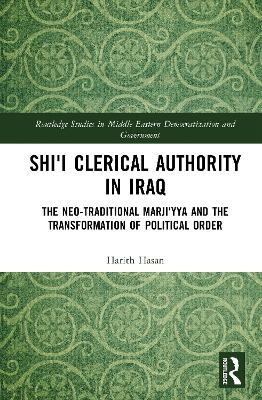
Shi'i Clerical Authority in Iraq
Routledge (Verlag)
978-1-041-15265-1 (ISBN)
- Noch nicht erschienen (ca. Juni 2026)
- Versandkostenfrei
- Auch auf Rechnung
- Artikel merken
Sh’i Clerical Authority in Iraq: The Neo-Traditional Marji’yya and the Transformation of Political Order provides the first comprehensive analysis of the evolving relationship between Shi'i religious authority and the state in Iraq through a distinctive historical sociology framework that illuminates structural and contextual transformations.
Spanning decades of complex interaction, it examines the often tense coexistence and rivalry between the state apparatus and the transnational Shi'i Marji'iyya, revealing how their relationship has been fundamentally reshaped by broader historical processes. Through meticulously researched case studies, the volume traces how state-building initiatives, secularization efforts, and shifting conceptions of national community have continuously challenged and reconfigured traditional religious authority. The analysis centers on the watershed moment of 2003, when Saddam Hussein's authoritarian regime collapsed, creating space for Shi'i religious and Islamist actors to emerge as significant political forces amid weakening central authority and a shift from homogenization to communitarianism as the organizing principle of political community. The author introduces the innovative concept of "neo-traditional Marji'iyya" to theorize the transformation in the public presence, political agency, and institutional configuration of Shi'i religious authority in contemporary Iraq.
A significant contribution to the fields of Middle Eastern studies, political theology, and state-religion relations, this book offers essential insights for scholars and policymakers seeking to understand the complex interplay between religious institutions and political power in post-authoritarian contexts and fragile states.
Harith Hasan is an Associate Researcher at the Arab Centre for Research and Policy Studies. Previously, he was a non-resident senior fellow at the Carnegie Middle East centre (2019-2024); Director of Iraq’s Initiative at the Atlantic Council (2016-2018); Research Fellow at the Central European University (2017-2018), a Fellow at Radcliffe Institute-Harvard University (2014-2015). He has a PhD in political Science.
Acknowledgments
Introduction
Chapter One: The Modern State, Secularization and Religious Authority in Iraq
The Construction of the Marjiʿyya
Moder State formation and Shiʿi Clerical Authorities
Marjʿiyya under the authoritarian state
Chapter Two: State Atrophy, Islamization, and the Dynamics of the Religious Field
Shiʿi Clerics and the Response to Secularization
The Decline of the Modernizing State
The Shiʿi Uprising, Khoui’s Death and the Emergence of Sistani
The Rise of Sadr II and the Division in the religious Field
Chapter Three: Marjiʿyya and the Recreation of Sociopolitical Order after 2003
The Occupation and Disintegration of State Authority
Marjiʿyya and State-Rebuilding
Between Legal Tradition and New Realities
Marjiʿyya as an Extra-Constitutional Body
Chapter Four: Marjiʿyya and the Shiʿi Political Power: National and Transnational Dimensions
The Marjiʿyya and Shiʿi Islamism: From Opposition to domination
Historical Background
Marjiʿyya and the Shiʿi-led State
Moral Authority or Political Guarantor
Marjiʿyya, Wilayat Al-Faqih and Transnational Relations
The Controversy on Wilayat al-Faqih
The Neo-Traditional Marjiʿyya vs. Wilayat al-Faqih
Chapter Five: The Neo-Traditional Marjiʿyya: Religious Authority and the New Articulations
Restructuring the Religious Field: Awqaf, Atabat and Marjiʿyya’s New roles
The hybrid administration of Shrines
Shrine Administrations and their Socioeconomic Activities
The loose institutionalization
The Neo-Traditional Marj’iyya and the Questions of Legitimacy, Legality and Public Morality
The Question of Legitimacy: The Marjiʿyya as a Parallel Authority
The Marjiʿyya, Public Morality and Social Governance
Between Religious Jurisprudence and Formal Law
Conclusions
Bibliography
Index
| Erscheint lt. Verlag | 3.6.2026 |
|---|---|
| Reihe/Serie | Routledge Studies in Middle Eastern Democratization and Government |
| Zusatzinfo | 1 Line drawings, black and white; 1 Illustrations, black and white |
| Verlagsort | London |
| Sprache | englisch |
| Maße | 156 x 234 mm |
| Themenwelt | Geisteswissenschaften ► Religion / Theologie ► Islam |
| Sozialwissenschaften ► Politik / Verwaltung | |
| Sozialwissenschaften ► Soziologie | |
| ISBN-10 | 1-041-15265-5 / 1041152655 |
| ISBN-13 | 978-1-041-15265-1 / 9781041152651 |
| Zustand | Neuware |
| Informationen gemäß Produktsicherheitsverordnung (GPSR) | |
| Haben Sie eine Frage zum Produkt? |
aus dem Bereich