


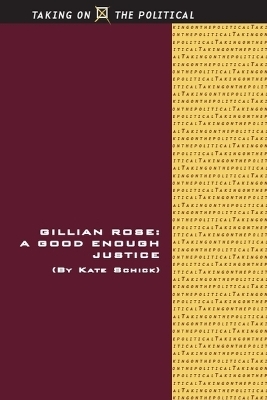
Gillian Rose
A Good Enough Justice
Seiten
2026
Edinburgh University Press (Verlag)
978-1-3995-6121-1 (ISBN)
Edinburgh University Press (Verlag)
978-1-3995-6121-1 (ISBN)
- Noch nicht erschienen (ca. Mai 2026)
- Portofrei ab CHF 40
- Auch auf Rechnung
- Artikel merken
Makes the case for the rediscovery of British philosopher Gillian Rose’s unique but neglected voice.
Makes the case for the rediscovery of British philosopher Gillian Rose’s unique but neglected voice
Kate Schick explains the core themes of Gillian Rose's work. She engages with the work of Benjamin, Honig, Zizek and Butler and locates Rose's ideas within central debates in contemporary social theory: trauma and memory, exclusion and difference, tragedy and messianic utopia. She shows how Rose’s speculative perspective brings a different gaze to bear on debates, avoiding well-worn liberal, critical theoretic and post-structural positions.
Gillian Rose draws on idiosyncratic readings of thinkers such as Hegel, Adorno and Kierkegaard to underpin her philosophy, refusing to privilege the particular over the universal. While of the left, she is sharply critical of much left-wing thought, insisting that it shirks the work of coming to know and taking political risk in the hope that we might find a ‘good enough justice’.
Makes the case for the rediscovery of British philosopher Gillian Rose’s unique but neglected voice
Kate Schick explains the core themes of Gillian Rose's work. She engages with the work of Benjamin, Honig, Zizek and Butler and locates Rose's ideas within central debates in contemporary social theory: trauma and memory, exclusion and difference, tragedy and messianic utopia. She shows how Rose’s speculative perspective brings a different gaze to bear on debates, avoiding well-worn liberal, critical theoretic and post-structural positions.
Gillian Rose draws on idiosyncratic readings of thinkers such as Hegel, Adorno and Kierkegaard to underpin her philosophy, refusing to privilege the particular over the universal. While of the left, she is sharply critical of much left-wing thought, insisting that it shirks the work of coming to know and taking political risk in the hope that we might find a ‘good enough justice’.
Kate Schick is Associate Professor of International Relations at Te Herenga Waka-Victoria University of Wellington. She is co-editor of Subversive Pedagogies: Radical Possibility in the Academy (with Claire Timperley, 2022), The Vulnerable Subject: Beyond Rationalism in International Relations (with Amanda Russell Beattie, 2013) and Recognition in Global Politics: Critical Encounters between State and World (with Patrick Hayden, 2016).
Introduction
Part I. Speculative philosophy
1. Speculative dialectics
2. The broken middle
Part II. Speculative politics
3. Trauma, memory and the political
4. Cosmopolitanism, difference and aporetic universalism
5. Between tragedy and utopia
Conclusion
| Erscheint lt. Verlag | 31.5.2026 |
|---|---|
| Reihe/Serie | Taking on the Political |
| Verlagsort | Edinburgh |
| Sprache | englisch |
| Maße | 156 x 234 mm |
| Themenwelt | Geisteswissenschaften ► Philosophie |
| Sozialwissenschaften ► Politik / Verwaltung ► Politische Systeme | |
| Sozialwissenschaften ► Politik / Verwaltung ► Politische Theorie | |
| ISBN-10 | 1-3995-6121-9 / 1399561219 |
| ISBN-13 | 978-1-3995-6121-1 / 9781399561211 |
| Zustand | Neuware |
| Informationen gemäß Produktsicherheitsverordnung (GPSR) | |
| Haben Sie eine Frage zum Produkt? |
Mehr entdecken
aus dem Bereich


aus dem Bereich
Das politische System der USA und die Zukunft der Demokratie
Buch | Hardcover (2025)
C.H.Beck (Verlag)
CHF 39,20
Russland, Europa, Amerika
Buch | Softcover (2025)
C.H.Beck (Verlag)
CHF 25,20


