


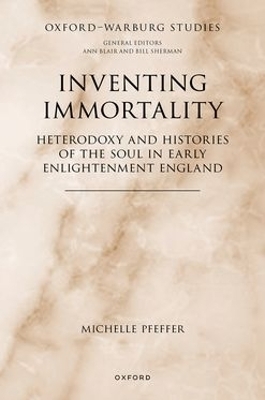
Inventing Immortality
Heterodoxy and Histories of the Soul in Early Enlightenment England
Seiten
2026
Oxford University Press (Verlag)
978-0-19-898920-2 (ISBN)
Oxford University Press (Verlag)
978-0-19-898920-2 (ISBN)
- Noch nicht erschienen (ca. März 2026)
- Versandkostenfrei
- Auch auf Rechnung
- Artikel merken
Around 1700, England saw a heated public debate about the soul's immortality. Two unlikely figures--a lawyer and a physician--claimed this belief was a pagan invention and wrongly adopted by Christianity. This book explores how everyday readers reshaped big debates, revealing the early Enlightenment as a remix of old arguments in new hands.
In the decades either side of 1700, England witnessed a major public debate about the immortality of the soul. At its centre were two unlikely figures: the lawyer Henry Layton and the physician William Coward. Across numerous publications, both argued that the soul's immortality was a pagan invention absent from early scripture and only later absorbed into Christianity. Their detailed histories of the soul aimed to recast it as an inescapably human creation, rather than a natural and revealed truth.
Though often seen as the product of radical freethinking circles, Layton and Coward's histories drew directly on scholarly commonplaces that they simply reassembled and repurposed. Economic, social, and cultural shifts across the seventeenth century had made academic scholarship more accessible than ever, enabling a growing number of non-specialists to participate in scholarly debates that were now more firmly in the public sphere. The derivative nature of their work should not see writers like Layton and Coward dismissed as mere hacks. Technical proficiency does not automatically confer historical significance, nor does its absence preclude it. Layton and Coward's contributions to the debate about the soul were amateurish and, to specialist scholars at the time, unsurprising. Yet they helped push scholarship in new directions. The impact of ideas depends as much on the context of their circulation as on their originality and rigour.
Rather than portraying the heterodox publications of the period c.1700 as the 'unintended consequences' of scholarship, this book presents a more dynamic model: a feedback loop between lay and specialist knowledge, in which amateur contributions actively shaped scholarly debates. The early Enlightenment, this book suggests, may be best understood less in terms of substantive new ideas, and more in the repackaging of older ones, with different targets, by different sorts of people, for different audiences.
In the decades either side of 1700, England witnessed a major public debate about the immortality of the soul. At its centre were two unlikely figures: the lawyer Henry Layton and the physician William Coward. Across numerous publications, both argued that the soul's immortality was a pagan invention absent from early scripture and only later absorbed into Christianity. Their detailed histories of the soul aimed to recast it as an inescapably human creation, rather than a natural and revealed truth.
Though often seen as the product of radical freethinking circles, Layton and Coward's histories drew directly on scholarly commonplaces that they simply reassembled and repurposed. Economic, social, and cultural shifts across the seventeenth century had made academic scholarship more accessible than ever, enabling a growing number of non-specialists to participate in scholarly debates that were now more firmly in the public sphere. The derivative nature of their work should not see writers like Layton and Coward dismissed as mere hacks. Technical proficiency does not automatically confer historical significance, nor does its absence preclude it. Layton and Coward's contributions to the debate about the soul were amateurish and, to specialist scholars at the time, unsurprising. Yet they helped push scholarship in new directions. The impact of ideas depends as much on the context of their circulation as on their originality and rigour.
Rather than portraying the heterodox publications of the period c.1700 as the 'unintended consequences' of scholarship, this book presents a more dynamic model: a feedback loop between lay and specialist knowledge, in which amateur contributions actively shaped scholarly debates. The early Enlightenment, this book suggests, may be best understood less in terms of substantive new ideas, and more in the repackaging of older ones, with different targets, by different sorts of people, for different audiences.
Michelle Pfeffer is a historian of science and religion in the early modern period. She received a BA (Hons.) in History from The University of Queensland (UQ), and an MSc in History of Science, Medicine and Technology from the University of Oxford, for which she won the Charles Webster Prize. After completing her PhD in History at UQ, she was a Fellow by Examination at Magdalen College, Oxford. She now holds a postdoctoral research fellowship in the Calleva Centre at Magdalen. Her articles have appeared in Past and Present and The Historical Journal, and she regularly writes for public audiences.
| Erscheint lt. Verlag | 26.3.2026 |
|---|---|
| Zusatzinfo | 4 b&w illustrations |
| Verlagsort | Oxford |
| Sprache | englisch |
| Maße | 156 x 234 mm |
| Themenwelt | Geschichte ► Allgemeine Geschichte ► Mittelalter |
| Geschichte ► Teilgebiete der Geschichte ► Religionsgeschichte | |
| Geisteswissenschaften ► Sprach- / Literaturwissenschaft ► Anglistik / Amerikanistik | |
| Geisteswissenschaften ► Sprach- / Literaturwissenschaft ► Literaturwissenschaft | |
| ISBN-10 | 0-19-898920-2 / 0198989202 |
| ISBN-13 | 978-0-19-898920-2 / 9780198989202 |
| Zustand | Neuware |
| Informationen gemäß Produktsicherheitsverordnung (GPSR) | |
| Haben Sie eine Frage zum Produkt? |
Mehr entdecken
aus dem Bereich


aus dem Bereich
Geschichte einer Augsburger Familie (1367-1650)
Buch | Softcover (2024)
Kohlhammer (Verlag)
CHF 47,60
der epische Kampf um das Heilige Land
Buch | Hardcover (2025)
C.H.Beck (Verlag)
CHF 49,95


