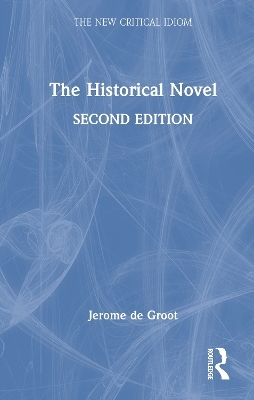
The Historical Novel
Routledge (Verlag)
978-1-032-44348-5 (ISBN)
- Noch nicht erschienen (ca. März 2026)
- Versandkostenfrei
- Auch auf Rechnung
- Artikel merken
In the second edition of The Historical Novel, Jerome de Groot expertly charts the evolution of one of literature's most beloved and complex forms. From its eighteenth-century origins to postmodern and contemporary historical fiction, de Groot reveals how historical fiction continues to challenge, provoke, and transform our understanding of the past.
The new edition has been thoroughly revised and expanded with global perspectives and new emphasis on the role and importance of female writers throughout. Readers will discover fresh insights on:
different genres, such as sensational or ‘low’ fiction, crime novels, literary works, counterfactual writing and related issues of audience, value, and authenticity;
the many functions of historical fiction, particularly the challenges it poses to accepted histories and postmodern questioning of ‘grand narratives’;
the relationship of the historical novel to the wider cultural sphere with reference to historical theory, the internet, television, and film;
key theoretical concepts such as the authentic fallacy, postcolonialism, Marxism, Neo-Victorian approaches, critical race theory, queer and feminist reading;
works which diversify our understanding of the form and reflect an increasing sense that the writer should be understood as intervening in historical debates—including the work of Hilary Mantel, Toni Morrison, Sylvia Townsend Warner, W.G. Sebald, Chinua Achebe, Sarah Waters, Amitav Ghosh, George Eliot, and Leo Tolstoy.
Drawing on a wide range of examples from across the centuries and around the globe, the second edition of The Historical Novel is essential reading for exploring the rich intersection where history meets fiction—a creative borderland where the past continues to be reimagined.
Jerome de Groot is Professor of Literature and Culture at University of Manchester, UK. He is the author of Consuming History: Historians and Heritage in Contemporary Popular Culture, Second Edition (2016), Remaking History: The Past in Contemporary Historical Fictions (2016), and Double Helix History: Genetics and the Past (2023).
Series Editor’s Preface
Acknowledgements
Introduction: The Historical Novel NOW
Chapter 1 Early Manifestations and Some Definitions
Jane Porter and Maria Edgeworth
Sir Walter Scott: The Waverley Novels
Theoretical Paradigms: Franco Moretti and Distant Reading
Chapter 2: Developments and expansion
Novelist as Theorist: Alessandro Manzoni
Mary Shelley: romance and temporal experiment
History, theory, popularity
Charlotte Brönte’s experimentation
Novelist as Theorist: George Eliot and realism
The historical novel in America
African American historical novels
Huckleberry Finn, race, and history
Novelist as Theorist: Leo Tolstoy
Chapter 3: Into the Twentieth Century
Theories of the Historical Novel During the Twentieth Century
Theoretical Paradigms: Georg Lukács
Modernism and The End-Of-History Novel
Novelist as theorist: Sylvia Townsend Warner
Chapter 4: Through the century: Romance and Postmodernism
Historical romance
Theoretical Paradigms: Diana Wallace
Postmodernism and Metafiction
Theoretical Paradigms: Linda Hutcheon
Umberto Eco, The Name of the Rose and Detective Fiction
‘Tap-Dancing on the Edge of the Abyss’: Problematising Postmodernism Through History
Chapter 5: History from the mid-1990s and the post-2000 boom
Novelist as Theorist: Hilary Mantel
New apparatuses and support mechanisms for historical fictions
New and expanded genres
Crime Fiction
Fantasy and alternative histories
Writing the immediate past and the art of simultaneity
Rewriting: revision and parody
The Neo-Victorian, and the Neo-Historical
Novelist as Theorist: W.G. Sebald
Chapter 6: Undoing History
Conservative Historical Fiction
Reclaiming Black and Indigenous histories in America
Novelist as Theorist: Toni Morrison
Reclaiming narratives and rewriting the past
Challenging colonial temporality
Senegalese historical fiction
Novelist as Theorist: Chinua Achebe and anti-colonial writing
Rewriting the past
Theoretical Paradigms: Trauma Theory
New genealogies and roots
Magical Realism and History
Sexual and Gender Diversity in/ and historical novels
Novelist as Theorist: Sarah Waters
Theoretical paradigms: Trans
Climate Emergency and Climate Fiction
Novelist as Theorist: Amitav Ghosh
Appendix: Ways of approaching an historical novel
Bibliography
Index
| Erscheint lt. Verlag | 26.3.2026 |
|---|---|
| Reihe/Serie | The New Critical Idiom |
| Verlagsort | London |
| Sprache | englisch |
| Maße | 129 x 198 mm |
| Themenwelt | Geisteswissenschaften ► Sprach- / Literaturwissenschaft ► Anglistik / Amerikanistik |
| Geisteswissenschaften ► Sprach- / Literaturwissenschaft ► Literaturwissenschaft | |
| ISBN-10 | 1-032-44348-0 / 1032443480 |
| ISBN-13 | 978-1-032-44348-5 / 9781032443485 |
| Zustand | Neuware |
| Informationen gemäß Produktsicherheitsverordnung (GPSR) | |
| Haben Sie eine Frage zum Produkt? |
aus dem Bereich