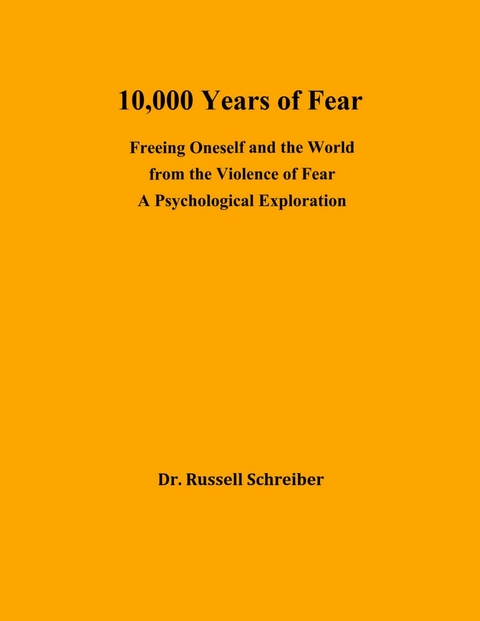
10,000 Years of Fear (eBook)
424 Seiten
Bookbaby (Verlag)
979-8-3178-1201-0 (ISBN)
Dr. Schreiber has over 40 years of experience supporting people in their process of inner growth. As a clinical psychologist with a PsyD, an M.A. in Clinical Psychology, and an M.A. in Counseling Psychology, he has explored fear in personal and group work in clinical settings. His psychological skills were honed as a clinical psychologist in private practice and as a staff psychologist supervising and training psychotherapists and interns at a large psychotherapy clinic in Northern California. An important mistake he explores is that human beings fail to correctly understand the role of fear in their lives. Humanity's intention has always been to get rid of fear. These attempts to get rid of fear, to bypass it, to distract from it and a host of other ways of dealing with fear, have missed the mark. His work has led him to explore fear deeply to understand its purpose and leads directly to self-understanding and self-compassion. In current psychotherapy, the client, therapist, medical practitioners and pharmaceutical companies are each coerced to get rid of a patient's fear. This tendency has not produced an objective and useful understanding of fear, but rather has suppressed a real understanding of fear and causes fear to be acted out symptomatically and even violently. Likewise, nations are led by politicians who use fear to maintain power and artificially demonstrate to citizens how they will stop fear by the development of armies and military weapons. These behaviors may stave off fear, but often result in violence or war. A new way to work with fear is required if we are going to understand and transform the violence that fear breeds worldwide. Dr. Schreiber's work is concerned with teaching individuals and groups new respect and understanding of fear and prompts them to study it in themselves. This study can lead to greater self-compassion and compassion for others. Such self-study and understanding of fear can foster an alternative remedy to the violence that grips our planet.
One of the areas of human study that is insufficiently explored is human fear and how fear has shaped the world we live in. The exploration in this book is just a beginning point and hopefully acts as an impetus for others to explore how fear may be a primary cause of the violence that exists on this planet. It is not quite as simple as it appears at first, and most people will say, of course, fear causes violence. I have found that the root reasons for fear causing violence are not to be found in economic, social, or historical development, but rather it is psychological-this is a case where the psychology of human beings is the primary determinant of the human reaction to fear that has spawned our violent world. My exploration has shown me that there is a maladaptive way human beings react to the emotion fear there is a "e;glitch"e; in the human fear reaction. I will explain the underlying causes for this "e;glitch"e; and how it has caused the catastrophic, violent behavior of human beings toward one another.
Chapter 1: The Basics of Fear
Some Preliminary Concepts that serve as seeds to help understanding grow:
Fear is ancient. It is an instinctive animal survival reaction connected to our need for safety.
Fear versus Anxiety
Both fear and anxiety are real and important states of being. Survival fear is usually a temporary experience activated by a particular situation, such as being caught out in a storm or seeing a lightning strike and being afraid of being hit by lightning. Fear usually has a definite set of memories and stimuli that activate it, and it lasts for a limited amount of time. When I see a bicyclist riding in traffic, and he doesn’t seem to be paying attention, it triggers my own memories of bicycling. I remember riding my bike as a boy, losing control and, running into the side of a bus and hurting myself. Even now, I see the green side of the bus coming up at me and flying over the handlebars and hitting my head. This memory of the experience and fear is triggered, and then it is over for me.
Anxiety can last much longer and, as such, is a more difficult state to escape from, as it may or may not be tied to specifically identifiable stimuli or situations, or it can be the result of many small fears. Free-floating anxiety is not necessarily tied to any particular stimulus and can be extremely debilitating and difficult to deal with since its many antecedent causes live in a person’s past and may not be easily remembered.
Fear and anxiety can also activate and augment each other. Many anxious people use a few glasses of wine or a couple of hits of marijuana in the evening to reduce or numb the part of them that may activate their anxiety. It is important to note that such methods of reducing anxiety in these ways depend on an outside element, a drug for example. These methods bypass the potential for an individual to learn about and understand their anxiety. When anxiety becomes too much, then methods of numbing it can become problematic and include just about anything from drugs and gambling to shopping, opioid addiction, or domestic violence. Certain individuals who lack self-control may attack another person or, in extreme cases, kill them. In certain situations, when anxiety becomes too much for a person and has worked its way into their life so that they feel it continually, they may or may not even be aware of its effects. In any case, this anxiety has definite hormonal, emotional and physical effects on the body. Anxiety can also perpetuate wasteful cognitive patterns, dysfunctional behavior, and mental dissociation and confusion that can become debilitating.
Many people simply find ways to reduce their stress, anxieties and fear through drugs or substances that numb them and make their lives manageable. California, where I live, is filled with functional alcoholics, functional cannabis users and anxiety pill poppers of every variety of pill. Additionally, many of these drugs enhance connectedness between people as they disinhibit their behavior and allow them to feel, socialize and connect with others more easily. I’ve had clients who socially are unable to interact with others unless they have a drink in their hands or take a hit of a joint. They may feel that the connectedness they want with their partner or others is missing or impossible for them to find unless they “take the edge off” their stress.
A beginning question for us is where does anxiety come from, and is it just a lower intensity of fear? In my experience with clients, anxiety results from fears a specific part of them has about a situation or memory that a part of them either represses or suppresses. It is important here that I confess that I have found that anxiety of fear is not really the result of the whole person feeling fear, but rather that a particular part of them, you might call it a subpart of their personality, carries or reacts fearfully. I will speak more of this gradually.
Repression of fear means that a person is unaware that there is a holding back or pressing down their fear. The repression takes place unconsciously in a part of them, and they remain relatively unaware of it. A person may also have a part of them that suppresses their fear intentionally and finds ways that work to get away from the fear this part feels. This part may distract them from the anxiety that has been triggered by going to a movie, drinking, or buying things, to name just a few ways we distract ourselves. They may realize that they are afraid and know these distractions help them to cope. In repression of fear, where the fear is not recognized by the person consciously, they are unable to experience their fear, remain unaware of it and the behavior it may be linked to. We have many parts that attempt to protect us from our fears and other parts that step in to distract us or manage fear when it is triggered.
However, in either case of repression or suppression of fear, the emotion fear is still experienced in the body. In the body, fear is bound up by muscles that remain in a contracted state in an attempt not to feel anticipated pain. Eventually, our muscles may not be able to hold the tension caused by attempting to block the anticipated pain of fear. Then, fear in the form of emotional stress breaks through and affects our emotional state regardless of whether you want to experience your fear or not. Small fears constantly breaking through this way result in the feeling of anxiety. When clients come into my office with anxiety, the first thing I often say is anxiety is not necessarily a bad thing and may be a positive sign that they need to turn toward their fear and understand what is really bothering them.
Anxiety is not always negative and can be very useful if it makes me cautious in a dangerous situation. If I’m on a difficult hiking trail where I might fall, I need to be extra
careful. If being questioned by a lawyer, I need to be careful and thoughtful in how I answer questions. If my child is being bullied in school, I need to be sensitive to his or her anxiety and take it seriously. All the latter situations can make one anxious. Conversely, severe anxiety can make a person completely non-functional and result in a myriad of psychological disorders such as phobias of every type, depression and—in extreme cases— suicide. I have seen many depressed people over the years who speak quite a bit about their suicidal thoughts, and yet I am rarely as concerned about them as I am about a highly anxious person who is unable to get any relief from their anxiety. I find them at much greater risk of actually taking their lives as a means to escape from anxiety.
Being able to distinguish internally what is fear and what is anxiety helps you get a better understanding of how you react to these difficult emotions and their effects on your body and mind.
Panic Attack
In a severe case of anxiety called a “panic attack,” it is not uncommon for a person to interpret the muscular contractions in their upper chest as a symptom of having a heart attack. Contractions in their chest muscles may be the result of stress that they are under. Stress causes people to tense their diaphragm and chest muscles and often results in their taking in less oxygen since their lungs cannot expand to normal capacity during inhalation. The lack of oxygen increases levels of lactate and carbon dioxide in their blood, and if the levels rise sufficiently, it makes them feel as though they are suffocating. When this happens, a person can overreact by hyperventilating (breathing too quickly and shallowly), subsequently causing a too-rapid lowering of carbon dioxide levels and increasing phosphates in the bloodstream. With continued hyperventilation, carbon dioxide buildup may rise dramatically, causing the sympathetic nervous system to react. Then, the heart rate goes up, and respirations increase, but you are still not getting enough oxygen. Along with these physiological reactions are the psychological fear reactions to bodily sensations that may further confirm you are having a heart attack; you may perspire heavily and become hyper-vigilant of small somatic changes in your body. Then, you are in a panic attack, an anticipatory attack that something bad is happening to you.
I explain to clients who suffer from panic attacks that during a panic attack, their oxygen intake is unintentionally reduced by the constriction of their chest muscles due to anxiety. Then, the body’s automatic reaction to reduced oxygen causes them to breathe faster, and they end up hyperventilating, which makes them feel light-headed as if they may faint. I further explain that if, in fact, they passed out, then their more primitive hindbrain (functions of sleep, respiration, motor coordination and organization, and reflexes) would know everything was alright due to relaxation of their breathing muscles, allowing normal oxygen intake to resume; they would then wake up and recover from their faint. However, people rarely faint, and instead, they rush to an emergency room believing they are dying. Once there, they are usually told, no, you are not having a heart attack or dying, but you are having a panic attack.
If you have a panic attack, one way to handle it is as follows: you are in the attack and feel like you are going to pass out or have a heart attack—simply breathe slowly and focus your attention on the air going in and out of your nostrils. If your attention has something to concentrate on other than your fear of dying, your faculty of attention being used in this way is actually calming, and normal breathing informs the hindbrain that all is well and the muscles of the neck, throat, chest and others relax. What is important here for our study is that anxiety or fear causes muscular contraction. In the case...
| Erscheint lt. Verlag | 18.9.2025 |
|---|---|
| Sprache | englisch |
| Themenwelt | Geisteswissenschaften ► Psychologie ► Sozialpsychologie |
| ISBN-13 | 979-8-3178-1201-0 / 9798317812010 |
| Informationen gemäß Produktsicherheitsverordnung (GPSR) | |
| Haben Sie eine Frage zum Produkt? |
 EPUB (Ohne DRM)
Größe: 738 KB
Digital Rights Management: ohne DRM
Dieses eBook enthält kein DRM oder Kopierschutz. Eine Weitergabe an Dritte ist jedoch rechtlich nicht zulässig, weil Sie beim Kauf nur die Rechte an der persönlichen Nutzung erwerben.
Dateiformat: EPUB (Electronic Publication)
EPUB ist ein offener Standard für eBooks und eignet sich besonders zur Darstellung von Belletristik und Sachbüchern. Der Fließtext wird dynamisch an die Display- und Schriftgröße angepasst. Auch für mobile Lesegeräte ist EPUB daher gut geeignet.
Systemvoraussetzungen:
PC/Mac: Mit einem PC oder Mac können Sie dieses eBook lesen. Sie benötigen dafür die kostenlose Software Adobe Digital Editions.
eReader: Dieses eBook kann mit (fast) allen eBook-Readern gelesen werden. Mit dem amazon-Kindle ist es aber nicht kompatibel.
Smartphone/Tablet: Egal ob Apple oder Android, dieses eBook können Sie lesen. Sie benötigen dafür eine kostenlose App.
Geräteliste und zusätzliche Hinweise
Buying eBooks from abroad
For tax law reasons we can sell eBooks just within Germany and Switzerland. Regrettably we cannot fulfill eBook-orders from other countries.
aus dem Bereich