


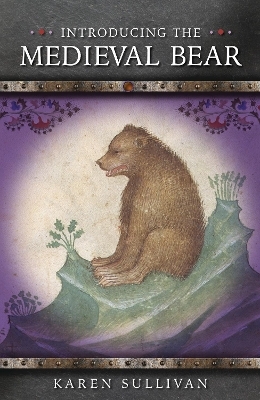
Introducing the Medieval Bear
Seiten
2026
University of Wales Press (Verlag)
978-1-83772-375-1 (ISBN)
University of Wales Press (Verlag)
978-1-83772-375-1 (ISBN)
- Noch nicht erschienen (ca. Juli 2026)
- Portofrei ab CHF 40
- Auch auf Rechnung
- Artikel merken
Since the Middle Ages, bears have most frequently been seen as objects. For many centuries, Europeans regarded bears as pests to be eradicated because of the danger they posed to human beings and livestock, whilst in recent decades they have increasingly been seen as victims to be protected from human violence. When a bear attacks, the contemporary response is typically to blame human beings’ failure, either to signal their presence in bears’ habitats or to bear-proof their backyards. For climate change activists, the polar bear has become emblematic of the threat posed by humans to the natural world, even though the polar bear’s population has steadily increased in recent times. At two extremes, bears have been objects of predation or pity.
In medieval times, however, bears were not objects but subjects viewed as creatures of God. They were seen as being in possession of something analogous to rationality, which enabled them to display surprising intelligence: as warriors endowed with both strength and courage to which humans could only aspire; as fierce competitors in bear-baiting spectacles, like prize-fighters engaged in a bloody sport; or as lovers, inclined to abduct women and have children with them. People treated bears as they expected to be treated themselves, and expected them to behave as humans would; not as passive victims of human action, but as active subjects.
In medieval times, however, bears were not objects but subjects viewed as creatures of God. They were seen as being in possession of something analogous to rationality, which enabled them to display surprising intelligence: as warriors endowed with both strength and courage to which humans could only aspire; as fierce competitors in bear-baiting spectacles, like prize-fighters engaged in a bloody sport; or as lovers, inclined to abduct women and have children with them. People treated bears as they expected to be treated themselves, and expected them to behave as humans would; not as passive victims of human action, but as active subjects.
Karen Sullivan is the Irma Brandeis Professor of Romance Culture and Literature at Bard College. She is the author of several books on medieval literature and history, many published by the University of Chicago Press.
List of Illustrations
List of Abbreviations
Introduction
1. Bears as Creatures of God
2. Bears as Warriors, Warriors as Bears
3. Bears as Ravishers, Bears as Lovers
4. Bears as Hunters, Bears as Hunted
5. Bears as Entertainers
Conclusion
Selected Bibliography
Index
| Erscheint lt. Verlag | 20.7.2026 |
|---|---|
| Reihe/Serie | Medieval Animals |
| Zusatzinfo | Not illustrated |
| Verlagsort | Wales |
| Sprache | englisch |
| Maße | 129 x 198 mm |
| Themenwelt | Geschichte ► Allgemeine Geschichte ► Mittelalter |
| Geisteswissenschaften ► Geschichte ► Regional- / Ländergeschichte | |
| Geisteswissenschaften ► Sprach- / Literaturwissenschaft ► Anglistik / Amerikanistik | |
| Geisteswissenschaften ► Sprach- / Literaturwissenschaft ► Literaturwissenschaft | |
| ISBN-10 | 1-83772-375-3 / 1837723753 |
| ISBN-13 | 978-1-83772-375-1 / 9781837723751 |
| Zustand | Neuware |
| Informationen gemäß Produktsicherheitsverordnung (GPSR) | |
| Haben Sie eine Frage zum Produkt? |
Mehr entdecken
aus dem Bereich



aus dem Bereich
Geschichte einer Augsburger Familie (1367-1650)
Buch | Softcover (2024)
Kohlhammer (Verlag)
CHF 47,60


