


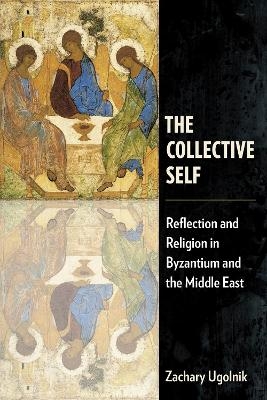
The Collective Self
Reflection and Religion in Byzantium and the Middle East
Seiten
2026
Fordham University Press (Verlag)
978-1-5315-1419-8 (ISBN)
Fordham University Press (Verlag)
978-1-5315-1419-8 (ISBN)
- Noch nicht erschienen (ca. August 2026)
- Versandkostenfrei
- Auch auf Rechnung
- Artikel merken
Reveals a conception of selfhood in Byzantine and Middle-Eastern sources that is fundamentally collective rather than merely individual, challenging Western-centric narratives of the modern self and enriching contemporary discussions on communal ways of being.
What if the story we tell ourselves about of the modern self is incomplete? The Collective Self challenges narrow histories of Western selfhood that limit our understanding of both past and present.
Drawing on mirror imagery as a unifying thread, this book brings overlooked sources from the eastern Mediterranean, Middle East, and Orthodox Christian tradition into conversation with Western genealogies of "knowing thyself." Reflections and mirrors—an ancient technology—become embedded in discussions of self-knowledge. From the Odes of Solomon and Plotinus's Enneads to the writings of Evagrius, Athanasius, and Ephrem the Syrian, concluding with medieval Syriac writers and a few emblematic Sufi sources, Ugolnik reveals a conception of selfhood that is fundamentally collective rather than merely individual.
The Collective Self intervenes in current debates about embodiment, interdependence, and communion by demonstrating that reflexivity and communal selfhood are not exclusively modern or post-modern innovations. By highlighting optical theories that allow convergence in perception and embodied notions of the self, this book problematizes the assumption that introspection is only mental or individual and challenges typical associations of what is ancient or modern, Eastern or Western.
In these texts, mirror imagery articulates a convergence of gazes between oneself, the divine, and glorified beings—what Ugolnik calls "I and We." This synthesis occurs through communal practices of prayer, liturgy, psalm and hymn singing that create pathways for practitioners to participate in each other's subjectivity across space and time.
As we enter a new bio-technological and computational age, this alternative history of self-reflection offers vital resources for imagining more inclusive models of identity, empathy, and collective flourishing—reminding us that technology has long served as a medium for understanding who we are.
What if the story we tell ourselves about of the modern self is incomplete? The Collective Self challenges narrow histories of Western selfhood that limit our understanding of both past and present.
Drawing on mirror imagery as a unifying thread, this book brings overlooked sources from the eastern Mediterranean, Middle East, and Orthodox Christian tradition into conversation with Western genealogies of "knowing thyself." Reflections and mirrors—an ancient technology—become embedded in discussions of self-knowledge. From the Odes of Solomon and Plotinus's Enneads to the writings of Evagrius, Athanasius, and Ephrem the Syrian, concluding with medieval Syriac writers and a few emblematic Sufi sources, Ugolnik reveals a conception of selfhood that is fundamentally collective rather than merely individual.
The Collective Self intervenes in current debates about embodiment, interdependence, and communion by demonstrating that reflexivity and communal selfhood are not exclusively modern or post-modern innovations. By highlighting optical theories that allow convergence in perception and embodied notions of the self, this book problematizes the assumption that introspection is only mental or individual and challenges typical associations of what is ancient or modern, Eastern or Western.
In these texts, mirror imagery articulates a convergence of gazes between oneself, the divine, and glorified beings—what Ugolnik calls "I and We." This synthesis occurs through communal practices of prayer, liturgy, psalm and hymn singing that create pathways for practitioners to participate in each other's subjectivity across space and time.
As we enter a new bio-technological and computational age, this alternative history of self-reflection offers vital resources for imagining more inclusive models of identity, empathy, and collective flourishing—reminding us that technology has long served as a medium for understanding who we are.
Zachary Ugolnik is a scholar and writer specializing in interdisciplinary approaches to life’s biggest questions. He currently works in philanthropy at the intersection of the social sciences, philosophy, and theological studies. He earned his master’s from Harvard University and his Ph.D. from Columbia University’s religion department. He has co-edited and authored scholarly articles in outlets such as Dædalus, The Journal of Religion, Religion & Literature, and Harvard Divinity Bulletin.
| Erscheint lt. Verlag | 4.8.2026 |
|---|---|
| Reihe/Serie | Orthodox Christianity and Contemporary Thought |
| Zusatzinfo | 7 b/w illustrations |
| Verlagsort | New York |
| Sprache | englisch |
| Maße | 152 x 229 mm |
| Themenwelt | Geisteswissenschaften ► Geschichte ► Regional- / Ländergeschichte |
| Geisteswissenschaften ► Philosophie ► Philosophie Altertum / Antike | |
| Geisteswissenschaften ► Religion / Theologie | |
| ISBN-10 | 1-5315-1419-7 / 1531514197 |
| ISBN-13 | 978-1-5315-1419-8 / 9781531514198 |
| Zustand | Neuware |
| Informationen gemäß Produktsicherheitsverordnung (GPSR) | |
| Haben Sie eine Frage zum Produkt? |
Mehr entdecken
aus dem Bereich


aus dem Bereich
die Geschichte meiner Urgroßmutter
Buch | Hardcover (2025)
C.H.Beck (Verlag)
CHF 32,15
Träume und Macht : eine Biografie
Buch | Hardcover (2025)
C.H.Beck (Verlag)
CHF 61,60


