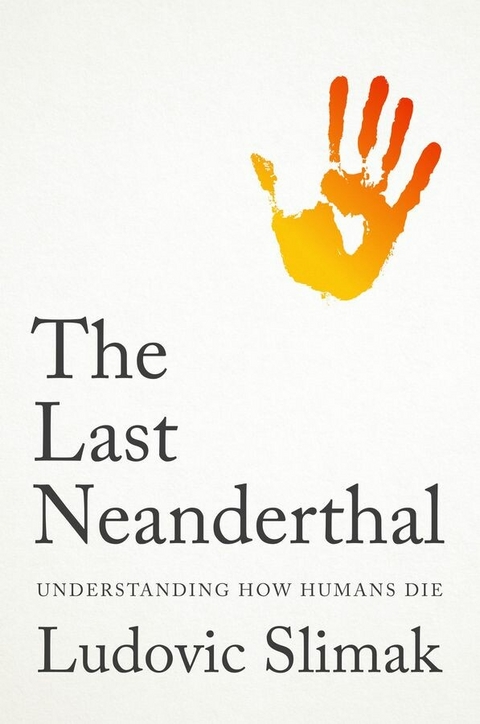
The Last Neanderthal (eBook)
287 Seiten
Polity (Verlag)
978-1-5095-6959-5 (ISBN)
Slimak takes the reader on an extraordinary journey of discovery that is both scientific and profoundly human, blending rigorous research with evocative storytelling. This breathtaking exploration of the past not only unearths the lost world of the Neanderthals but forces us to confront the unspoken question: is this how humanity dies?
A compelling narrative spanning millennia, The Last Neanderthal is both a groundbreaking scientific revelation and a profound reflection on the fragility of humanity and the threads that connect us to the distant past.
Ludovic Slimak is a paleoanthropologist at the University of Toulouse.
1
Unexpected complications on the way to the unthought
Boldly risking a step into the unknown
In old Neanderthal caves there’s something uncertain about the smell of earth and flint. It is decaying, dry and damp at the same time, a bit like the smell of broken spring soil; a place where the living and the dead grow out of each other and can thus give voice.
Something almost unpleasant, but something that still makes you want to smell it again, to come back to it. As if to remember that scent, quite unlike anything else. Is it the scent of millennia? From all the cooking, the rotting, the infinite amount of stuff left behind, emitting this little whiff of sourness? All those bones, that bone dust, that humus of meat. Those thousands of generations of love; those thousands of generations of death.
I don’t know. Maybe those smells aren’t so old, when you think about it. Maybe they just indicate recent putrefaction, all those bacterial decompositions, those mosses, those algae and all the modest life of cave floors? There are things happening in these soils. There is nothing inert about them: they continue their small lives, quietly, at their microbial pace. These invisible lives are all around us.
But, for some time now, there is something else. It’s no longer the familiar harsh little smell that invades my olfactory space when I dig around in the ancient Neanderthal soils.
Something else haunts these places.
Regularly, or rather just occasionally, powerful smells of grilling emerge from the soils I’m digging in. It’s … how can I put it? – like fire, burning, ash, coal. No. No. It’s not really that. It’s stronger, more intoxicating. Like … Like a gamey aroma. Yes, that’s it, grilled flesh, charred game, burnt fat. Yes, a powerful smell of grilled game. The smell seems to emerge from the ground so strongly that, for a moment, the air is almost unbreathable. And the smells vary from place to place and with the depth of my digging. Here, there’s something soft, almost subtle, about it: but a few days later, in a different area of the cave and in older soils, the smell of charred flesh is so strong that for short moments I stop digging. I breathe it in, trying to find where these incredible aromas come from. How on earth? We are on archaeological soils that are more than fifty-five millennia old. What’s going on with these prehistoric odours? Neanderthal smells. It makes no sense. And yet, they’re here, powerful, obvious, unavoidable – and I don’t know what it means. No one has ever reported smells from the age-old depths of caves. But these smells suddenly permeate the entire space, without warning, and disappear just as quickly. But they’re certainly here. I can’t pretend otherwise. I can’t deny them. Something has survived and still haunts these places. Something still breathes this life of yesteryear, and one’s nose isn’t mistaken. It seems insane, but we have to deal with it. That’s how it is. Odours clearly linked to the activities of Neanderthal populations have transgressed time, inviting themselves to gather around us tens of millennia later.
But these conclusions, this awareness, became clear to me only in 2006. I’d already been searching tirelessly in caves, three to four months a year, for almost fifteen years. Fifteen years of smelling without understanding and, more importantly, without accepting the facts. In fact, I think my senses perceived it, that’s clear enough; but the impossibility of the situation stopped me from becoming fully aware of an objective reality. That’s the whole problem in science. We do science only when we take a step into the unknown. When we agree to consider a possibility that doesn’t seem reasonable. When we consider a solution that instinctively seems a little ridiculous. But doing science isn’t dressing up in a white coat and running computers to crack infinite equations. In the first instance, doing science is considering the improbable. The instinctively ridiculous. And taking this leap into the void. And the problem is the way we rely on a parachute. On all the unconscious presuppositions that muffle our thinking, bringing it delicately back down into our comfort zones. The leap into the unknown isn’t just painful; it’s a fight against ourselves, against the countless filters that frame us, supervise us, police us, prevent us from thinking in real freedom; prevent us for fifteen years from understanding that it smells like … grilled game, for heaven’s sake! That it smells horribly like game. The brain filters things, brings us back to the familiar. Always. Back to the possible. Back to the reasonable, the reassuring. I thought I was free. We always think we’re free, in general. But we’re always prisoners of ourselves. However, we have to take it, sometimes – this risky step into the unknown. Accepting this transgression should constitute the first lesson of scientific thought. Learning to free ourselves, to reject our logic. No longer to reject the impossible. To revise, at each step, the field of possibilities that frames us. To love doubt. Do you want to know what a true scientific discovery is? Well, it’s understanding something that seems impossible to us. More precisely, it’s the demonstration that something that seems a bit ridiculous, a bit laughable, is a reality. If the discovery doesn’t rub up against common sense, doesn’t chip away at it, you can be sure that the discovery is of very secondary importance. It doesn’t constitute a step. A crossing. If you transgress the common notion of reality, if the idea seems so ridiculous that you’d hardly dare to put it in words, then you’re touching on science. You’ve taken this step, this transgression towards the unknown. But, by definition, consciousness and common sense block information. They block any truly free thought. Don’t you forget it!
And then comes the slap in the face. At a certain point, the unconscious establishes connections. Serial connections. Calculations. Equations of which we have absolutely no perception and which, at the least expected moment, hand over the answer to consciousness. We don’t know why the answer arrives at this precise moment. And we don’t know why it took so long to express itself.
I remember that moment very precisely.
I was knees in the dirt, as usual; I got up, I picked up my bucket of fifty-thousand-year-old sand and I left the cave. I suddenly had a conviction that was both improbable and overwhelming, like the tunes you hear in the morning that cling to you, turn into ear-worms, going endlessly round and round. You see? I had to check. I had to test this strange conviction, this nagging idea. I sifted through these prehistoric sands, as usual, to be sure I hadn’t missed a bit of flint or a little piece of bone when digging through the archaeological soil. But, instead of throwing away the little stones, I kept them. I broke them open. I brought them up to my nose. I breathed them in. With each crack, with each rupture of the surfaces, an explosion of smells. The scents weren’t in the soil, they were frozen in the stone. These stones are fragments of the ancient vault of the cavern. They have fossilized all the soot deposited on the walls when the Neanderthals lit their fires in the cave. And, what I have before my eyes, after breaking my stones, is a real barcode of blacks and whites: the black of the soot, the white of the calcite concretions that cover them and fossilize them. They’re there, my smells, trapped in the stone, like an immaterial fossil. The fossil of past breaths.
It would take us more than ten years to get these black and white edges to speak but, from 2006 onwards, we had a gut feeling, a certainty, that we would be able to transgress time.1
Another place, another time?
It didn’t look like much, of course, I hadn’t just discovered the Sistine Chapel or Tutankhamun’s tomb, true – but these little pebbles would be one of the keys to rethinking the encounter between Neanderthals and that damned Sapiens.
Because, on these pebbles, it wasn’t just the smell that had been trapped. It was time.
When we archaeologists dig, we have no notion of time. No idea of the precise age of the flint object that we’ve just extracted from the earth. We measure, we date, using the formidable tool of carbon 14. Suddenly, we know that the last Neanderthal is forty-two thousand years old. We also know that the first Sapiens on this same territory is, likewise, forty-two thousand years old. But Neanderthal and Sapiens exist in time loops where the uncertainty factor is more or less one thousand years.
My little stones, my barcodes, would enable us to perceive real time, and no longer the time of physicists – they would mean we could, year after year, watch the seasons passing. The calcite gradually deposits itself on the walls, a thin layer in the dry season, a thin layer in the wet season and, for the first time there are human traces, trapped between these thin layers of stone. We could finally look at time and finally analyse Neanderthals in their temporal reality, in six-month steps. We’d probably never do any better than this astonishingly high degree of resolution, unless we invented the time machine. This wonderful scientific advance, fuliginochronology (from Latin...
| Erscheint lt. Verlag | 10.9.2025 |
|---|---|
| Übersetzer | Andrew Brown |
| Sprache | englisch |
| Themenwelt | Geisteswissenschaften ► Archäologie |
| Geisteswissenschaften ► Geschichte ► Allgemeines / Lexika | |
| Schlagworte | Anthropology • archaeological records • archaeology • could Homo sapiens become extinct? • Eurasian prehistory • exploring Neanderthal caves • Grotte Mandrin, France • Homo sapiens • how could Homo sapiens die out • how did the Neanderthals die out • Humankind • kinds of human • Ludovic Slimak's new book • modern human extinction • Neanderthal • Neanderthal technologies • Paleolithic Age • Scientific Discovery • The Naked Neanderthal • Thorin • were the Neanderthals intelligent • what do we know now about the Neanderthals • what is the newest research on human prehistory and Neanderthals • when did Neanderthals become extinct? • why did Neanderthals become extinct? |
| ISBN-10 | 1-5095-6959-6 / 1509569596 |
| ISBN-13 | 978-1-5095-6959-5 / 9781509569595 |
| Informationen gemäß Produktsicherheitsverordnung (GPSR) | |
| Haben Sie eine Frage zum Produkt? |
 EPUB (Adobe DRM)
Kopierschutz: Adobe-DRM
Adobe-DRM ist ein Kopierschutz, der das eBook vor Mißbrauch schützen soll. Dabei wird das eBook bereits beim Download auf Ihre persönliche Adobe-ID autorisiert. Lesen können Sie das eBook dann nur auf den Geräten, welche ebenfalls auf Ihre Adobe-ID registriert sind.
Details zum Adobe-DRM
Dateiformat: EPUB (Electronic Publication)
EPUB ist ein offener Standard für eBooks und eignet sich besonders zur Darstellung von Belletristik und Sachbüchern. Der Fließtext wird dynamisch an die Display- und Schriftgröße angepasst. Auch für mobile Lesegeräte ist EPUB daher gut geeignet.
Systemvoraussetzungen:
PC/Mac: Mit einem PC oder Mac können Sie dieses eBook lesen. Sie benötigen eine
eReader: Dieses eBook kann mit (fast) allen eBook-Readern gelesen werden. Mit dem amazon-Kindle ist es aber nicht kompatibel.
Smartphone/Tablet: Egal ob Apple oder Android, dieses eBook können Sie lesen. Sie benötigen eine
Geräteliste und zusätzliche Hinweise
Buying eBooks from abroad
For tax law reasons we can sell eBooks just within Germany and Switzerland. Regrettably we cannot fulfill eBook-orders from other countries.
aus dem Bereich