Zum Hauptinhalt springen
Nicht aus der Schweiz? Besuchen Sie lehmanns.de
Für diesen Artikel ist leider kein Bild verfügbar.

Spectator in the Cartesian Theater (eBook)

Where Theories of Mind Went Wrong since Descartes

(Autor)

eBook Download: PDF
2023
1 Seiten
Bloomsbury Publishing (USA) (Verlag)
978-1-9787-7246-5 (ISBN)
Systemvoraussetzungen
101,07 inkl. MwSt
(CHF 98,75)
Der eBook-Verkauf erfolgt durch die Lehmanns Media GmbH (Berlin) zum Preis in Euro inkl. MwSt.
  • Download sofort lieferbar
  • Zahlungsarten anzeigen
The "e;Cartesian Theater"e; is Dennett's famous metaphor for the idea that a homunculus or "e;little man"e; watches the screen on which our thoughts appear. However, contrary to much academic teaching and scholarship, Spectator in the Cartesian Theater: Where Theories of Mind Went Wrong since Descartes shows that Descartes was not guilty of this fallacy for which he has been blamed. In his physiological writings neglected by philosophers, Descartes explained that the pseudo-explanation arises not from what is included in our theory of consciousness, but rather from what is missing. We fail to notice that the theory is incomplete because we are intuitively doing part of the explanatory work. That is, we are the spectators in the Cartesian Theater.With detailed critiques, Peter Slezak shows that Searle's Chinese Room Argument, Kripke's theory of proper names, Davidson's semantics of natural language and Kosslyn's theory of visual imagery rely on what is intuitively meaningful to us rather than what follows from the theory. Slezak offers a novel solution to the elusive logic of the Cogito argument, showing it to be akin to the Liar Paradox. Since Descartes' perplexity is our own, this shows how the subjective certainty of consciousness and the mind-body problem can arise for a physical system. An intelligent computer would think that it isn't one.
Erscheint lt. Verlag 1.8.2023
Sprache englisch
Themenwelt Geisteswissenschaften Philosophie Sprachphilosophie
Geisteswissenschaften Psychologie Allgemeine Psychologie
Geisteswissenschaften Psychologie Verhaltenstherapie
ISBN-10 1-9787-7246-7 / 1978772467
ISBN-13 978-1-9787-7246-5 / 9781978772465
Informationen gemäß Produktsicherheitsverordnung (GPSR)
Haben Sie eine Frage zum Produkt?
PDFPDF (Adobe DRM)

Kopierschutz: Adobe-DRM
Adobe-DRM ist ein Kopierschutz, der das eBook vor Mißbrauch schützen soll. Dabei wird das eBook bereits beim Download auf Ihre persönliche Adobe-ID autorisiert. Lesen können Sie das eBook dann nur auf den Geräten, welche ebenfalls auf Ihre Adobe-ID registriert sind.
Details zum Adobe-DRM

Dateiformat: PDF (Portable Document Format)
Mit einem festen Seiten­layout eignet sich die PDF besonders für Fach­bücher mit Spalten, Tabellen und Abbild­ungen. Eine PDF kann auf fast allen Geräten ange­zeigt werden, ist aber für kleine Displays (Smart­phone, eReader) nur einge­schränkt geeignet.

Systemvoraussetzungen:
PC/Mac: Mit einem PC oder Mac können Sie dieses eBook lesen. Sie benötigen eine Adobe-ID und die Software Adobe Digital Editions (kostenlos). Von der Benutzung der OverDrive Media Console raten wir Ihnen ab. Erfahrungsgemäß treten hier gehäuft Probleme mit dem Adobe DRM auf.
eReader: Dieses eBook kann mit (fast) allen eBook-Readern gelesen werden. Mit dem amazon-Kindle ist es aber nicht kompatibel.
Smartphone/Tablet: Egal ob Apple oder Android, dieses eBook können Sie lesen. Sie benötigen eine Adobe-ID sowie eine kostenlose App.
Geräteliste und zusätzliche Hinweise

Buying eBooks from abroad
For tax law reasons we can sell eBooks just within Germany and Switzerland. Regrettably we cannot fulfill eBook-orders from other countries.

Mehr entdecken
aus dem Bereich
Wie Worte ausgrenzen, abwerten und manipulieren

von Tim Henning; Nikola Anna Kompa; Christian Nimtz

eBook Download (2025)
C.H.Beck (Verlag)
CHF 21,45
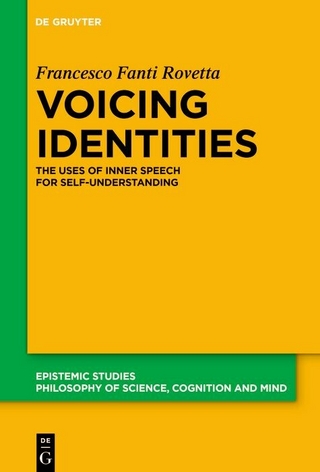
The Uses of Inner Speech for Self-Understanding

von Francesco Fanti Rovetta

eBook Download (2024)
Walter de Gruyter GmbH & Co.KG (Verlag)
CHF 117,15