


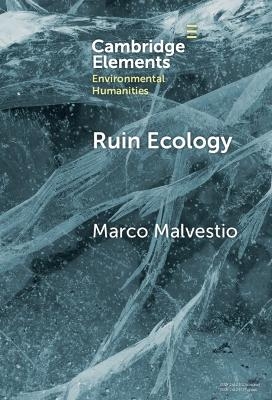
Ruin Ecology
An Exercise in Environmental Imagination
Seiten
2025
Cambridge University Press (Verlag)
978-1-009-68302-9 (ISBN)
Cambridge University Press (Verlag)
978-1-009-68302-9 (ISBN)
This Element discusses the presence of ruins in contemporary environmental imagination. Contemporary ruins express a fascination with and a dread of the non-human agencies, while countering the nostalgic dimension of traditional representations of ruins. At the centre of ruins' aesthetic power is the interaction of human and non-human forces.
This Element discusses the presence of ruins in contemporary environmental imagination. Contemporary ruins, much more than those that served as constituents of Romantic and Gothic aesthetics, simultaneously express a fascination with and a dread of the non-human agencies at play in the world, while also countering the nostalgic dimension of traditional representations of ruins. The contemporary success of ruins can be connected to the sense of planetary precarity induced by anthropogenic climate change, and to the widespread presence of eco-anxiety in the public conscience. Moreover, at the centre of ruins' aesthetic power is the interaction of human and non-human forces, and in the process of ruination, buildings and monuments find new meaning thanks to the intervention of external agents that human civilization has long attempted to tame or eliminate and that make a disturbing return as soon as anthropic activity ceases.
This Element discusses the presence of ruins in contemporary environmental imagination. Contemporary ruins, much more than those that served as constituents of Romantic and Gothic aesthetics, simultaneously express a fascination with and a dread of the non-human agencies at play in the world, while also countering the nostalgic dimension of traditional representations of ruins. The contemporary success of ruins can be connected to the sense of planetary precarity induced by anthropogenic climate change, and to the widespread presence of eco-anxiety in the public conscience. Moreover, at the centre of ruins' aesthetic power is the interaction of human and non-human forces, and in the process of ruination, buildings and monuments find new meaning thanks to the intervention of external agents that human civilization has long attempted to tame or eliminate and that make a disturbing return as soon as anthropic activity ceases.
Introduction: dreaming among ruins; 1. A new ruinenlust; 2. The world without whom?; 3. An ecology of negativity; 4. The promises of ghosts; Conclusion: the state of things to come; References.
| Erscheinungsdatum | 28.10.2025 |
|---|---|
| Reihe/Serie | Elements in Environmental Humanities |
| Zusatzinfo | Worked examples or Exercises |
| Verlagsort | Cambridge |
| Sprache | englisch |
| Gewicht | 252 g |
| Themenwelt | Schulbuch / Wörterbuch |
| Geisteswissenschaften ► Sprach- / Literaturwissenschaft ► Anglistik / Amerikanistik | |
| Geisteswissenschaften ► Sprach- / Literaturwissenschaft ► Literaturwissenschaft | |
| Sozialwissenschaften ► Ethnologie | |
| Sozialwissenschaften ► Soziologie | |
| ISBN-10 | 1-009-68302-0 / 1009683020 |
| ISBN-13 | 978-1-009-68302-9 / 9781009683029 |
| Zustand | Neuware |
| Informationen gemäß Produktsicherheitsverordnung (GPSR) | |
| Haben Sie eine Frage zum Produkt? |
Mehr entdecken
aus dem Bereich

aus dem Bereich
Poetik eines sozialen Urteils
Buch | Hardcover (2023)
De Gruyter (Verlag)
CHF 83,90


