


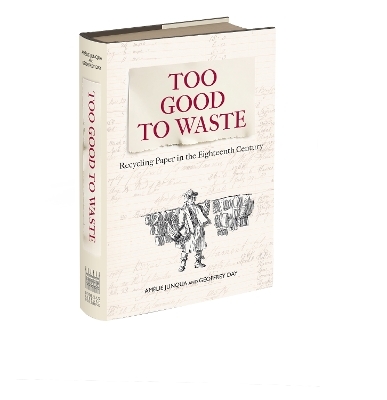
Too Good to Waste
Recycling Paper in the Eighteenth Century
Seiten
2026
Bodleian Library (Verlag)
978-1-85124-653-3 (ISBN)
Bodleian Library (Verlag)
978-1-85124-653-3 (ISBN)
- Noch nicht erschienen (ca. Juni 2026)
- Versandkostenfrei
- Auch auf Rechnung
- Artikel merken
A groundbreaking study of the uses of paper and its recycling in eighteenth-century England.
Paper was a precious commodity in the eighteenth century: every sheet was made by hand. There was therefore a significant market in recycling substandard paper from paper mills and discarded proofs and sheets from printers and booksellers for secondary use, alongside a black market in which stealing and receiving stolen paper took place on a vast scale. A single piece of paper could be termed ‘waste’ and yet sold for cash three times in succession, on each occasion performing a useful function. The end user would keep the newly purchased ‘waste’ or paper wrapping in a special drawer from which it would be taken for a myriad household purposes, including cooking, needlework, decoration and hygiene. Popular satirical prints depicted explicit paper uses, while creators of flamboyant papier mâché ceilings concealed the material by gilding it.
With over 100 illustrations, and drawing on letters from a range of people from farmers to notable authors and members of the aristocracy, together with meticulous archival research, this book traces the extraordinary history of ingenious paper recycling in eighteenth-century England.
Paper was a precious commodity in the eighteenth century: every sheet was made by hand. There was therefore a significant market in recycling substandard paper from paper mills and discarded proofs and sheets from printers and booksellers for secondary use, alongside a black market in which stealing and receiving stolen paper took place on a vast scale. A single piece of paper could be termed ‘waste’ and yet sold for cash three times in succession, on each occasion performing a useful function. The end user would keep the newly purchased ‘waste’ or paper wrapping in a special drawer from which it would be taken for a myriad household purposes, including cooking, needlework, decoration and hygiene. Popular satirical prints depicted explicit paper uses, while creators of flamboyant papier mâché ceilings concealed the material by gilding it.
With over 100 illustrations, and drawing on letters from a range of people from farmers to notable authors and members of the aristocracy, together with meticulous archival research, this book traces the extraordinary history of ingenious paper recycling in eighteenth-century England.
AMÉLIE JUNQUA is a Senior Lecturer in English at the University of Amiens. GEOFFREY DAY was formerly Fellows’ Librarian at Winchester College and subsequently Chair of the York Bibliographical Society.
| Erscheint lt. Verlag | 18.6.2026 |
|---|---|
| Zusatzinfo | 59 Illustrations, black and white; 31 Illustrations, color |
| Sprache | englisch |
| Maße | 156 x 234 mm |
| Themenwelt | Geisteswissenschaften ► Geschichte ► Regional- / Ländergeschichte |
| ISBN-10 | 1-85124-653-3 / 1851246533 |
| ISBN-13 | 978-1-85124-653-3 / 9781851246533 |
| Zustand | Neuware |
| Informationen gemäß Produktsicherheitsverordnung (GPSR) | |
| Haben Sie eine Frage zum Produkt? |
Mehr entdecken
aus dem Bereich


aus dem Bereich
die Geschichte meiner Urgroßmutter
Buch | Hardcover (2025)
C.H.Beck (Verlag)
CHF 32,15
Träume und Macht : eine Biografie
Buch | Hardcover (2025)
C.H.Beck (Verlag)
CHF 61,60


