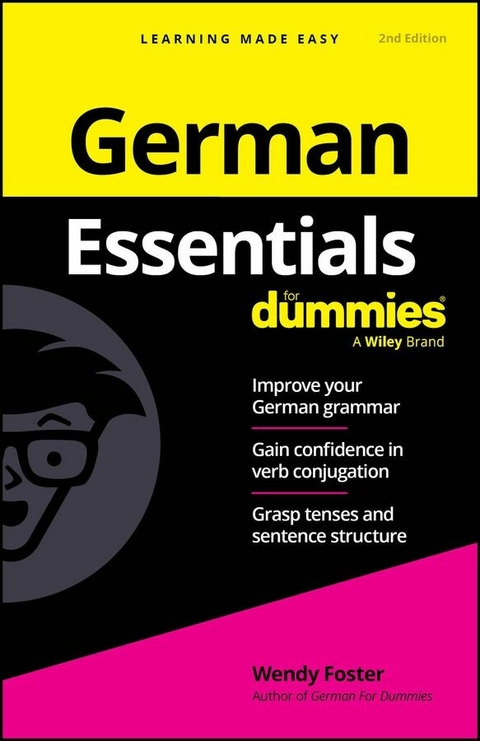
German Essentials For Dummies (eBook)
209 Seiten
For Dummies (Verlag)
978-1-394-37357-4 (ISBN)
An easy-to-follow and hands-on guide for German learners new to the language and for anyone seeking to brush up on the fundamentals
German Essentials For Dummies, 2nd Edition is a quick, concise, and straightforward guide to conversational German. Perfect for anyone who wants to jumpstart their understanding of German, the book is packed with examples, definitions, and handy tips you can start using immediately.
This clear guide explains key German concepts you can use to accelerate your progress in a German class, in self-instruction, or as you move through a language-learning app.
Inside:
- Know the foundations of the German language
- Understand German grammar, sentence structure, pronunciation, and language conventions
- See German conversation examples and definitions
Packed with vocabulary tips, grammar instruction, pronunciation techniques, and more, German Essentials For Dummies, 2nd Edition is a can't-miss guide for German learners, German students, and language app users looking for a learning boost.
Wendy Foster is a polyglot and the author of German For Dummies. She spent thirty years in Munich studying German and has a master's degree in French.
An easy-to-follow and hands-on guide for German learners new to the language and for anyone seeking to brush up on the fundamentals German Essentials For Dummies, 2nd Edition is a quick, concise, and straightforward guide to conversational German. Perfect for anyone who wants to jumpstart their understanding of German, the book is packed with examples, definitions, and handy tips you can start using immediately. This clear guide explains key German concepts you can use to accelerate your progress in a German class, in self-instruction, or as you move through a language-learning app. Inside: Know the foundations of the German language Understand German grammar, sentence structure, pronunciation, and language conventions See German conversation examples and definitions Packed with vocabulary tips, grammar instruction, pronunciation techniques, and more, German Essentials For Dummies, 2nd Edition is a can't-miss guide for German learners, German students, and language app users looking for a learning boost.
Chapter 1
Laying the Foundations of German
IN THIS CHAPTER
Speaking like a native speaker
Counting with cardinal and ordinal numbers
Stating dates and times
Pointing out the parts of speech
Familiarizing yourself with how to use numbers, time, and dates is basic to your German skills. Understanding parts of speech will get you ahead in using spoken and written German.
Sounding Like a German: Pronunciation Basics
The best way to learn to pronounce German is to imitate German speakers as accurately as you possibly can. You’ll be pleased to discover that many German sounds are just like those of English. Other sounds may be unfamiliar at first, so you may need to practice those sounds carefully. The following section provides you with a brief overview of the essentials you need to give you confidence in pronouncing German.
For a complete guide to German pronunciation, refer to the latest edition of German For Dummies (John Wiley & Sons, Inc.), which provides you with a detailed explanation of how to pronounce letters, syllables, and words. The audio files on its website allow you to practice pronunciation as you go along.
Focusing on the German alphabet
The German alphabet has all the letters that English does — 26 of ’em — plus four special letters: ä, ö, ü, and ß. The good news is that German words are generally pronounced just as they’re spelled. This means there’s no confusion, as English has with the likes of bow (tie), (take a) bow, and tree bough. The bad news is that many of the normal-looking letters are pronounced differently from their English counterparts.
Pronouncing vowels
In German, vowels (a, e, i, o, and u) can generally be pronounced in two ways — as short or long vowel sounds. The short vowel sounds are clipped, and they’re pronounced shorter than their English equivalents. Long vowel sounds are steady-state or pure, meaning that the sound quality doesn’t change even though it’s a long sound. Here are the general rules:
- A vowel is long when it’s followed by the letter h, as in Stahl (steel).
- A vowel is generally long when it’s followed by a single consonant, as in Tag (day).
- A vowel is long when it’s doubled, as in Teer (tar) or Aal (eel).
- In general, a vowel is short when followed by two or more consonants, as in Tanne (fir tree).
Pronouncing ä, ö, and ü
German has three extra vowels: ä, ö, and ü. The German word for those curious double dots over the vowels is Umlaut (oom-lout) (umlaut). Umlauts slightly alter the sound of the vowels a, o, and u, as outlined in Table 1-1. These sounds have no equivalent in English, so practice imitating words that contain umlauts.
To make your German vowels ä, ö, and ü sound a bit more authentic, try progressing through the ä, ö, and ü sounds, pronouncing the vowels as though you’re getting ready to kiss someone — in other words, when you make the ä sound, your lips are pursed in an oval shape, and when you make the ö sound, you round your lips into an O. For the ü sound, you pucker up, baby! The ü sound is pronounced with very pursed lips.
TABLE 1-1 Pronouncing Vowels with Umlauts
| German Letter | Symbol | As in English | German Word |
|---|
| ä (long) | ai | say (“ay” in say with spread lips) | nächste (next) |
| ä (short) | ê | bet (clipped “e”) | fällen (to fell [a tree]) |
| ö | er | her (without the “r” sound) | schön (pretty) (remember: no “r” sound) |
| ü | ue | lure (“ooh” with pursed lips) | Tür (door) |
Pronouncing diphthongs
Diphthongs are combinations of two vowels in one syllable (as in the English lie). One way to think about how diphthongs are pronounced in contrast to single vowel sounds is that diphthong sounds are drawn out; they take a little bit longer to pronounce. German has a few of them, as shown in Table 1-2.
Both the long German vowel i and the German vowel combination ie are pronounced like the English letter e in see, but the German ei, ai, and ay are pronounced like the English letter y in cry.
TABLE 1-2 Pronouncing German Diphthongs
| German Diphthong | Symbol | As in English | German Word |
|---|
| ai/ei/ay | ay | cry | Mais (corn) ein (a) Bayern (Bavaria) |
| au | ou | loud | laut (noisy) |
| au (in words of foreign origin) | uh | restaurant | Restaurant (restaurant) |
| äu/eu | oy | boy | Häuser (houses) Leute (people) |
| ie | ee | see | Miete (rent) |
Pronouncing consonants and combinations of consonants
Ahh, relief! The sounds of German consonants are easier to master than the German vowel sounds. In fact, they’re pronounced either almost the same as their English equivalents or like other English consonants.
Pronouncing f, h, k, m, n, p, t, x, and ß
As part of a word, the letters f, h, k, m, n, p, t, and x are pronounced the same in German as they are in English. The letter ß, on the other hand, doesn’t exist in English. It’s kind of cool looking, though, don’t you think? But even if you don’t care about looks, you’ll be glad to know that you pronounce it just like ss or s.
Pronouncing ch, ck, sch, sp, st, and tsch
The German language has a few consonant sounds that are either different or don’t occur in English. Most of them are easy to pronounce, except for the ch, which is unfamiliar to the English tongue.
The German letter combination ch is the trickiest one for English speakers to pronounce. There’s absolutely no equivalent for it in English. You actually have to learn a new sound — a kind of gentle “dry” gargling sound — in order to say it. The sound is a bit like trying to pronounce “hch,” and not a “k” sound. The sound is similar to the guttural “ch” in Scottish, like in Loch Ness.
Table 1-3 shows you how to pronounce these common consonant combinations.
TABLE 1-3 Pronouncing ch, ck, sch, sp, st, and tsch
| German Letter | Symbol | As in English | German Word |
|---|
| ch | H | Loch (Ness) | mich (me) |
| ck | k | check | Dreck (dirt) |
| sch | sh | shut | Tisch (table) |
| sp | shp | sh as in shut, p as in people | spät (late) |
| st (beginning of a word) | sht | sh as in shut, t as in table | Stadt (city) |
| st (middle/end of a word) | st | stable | fast (almost, nearly) |
| tsch | ch | switch | Deutsch (German) |
The English “th” sound doesn’t exist in the German language. The h is silent, as in the words Theorie (theory) and Theologie (theology).
Crunching the...
| Erscheint lt. Verlag | 5.9.2025 |
|---|---|
| Sprache | englisch |
| Themenwelt | Schulbuch / Wörterbuch ► Sprach- und Wörterbuch / Deutsch |
| Geisteswissenschaften ► Sprach- / Literaturwissenschaft ► Sprachwissenschaft | |
| Technik | |
| Schlagworte | basic german • Beginning German • german book • German for beginners • german fundamentals • German Grammar • German pronunciation • german sentence structure • German tips • german tutorial • how to learn german • is german easy? • learning german |
| ISBN-10 | 1-394-37357-0 / 1394373570 |
| ISBN-13 | 978-1-394-37357-4 / 9781394373574 |
| Informationen gemäß Produktsicherheitsverordnung (GPSR) | |
| Haben Sie eine Frage zum Produkt? |
 EPUB (Adobe DRM)
Kopierschutz: Adobe-DRM
Adobe-DRM ist ein Kopierschutz, der das eBook vor Mißbrauch schützen soll. Dabei wird das eBook bereits beim Download auf Ihre persönliche Adobe-ID autorisiert. Lesen können Sie das eBook dann nur auf den Geräten, welche ebenfalls auf Ihre Adobe-ID registriert sind.
Details zum Adobe-DRM
Dateiformat: EPUB (Electronic Publication)
EPUB ist ein offener Standard für eBooks und eignet sich besonders zur Darstellung von Belletristik und Sachbüchern. Der Fließtext wird dynamisch an die Display- und Schriftgröße angepasst. Auch für mobile Lesegeräte ist EPUB daher gut geeignet.
Systemvoraussetzungen:
PC/Mac: Mit einem PC oder Mac können Sie dieses eBook lesen. Sie benötigen eine
eReader: Dieses eBook kann mit (fast) allen eBook-Readern gelesen werden. Mit dem amazon-Kindle ist es aber nicht kompatibel.
Smartphone/Tablet: Egal ob Apple oder Android, dieses eBook können Sie lesen. Sie benötigen eine
Geräteliste und zusätzliche Hinweise
Buying eBooks from abroad
For tax law reasons we can sell eBooks just within Germany and Switzerland. Regrettably we cannot fulfill eBook-orders from other countries.
aus dem Bereich