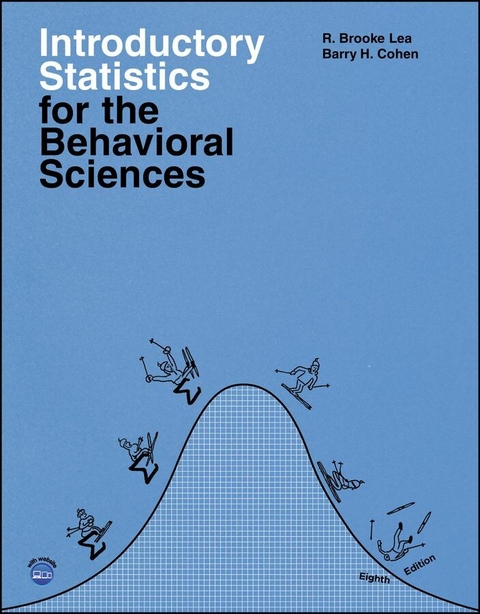
Introductory Statistics for the Behavioral Sciences (eBook)
1051 Seiten
Wiley (Verlag)
978-1-394-23474-5 (ISBN)
The accessible, hands-on statistics textbook that behavioral science students and instructors trust
Introductory Statistics for the Behavioral Sciences is a respected, practical textbook that offers carefully crafted exercises to support the teaching and learning of statistics. This revised eighth edition presents all the topics students in the behavioral sciences need in a uniquely accessible format, making statistics feel relevant and approachable. With fictitious yet realistic examples that reappear throughout the chapter, students can follow a continuous narrative that helps them engage with and internalize the content.
User-friendly integration with SPSS software enables readers to gain hands-on experience with the application of theoretical concepts. Exercises at the end of each chapter, with additional practice in the online study guide, give students the repetition they need to fully comprehend the material. After working through this textbook, students will understand, not only the what, but also the why of statistical analysis.
- Get plain-English explanations of statistical concepts and procedures important in behavioral sciences research
- Learn from relatable examples and exercises focused on psychology, sociology, and other behavioral science
- Work through well-crafted exercises designed to enhance your understanding of the material
- Get clear instructions on how to perform statistical procedures with the industry-standard SPSS software
Online resources for instructors include a test bank, chapter quizzes, and PowerPoint slides. Introductory Statistics for the Behavioral Sciences also includes a student website containing additional basic math coverage, math review exercises, a study guide, a set of additional SPSS exercises, and downloadable data sets.
R. BROOKE LEA, PhD, is DeWitt Wallace Professor of Psychology and Director of Cognitive Science at Macalester College in Saint Paul, MN, where he has taught psychological statistics for more than 25 years. He is a cognitive psychologist who studies reasoning and language processing, with a special interest in the role that poetic devices-such as rhyme, alliteration, and meter-play in the comprehension of poetry.
BARRY H. COHEN, Ph.D. earned a B.S. in Physics and a Ph.D in experimental psychology. Until his retirement, he was the director of the MA program in psychology at NYU, and taught statistics and research design at the graduate level there for more than 30 years. He is now spending his active retirement by collaborating on meditation research.
Preface
The eighth edition of this textbook has been a delight and honor to create. The book is one of the longest‐running statistics texts in the behavioral sciences. (This title has been in print continuously since 1971.) In creating this revision, we tried to maintain the original purpose of the text as defined by Joan Welkowitz and Jacob “Jack” Cohen, and expressed in the preface to the second edition: “to introduce and explain statistical concepts and principles clearly and in a highly readable fashion, assuming minimal mathematical sophistication, but avoiding a ‘cookbook’; approach to methodology.”
At the same time that we worked to uphold the original mission of this classic text, we have made substantial improvements to nearly every chapter. In addition, we have added a new chapter that presents an accessible introduction to the evolving and controverial role that null hypothesis testing plays in behavioral research, along with newer methods (e.g., bootstrapping and Bayesian statistics) that have gained popularity and importance since the last edition. In this new chapter—and throughout the book—we have adopted a more “comprehension‐based” approach that emphasizes how an understanding of statistical concepts informs students’ comprehension of primary sources of research. Borrowing the comprehension vs. production distinction from psycholinguistics, students of behavioral science use their statistical knowledge to comprehend (e.g., read and understand) research at least as much as they use it to produce statistical output (e.g., perform statistical tests). Our approach, especially for more advanced topics, is to ensure that readers of this book understand statistical techniques at a level that will be useful in a variety of educational and experiential contexts.
We also took a hard look at the examples that are used in the book and updated them to provide a more diverse and inclusive perspective on behavioral science. We have made substantial changes to the data set used for exercises by replacing variables that some students might find triggering (e.g., math phobia) with those that are more approachable.
We listened to feedback from students and adopters of the previous edition, who commented that once students have mastered the fundamentals of computing means and standard deviations by hand, the practice becomes needlessly tedious when exercises focus on more complex computations such as t tests, Pearson r, and ANOVA. Accordingly, we now supply summary statistics (means and SDs) so that students can focus their efforts on statistical concepts they are working to master. Of course, we also supply the raw data in case instructors would prefer students to continue to drill on computing descriptive statistics step by step, or use statistical calculators or spreadsheets.
As always, we emphasize the through‐lines that link newer topics with those that came before them in the text. We view this conceptual connective tissue as an important facilitator of learning content that, while divided into discrete topics and chapters, is deeply interconnected. Accordingly, we now provide specific page numbers when referring to formulas, tables, or figures presented earlier in the book to encourage students to refer back to familiar content that reinforces these connections.
Naturally, we took this opportunity to correct any mistakes we and others had noticed in previous editions, and to add some explanatory sentences for the concepts that we know our students have struggled with in the past.
As with the seventh edition of this text, the supplementary materials of this edition will overlap with those for the fourth edition of Barry Cohen’s graduate‐level statistics text, Explaining Psychological Statistics (https://www.wiley.com/en‐us/Explaining+Psychological+Statistics%2C+4th+Edition‐p‐9781118652145), also published by John Wiley & Sons.
There are several structural changes in this edition that are worth emphasizing, as described next.
1. Adding Page Numbers When Referring to Prior Material in the Text
One of our chief strategies for making statistics understandable is to point out the connections between related concepts; mastering behavioral statistics is easier when students can use prior knowledge to help scaffold new material. We have facilitated this process by providing both the name of the prior element and the page on which it appears (e.g., Formula 3.2, page 51). We hope this change will encourage students to appreciate the extent to which statistical knowledge is cumulative.
2. Reduced Emphasis on Rarely Used Procedures and Formulas
As the field advances and makes room for new techniques (see the new Chapter 12), older, rarely used procedures can be relegated to more specialized texts. Examples include linear interpolation procedures for percentiles and cumulative frequency distributions, and computational formulas that are only useful for processing a large quantity of numbers. Learning to compute the sum of squares by hand, for example, is mainly useful as a way for students to understand how examining deviations from the mean can lead to a useful descriptive measure of dispersion. The computational formulas for SS, by contrast, hold no pedagogical value and only exist to facilitate arriving at the correct value of SS with large amounts of data. The ubiquity of automated computation, however, obviates the need for such formulas and techniques.
3. Updating the Computer Exercises, SPSS Sections, and New Bridge to R
We revised Ihno’s data set to create Jackson’s data set for this edition by changing the variables so that they lead to more interesting exercises. We also took this opportunity to update our Bridge to SPSS sections to reflect changes in the most recent versions of SPSS. (The version current during the writing of this edition is 29.) In several chapters we have now included screenshots to illustrate the main SPSS dialog boxes commonly used by researchers to perform the analyses described in this text. In some cases, we have also included results boxes from the output that SPSS produces for particular analyses, in order to draw connections between the terms used by SPSS to label its output and the corresponding (sometimes different) terms used in this text. Furthermore, we now include “Bridge to R” sections as part of the online Supplementary Materials, which will help students using RStudio to successfully complete our Computer Exercises.
4. New Chapter on Newer, More Advanced Statistical Techniques
The new Chapter 12, titled “Beyond Null Hypothesis Testing,” addresses some important topics in behavioral statistics that have emerged since our last edition. We begin by reviewing some of the more trenchant critiques of null hypothesis testing, along with some cogent rebuttals that are sometimes omitted in treatments of this debate. A concrete analogy involving disease detection illustrates what a p value can and cannot tell you. This discussion leads to an introduction to “Robust Statistics” that includes a review of bootstrapping techniques along with the important role that nonparametric statistics can play in behavioral science. Every student should learn about the problems introduced by p Hacking, HARKing, and the file drawer problem. We explain the dangers associated with these practices, and how easily researchers can inadvertently find themselves falling into such traps. That discussion naturally leads into a treatment of the replication crisis in behavioral research, along with some proposed solutions. The last topic in this new chapter introduces alternatives to null hypothesis testing, including the “new” statistics, which emphasizes the interpretation of effect sizes and confidence intervals. Finally, we include an appendix to this chapter that serves as a primer to the use of Bayesian statistics. Overall, this chapter presents these advanced topics and debates in an accessible, friendly manner.
5. Updated Ancillaries
We have updated the Student Companion page on the Wiley website for the new edition, which can be found at: www.wiley.com/go/ISBS8e
The Student Companion Site includes the following items:
- Study Guide: A lively chapter‐by‐chapter review of the text with additional exercises and answers. Created by graduate students who recently served as teaching assistants for statistics, it provides another perspective on the material presented in this text.
- PowerPoint Slides: Expanded and updated for this new edition, these slides provide convenient summaries of the important points of each chapter, and can help instructors to organize their lectures around the key concepts for each statistical topic.
We have also completely updated the Wiley Instructor Companion Site for the eighth edition, which can also be found at: www.wiley.com/go/ISBS8e
In addition to the two items on the student site, the Instructor Website includes the following items:
- Instructor’s Manual: Step‐by‐step answers to all of the computational exercises in the text.
- Test Bank: Multiple choice questions, both conceptual and computational, that can be used to create quizzes to assess the students’ mastery of each chapter in the eighth edition. The test bank includes questions for Chapter 12 that can be used for...
| Erscheint lt. Verlag | 5.9.2025 |
|---|---|
| Sprache | englisch |
| Themenwelt | Geisteswissenschaften ► Psychologie |
| Schlagworte | introduction statistics • Introductory Statistics • Psychology statistics • sociology statistics • SPSS textbook • statistical analysis textbook • Statistics • statistics behavioral science • statistics social science • statistics textbook • stats psychology |
| ISBN-10 | 1-394-23474-0 / 1394234740 |
| ISBN-13 | 978-1-394-23474-5 / 9781394234745 |
| Informationen gemäß Produktsicherheitsverordnung (GPSR) | |
| Haben Sie eine Frage zum Produkt? |
 EPUB (Adobe DRM)
Kopierschutz: Adobe-DRM
Adobe-DRM ist ein Kopierschutz, der das eBook vor Mißbrauch schützen soll. Dabei wird das eBook bereits beim Download auf Ihre persönliche Adobe-ID autorisiert. Lesen können Sie das eBook dann nur auf den Geräten, welche ebenfalls auf Ihre Adobe-ID registriert sind.
Details zum Adobe-DRM
Dateiformat: EPUB (Electronic Publication)
EPUB ist ein offener Standard für eBooks und eignet sich besonders zur Darstellung von Belletristik und Sachbüchern. Der Fließtext wird dynamisch an die Display- und Schriftgröße angepasst. Auch für mobile Lesegeräte ist EPUB daher gut geeignet.
Systemvoraussetzungen:
PC/Mac: Mit einem PC oder Mac können Sie dieses eBook lesen. Sie benötigen eine
eReader: Dieses eBook kann mit (fast) allen eBook-Readern gelesen werden. Mit dem amazon-Kindle ist es aber nicht kompatibel.
Smartphone/Tablet: Egal ob Apple oder Android, dieses eBook können Sie lesen. Sie benötigen eine
Geräteliste und zusätzliche Hinweise
Buying eBooks from abroad
For tax law reasons we can sell eBooks just within Germany and Switzerland. Regrettably we cannot fulfill eBook-orders from other countries.
aus dem Bereich