


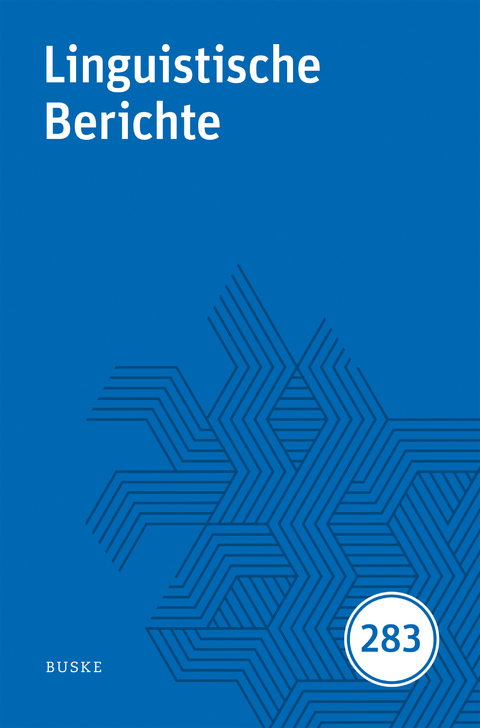
Linguistische Berichte Heft 283
Buske, H (Verlag)
978-3-96769-948-7 (ISBN)
– Felicitas Otte, Markus Steinbach & Nina-Kristin Meister: Auf dem Weg zur digitalen Barrierefreiheit in den Linguistischen Berichten: Errungenschaften und Ziele
Aktuelle Tendenzen in der Linguistik
– Silva H. Ladewig: Aktuelle Trends und Entwicklungen in der linguistischen Gesten- und Multimodalitätsforschung
Abstract: In the late 20th century, gestures were mainly regarded as part of pragmatics, separate from core linguistic fields like phonetics, morphology, syntax, and semantics. This division was rooted in Chomsky’s (1965) distinction between linguistic competence and performance, with only the former being considered within the scope of linguistics. This paper demonstrates that gestures have now become central to core linguistic research. It examines recent developments in gesture and multimodality research within linguistics, beginning with a discussion of gesture concepts, followed by an introduction to gestures as an empirical phenomenon. Recent find-ings on gestural modality and its integration into spoken language are presented, highlighting three key themes: the role of gestures in emphasizing information, their integration into syntax and prosody, and the emergence and stabilization of gestural and multimodal patterns. These developments suggest a growing recognition of gesture as integral to linguistic study.
Beiträge aus Forschung und Anwendung
– Sebastian Walter: Investigations on the at-issue status of viewpoint gestures
Abstract: Most accounts of the semantic contribution of ‘co-speech gestures’ posit that they contribute ‘not-at-issue’ meaning by default (e. g., Ebert & Ebert 2014). This claim has been experimentally validated by Ebert, Ebert & Hörnig (2020) for gestures conveying information about an ob-ject’s size or shape. In this article, the findings from two rating studies are reported investigat-ing the at-issue status of ‘character’ and ‘observer viewpoint gestures’ (CVGs and OVGs, respectively, McNeill 1992). It is questionable whether the findings of Ebert, Ebert & Hörnig’s (2020) study hold equally strong for CVGs and OVGs, as especially the former gesture type differs in size from the gestures used in their study. The results of the studies suggest that while both gesture types contribute not-at-issue meaning by default, CVGs can shift more toward the at-issue dimension than OVGs if they provide information relevant to the ‘question under discussion’, in line with a gradient approach to at-issueness (Barnes & Ebert 2023).
– Winfried Thielmann: Tempus und Zeit: Phänomene – Konzepte – linguistische Kategorienbildung
Abstract: It is widely held that temporal morphemes refer to temporal structures of reality in the way presented by Reichenbach in his ‘Symbolic Logic’ (1947). One of the earliest elaborations of the concept of time, namely the one found in Aristotle’s ‘Physics’, however, suggests that time is not a property of nature, but a complex linguistic elaboration of the human mind in order to come to terms with nature: Counting deictic focusing acts with respect to repeated constellations of a reference movement, e. g., meridian transits of the sun, the human psyche establishes a reference space that has no reality outside the human psyche. Because of this it is argued that it is quite implausible that grammatical morphemes should express a complex notion that relies on things such as number and a numeral system, but, rather, that it is later reifications of the concept of time gave rise to the assumption that linguistic structures encode temporal logic. As it will be shown, ‘temporal’ morphemes of German can indeed be described without reference to time, as they have a much more basic meaning. Hence it may be meaningful to ask the question, if linguistic thinking might in general be misled in believing that complex categories such as ‘time’ or, for instance, ‘causality’, are encoded in grammatical structures.
Rezensionen
– Nanna Fuhrhop: Ursula Bredel (2024): Das Schriftsystem des Deutschen. Graphetik – Graphematik – Orthographie – Erwerb. Eine Einführung.
Informationen und Hinweise
von Klaus Müllner und den Herausgeber*innen
Erscheinungsweise und Bezugsbedingungen: Jährlich erscheinen vier Hefte (Februar, Mai, August und November) mit einem Umfang von je ca. 128 S. Das Institutsabonnement (Print- und Onlineausgabe) kostet 398,00 € pro Jahr und das Privatabonnement 238,00 € (jeweils zzgl. Versandspesen: Inland 14,00 € bzw. Ausland 32,00 €). Jährlich kann ein Sonderheft erscheinen, das den Abonnenten mit einem Nachlass von ca. 15 % auf den jeweiligen Ladenpreis geliefert wird. Die Kündigungsfrist beträgt sechs Wochen zum Jahresende. Onlinezugang im Abonnement: buske.de/lb
Markus Steinbach hat an der Goethe-Universität Frankfurt am Main Germanistik und Philosophie studiert und 1998 an der Humboldt-Universität zu Berlin zum Thema „Middle Voice: A Comparative Study of the Syntax-Semantics Interface of German“ promoviert. Von 1998 bis 2002 war er zuerst wissenschaftlicher Mitarbeiter und anschließend akademischer Rat an der Gutenberg-Universitat Mainz. Seit 2009 ist er Professor für Deutsche Philologie/Sprachwissenschaft an der Georg-August-Universität Göttingen mit einem Schwerpunkt in der Semantik und Gebärdensprachlinguistik. Seit 2014 ist er als Herausgeber der „Linguistischen Berichte“ tätig.
Nina-Kristin Meister (geborene Pendzich) hat an der Georg-August-Universität Göttingen Deutsche Philologie und Geschichte studiert und in Germanistischer Linguistik zum Thema »Lexikalische nichtmanuelle Markierungen in der Deutschen Gebärdensprache (DGS)« promoviert. Seit 2017 ist sie Leiterin des Experimentellen Gebärdensprachlabors am Seminar für Deutsche Philologie der Georg-August-Universität Göttingen und unterrichtet Germanistische Linguistik mit Schwerpunkt in der DGS. Ebenfalls seit 2017 ist sie in der Redaktion der Fachzeitschrift »Linguistische Berichte« tätig.
| Erscheinungsdatum | 06.09.2025 |
|---|---|
| Reihe/Serie | Linguistische Berichte ; 283 |
| Co-Autor | Felicitas Otte, Markus Steinbach, Nina-Kristin Meister, Silva Ladewig, Sebastian Walter, Winfried Thielmann, Nanna Fuhrhop |
| Sprache | englisch; deutsch |
| Gewicht | 260 g |
| Einbandart | kartoniert |
| Themenwelt | Geisteswissenschaften ► Sprach- / Literaturwissenschaft ► Sprachwissenschaft |
| Schlagworte | Linguistik • Semantik • Sprachwissenschaft • Syntax |
| ISBN-10 | 3-96769-948-X / 396769948X |
| ISBN-13 | 978-3-96769-948-7 / 9783967699487 |
| Zustand | Neuware |
| Informationen gemäß Produktsicherheitsverordnung (GPSR) | |
| Haben Sie eine Frage zum Produkt? |
aus dem Bereich


