


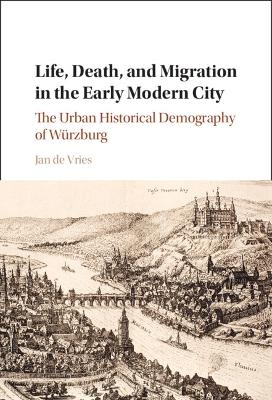
Life, Death, and Migration in the Early Modern City
The Urban Historical Demography of Würzburg
Seiten
2026
Cambridge University Press (Verlag)
978-1-009-64151-7 (ISBN)
Cambridge University Press (Verlag)
978-1-009-64151-7 (ISBN)
- Noch nicht erschienen (ca. April 2026)
- Versandkostenfrei
- Auch auf Rechnung
- Artikel merken
In this rich study of the pre-industrial city in early modern Europe, Jan de Vries uses modern demographic techniques to reconstruct life in Würzburg between 1696–1711. He emphasises the critical role of migrants to the urban community, with wider implications for understanding urban historical demography across Germany and Europe.
In this rich study of early modern Würzburg, Jan de Vries reconstructs the demographic life of a pre-industrial city. Utilising modern demographic techniques, he analyses data about thousands of families between 1696–1711 and examines every stage of the life course from infancy, leaving home, marriage and fertility, to widowhood, remarriage, and mortality. Close study of a single German city allows for special attention to be paid to differences of social class and migrant status, and de Vries emphasises the critical role of migrants to the make-up of the urban community. This new interpretation allows for the Sharlin theory and other questions concerning marriage choice, fertility control, and mortality risks to be tested. At every stage, de Vries compares the findings for Würzburg to those of other cities in Germany and Europe, developing existing generalisations, and contributing to a better understanding of urban historical demography.
In this rich study of early modern Würzburg, Jan de Vries reconstructs the demographic life of a pre-industrial city. Utilising modern demographic techniques, he analyses data about thousands of families between 1696–1711 and examines every stage of the life course from infancy, leaving home, marriage and fertility, to widowhood, remarriage, and mortality. Close study of a single German city allows for special attention to be paid to differences of social class and migrant status, and de Vries emphasises the critical role of migrants to the make-up of the urban community. This new interpretation allows for the Sharlin theory and other questions concerning marriage choice, fertility control, and mortality risks to be tested. At every stage, de Vries compares the findings for Würzburg to those of other cities in Germany and Europe, developing existing generalisations, and contributing to a better understanding of urban historical demography.
Jan de Vries is Emeritus Professor of History and Economics at the University of California at Berkeley. He is author of The Industrious Revolution, The First Modern Economy (with Ad van der Woude), and European Urbanization, 1500–1800.
1. Introduction; 2. Würzburg and its census; 3. The dynamics of an urban population; 4. Testing the Sharlin Thesis; Appendices; Bibliography; Index.
| Erscheint lt. Verlag | 30.4.2026 |
|---|---|
| Zusatzinfo | Worked examples or Exercises; 20 Line drawings, black and white |
| Verlagsort | Cambridge |
| Sprache | englisch |
| Gewicht | 500 g |
| Themenwelt | Geschichte ► Teilgebiete der Geschichte ► Kulturgeschichte |
| Sozialwissenschaften ► Soziologie ► Empirische Sozialforschung | |
| ISBN-10 | 1-009-64151-4 / 1009641514 |
| ISBN-13 | 978-1-009-64151-7 / 9781009641517 |
| Zustand | Neuware |
| Informationen gemäß Produktsicherheitsverordnung (GPSR) | |
| Haben Sie eine Frage zum Produkt? |
Mehr entdecken
aus dem Bereich



aus dem Bereich
Die Revolution des Gemeinen Mannes
Buch | Softcover (2024)
C.H.Beck (Verlag)
CHF 16,80
Eine Geschichte des Geschmacks
Buch | Hardcover (2025)
C.H.Beck (Verlag)
CHF 49,95
vom Mittelalter bis zur Gegenwart
Buch | Softcover (2024)
C.H.Beck (Verlag)
CHF 16,80


