The Diver of Paestum (eBook)
166 Seiten
Polity (Verlag)
978-1-5095-6814-7 (ISBN)
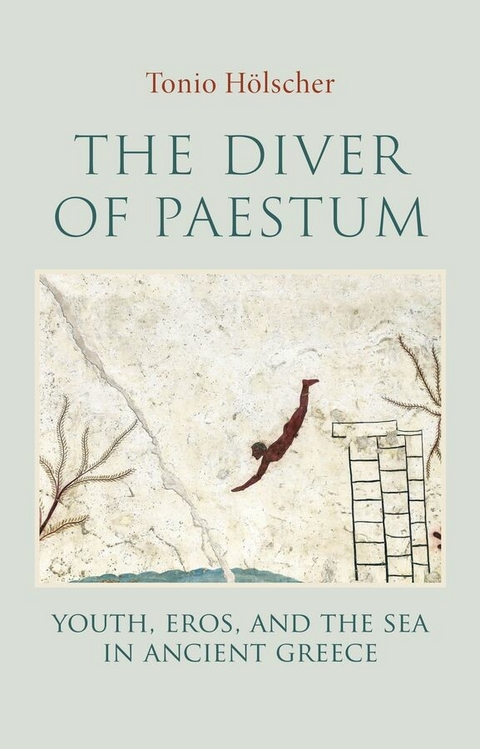
The eminent art historian Tonio Hölscher rejects this view, arguing that there is nothing symbolic or metaphorical about the painting: the scenes celebrate the real lives of the Greek colonists of the early 5th century BC. The painting captures a young man's spirited personality and pursuits during a life which may have been short, but was lived to the full. In a groundbreaking reversal of how the painting is typically interpreted, this book opens a window onto the world of Ancient Greece and its culture of athleticism, eroticism, love for nature and enjoyment of the sea. A joyful ode to youth, it is above all a unique portrait of the zest for life in Antiquity.
Tonio Hölscher is Emeritus Professor of Classical Archaeology at the University of Heidelberg.
1
Tomb, City, and Civic Culture: Challenges of a Sensational Discovery
The Italian archeologists who spent the 1960s excavating the necropolises of the ancient city of Paestum – or Poseidonia, to give it its Greek name – under the far-sighted direction of their superintendent, Mario Napoli, must have rubbed their eyes in disbelief when, on June 3, 1968, they stumbled upon a gravesite that catapulted this already well-known historical site to new heights of international fame (Figs. 1–6). The box-shaped interior, measuring 1.93 m × 0.96 m at the base and 0.79 m in height, was decorated on its side walls and horizontal ceiling with unique paintings of extraordinary artistic merit. The walls and ceiling each consisted of a solid travertine slab, which had been so carefully grouted and covered with a fine layer of plaster that the colors had lost none of their stupendous vibrancy.
On the four walls, a symposium is in full swing. Most of the six dining couches (klinai) are occupied by pairs of older and younger men. Three age groups are finely differentiated and arranged in varying constellations: mature adults sporting full beards and moustaches, younger men with side-whiskers and tufts of hair on their chins, and smooth-faced ephebes.
In the middle of the long northern wall, a younger man elegantly flicks the last drops of wine from his drinking cup at an imaginary target, competing for the favor of a lover in the popular game of kottabos. His companion gazes spellbound at the neighboring couple, who have set down their bowls on the table and are already further along in the erotic game: the younger man is still plucking the lyre while the elder draws his head toward him. They are poised for a kiss, the older man staring with hungry eyes, the younger raising his hand to indicate the expected restraint. On the opposite side, the partners in the middle are still decorously facing each other. To the right, the younger man is playing the double flute (aulos) in a way that makes his partner look up in rapture, his hand on his head and mouth opened in song. On both walls, an older man reclines alone on a third kline. One extends his drinking cup as if in welcome. The other has demonstratively raised his lyre with one hand while holding an egg in the other, apparently a love gift, and turns his head inquisitively in the same direction. A wide range of emotional facets is conveyed through facial expressions and gestures.
Figs. 1–4 Men at the symposium. Tomba del tuffatore, Paestum. c.480 BCE.
Figs. 5 and 5a Ephebe diving into the sea. Tomba del tuffatore, Paestum. c.480 BCE.
Two more participants appear on one of the narrow sides of the burial chamber: a handsome youth, smooth-faced and naked except for a bright blue cloak draped over his arms, his hand raised in greeting, followed by a bearded adult with a cloak and staff; they are preceded by a very young female aulos player. There has been some debate about whether they are coming or going, but in the context of the other scenes there can be hardly any doubt. On the wall behind them, no one seems to be aware that guests are leaving, while on the wall in front, the lone reveler lifts his drinking cup in welcome, cheerfully responding to the greeting of the young man in front. The two new arrivals will clearly participate in the festivities, and we can safely assume that they are about to join the adult men who are still without partners. The girl will probably take over the musical entertainment when the men are further along in their feast. The aulos, with its piercing, oboe-like timbre, was used to create a beguiling and stimulating atmosphere at symposia, in contrast to the more sober stringed instruments, the kithara and lyre. On the narrow side opposite, a metal krater – a two-handed vessel for mixing wine with water – stands on a table, the source and origin of sympotic and erotic vitality. Next to it, an ephebe, the only completely naked figure, prepares to serve wine to the symposiasts. If you have to lie in a tomb, it is hard to imagine a lovelier ambience.
Fig. 6 Tomba del tuffatore, Paestum. View of the burial chamber. c.480 BCE.
The truly sensational find, though, was and still is the cover slab, featuring a motif on its underside that immediately catches every eye: the “diver” who gave the tomb its name (Tomba del tuffatore). We look out over a natural landscape of the utmost delicacy. Below, a body of water, its surface slightly rippled. On the bank, a tower-like structure, its form hard to make out, but with a slab protruding at the top as a platform. A young man dives headfirst, his naked body elegantly tensed on its downward arc: chest strong and puffed out, bottom tight and tucked in, arms and legs outstretched. Only his small penis – an admired trait in antiquity – sticks out from the lithe, sinuous contours of his body, and his head, sprouting its first facial hair, is raised toward the surface of the water he is about to break. What is remarkable is the small size of the diver relative to the mostly open, empty background. Only two filigree trees, one growing on the far bank, the other at the right edge of the picture, spread their tendril-like branches toward the youth as if in erotic longing. This is an image of free, open nature. Even the borders curl in organically at the corners, where plant-like volutes and palmettes grow into the scene.
The “diver” quickly gained iconic status. No history of Greek art would be complete without it. The French film director and writer, Claude Lanzmann, made it the emblem of his own life – one headlong leap into the unknown after the other – in his essay collection, “La tombe du divin plongeur.” (The title given the German translation, “Das Grab des göttlichen Tauchers,” shifts the emphasis to the aspect of immersion, which is not actually depicted but carries other connotations.)
Even before the discovery, ancient Paestum had not been lacking in historical grandeur. Shortly before 600 BCE, Greek settlers from Sybaris, the town of proverbial, ‘sybaritic’ luxury in the south of the Italian peninsula, had founded a daughter city on the coast south of the Sorrento peninsula, near the mouth of the Sele river; they named it Poseidonia after Poseidon, the sea god. The lush and fertile plain around the city, to this day the pastureland for the buffalo herds that produce the finest mozzarella in Italy, soon became the basis for increasing prosperity, reflected in a spacious civic complex with a rectangular street grid and a center with a wide agora and monumental sanctuaries. Three unusually well-preserved, magnificent temples testified down the centuries to the city’s golden age in the sixth and fifth centuries BCE. Eighteenth- and nineteenth-century European travelers who, like Goethe, ventured further south beyond the well-trodden, relatively safe destinations of Rome, Naples, and Pompeii experienced the Greek temples of Paestum, usually the only accessible evidence of Greek culture, as an alien yet deeply impressive world. Those who looked further afield and were interested in more than just the great architectural art of the temples could also admire the best-preserved city walls from pre-Roman antiquity. An immense defensive barrier hewn from limestone blocks, they date from a later period, the second half of the fourth century BCE, when the city largely fell under the sway of native Lucanians, whose advance to the coasts led to widespread hostilities – until, in 273 BCE, the Romans founded a citizen colony there and renamed it Paestum.
New discoveries in the twentieth century considerably added to Paestum’s luster as an artistic center. To the city’s north, at the mouth of the Sele river, a sanctuary dedicated to the goddess Hera was excavated. It seems to have been a place where young women would undergo rites of initiation outside the urban area. Two imposing cult buildings from the sixth century BCE were decorated with extensive series of relief panels (metopes). One, executed in a bold and vigorous style, contains by far the largest number of images from Greek mythology known from any ancient monument: labors of Heracles (Fig. 7), scenes from the Trojan War, Ajax throwing himself on his sword in the first frenzy of his grief, Sisyphus futilely pushing his boulder up the mountain – a whole panorama of heroic feats and fates. The other shows a group of girls, richly and elegantly attired, dancing with seductive charm at the festival of the goddess (Fig. 8). The two series are without parallel in Greek art.
Fig. 7 Heracles slays the giant Alcyoneus. Metope from the first archaic temple at Foce del Sele. Paestum, Museo Archeologico Nazionale. c.550 BCE.
With this vibrant civic culture, Paestum presents itself as an outpost of the Greek world at its northernmost edge, where it brushed up against the very different, albeit equally sophisticated cultures of the native Italic peoples. Centuries earlier, Etruscans had occupied and settled the region around today’s Pontecagnano, just north of the territory of Paestum, bringing with them their important culture of metalwork and pottery. Other ethnic communities had built up centers of outstanding interest in the peninsula’s mountainous interior. It was a time of far-flung political, economic, and cultural connections,...
| Erscheint lt. Verlag | 3.9.2025 |
|---|---|
| Übersetzer | Robert Savage |
| Sprache | englisch |
| Themenwelt | Geschichte ► Allgemeine Geschichte ► Altertum / Antike |
| Schlagworte | adolescence • Afterlife • ageing process • Ancient Greece • Ancient Greek archaeology • Ancient Greek gods • Ancient Rome • banquet • Civilisation • classical archaeology • classics • Courage • Death • ephebes • Eros • eschatiá • female bathing scenes in ancient Greece • female eroticism • Fun • Funeral • good cheer • Greek colony in southern Italy • Gymnasia • Hedonism • heroism • hero myths • hetaerae • Homoerotic • Homosexuality • jumping into the sea • laughter • living life to the full • Love • Magna Graecia • male eroticism • male youth • Mario Nepoli • Mediterranean • Mythology • Necropolis • new interpretation of the Tomb of the Diver frescoes • Paestum • palestrae • Party • physical elegance • Poseidonia • Romans • Sarcophagus • settlers from Sybaris • Sexuality • symbolism of the Tomb of the Diver • Symposium • Tomb of Hunting and Fishing in Etruscan Tarquinia • Tomb of the Diver • Tyrrhenian Sea • Wealth • what can ancient Greek frescoes tell us about life in ancient times • what can painting tell us about convention and norms in ancient Greece • what is the meaning of the Diver of Paestum? • what was life like in 500 BCE • Wilderness • wine • worldly life • Zest for life |
| ISBN-10 | 1-5095-6814-X / 150956814X |
| ISBN-13 | 978-1-5095-6814-7 / 9781509568147 |
| Informationen gemäß Produktsicherheitsverordnung (GPSR) | |
| Haben Sie eine Frage zum Produkt? |
 EPUB (Adobe DRM)
Kopierschutz: Adobe-DRM
Adobe-DRM ist ein Kopierschutz, der das eBook vor Mißbrauch schützen soll. Dabei wird das eBook bereits beim Download auf Ihre persönliche Adobe-ID autorisiert. Lesen können Sie das eBook dann nur auf den Geräten, welche ebenfalls auf Ihre Adobe-ID registriert sind.
Details zum Adobe-DRM
Dateiformat: EPUB (Electronic Publication)
EPUB ist ein offener Standard für eBooks und eignet sich besonders zur Darstellung von Belletristik und Sachbüchern. Der Fließtext wird dynamisch an die Display- und Schriftgröße angepasst. Auch für mobile Lesegeräte ist EPUB daher gut geeignet.
Systemvoraussetzungen:
PC/Mac: Mit einem PC oder Mac können Sie dieses eBook lesen. Sie benötigen eine
eReader: Dieses eBook kann mit (fast) allen eBook-Readern gelesen werden. Mit dem amazon-Kindle ist es aber nicht kompatibel.
Smartphone/Tablet: Egal ob Apple oder Android, dieses eBook können Sie lesen. Sie benötigen eine
Geräteliste und zusätzliche Hinweise
Buying eBooks from abroad
For tax law reasons we can sell eBooks just within Germany and Switzerland. Regrettably we cannot fulfill eBook-orders from other countries.
aus dem Bereich