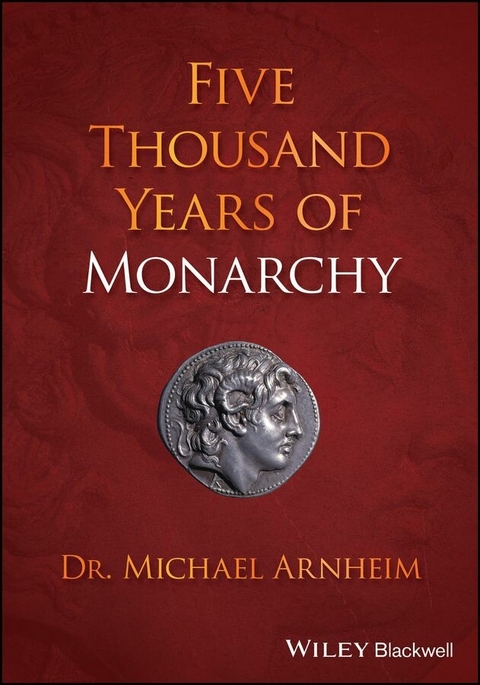
Five Thousand Years of Monarchy (eBook)
771 Seiten
Wiley-Blackwell (Verlag)
978-1-394-15443-2 (ISBN)
Offers a sweeping, entertaining journey through the real power structures of world history
Five Thousand Years of Monarchy challenges everything you thought you knew about political history. With wit, clarity, and a deep command of historical detail, Michael Arnheim reframes five millennia of global governance through a strikingly original lens: the idea that every government, from ancient Sumer to modern China, is either a monarchy or an oligarchy-regardless of its name or apparent ideology. This provocative framework reveals insights into some of history's greatest puzzles and personalities, from the Roman emperors to Castro's Cuba, Augustus to Queen Victoria, and from Louis XVI's missed opportunity to the untold powers of King Philip II.
Drawing on lively anecdotes, surprising facts, and colorful historical vignettes, Arnheim brings the power struggles of the past vividly to life. Why was Imperial China more stable than any modern democracy? Could World War I have been avoided by more autocracy? And why are aristocracies more hostile to monarchs than revolutions ever were? Engaging, opinionated, and highly readable, Five Thousand Years of Monarchy offers a powerful reminder that what really matters in politics isn't titles or constitutions-it's who holds the power, and how.
Presenting a bold and original reinterpretation of world history through the lens of power structure, Five Thousand Years of Monarchy:
- Distills all governments-ancient and modern-into just two essential types: monarchy or oligarchy
- Provides a global scope, covering rulers and regimes from every major civilization
- Reveals little-known historical facts, such as King Philip II of Spain's reign as King of England
- Offers original, counterintuitive takes on major events such as the French Revolution and World War I
- Explores the surprising longevity and success of the Roman and Chinese empires
- Challenges conventional narratives and political assumptions with evidence-based analysis
Written in an engaging, accessible, and often humorous style, Five Thousand Years of Monarchy is ideal for general readers with an interest in history, politics, or leadership, as well as students and instructors in History, Classics, and Political Science.
DR. MICHAEL ARNHEIM is a former Fellow of St. John's College, Cambridge, and a practicing barrister based in London. The author of 25 books to date, he previously served as Professor and Head of the Department of Classics at his alma mater in South Africa.
Offers a sweeping, entertaining journey through the real power structures of world history Five Thousand Years of Monarchy challenges everything you thought you knew about political history. With wit, clarity, and a deep command of historical detail, Michael Arnheim reframes five millennia of global governance through a strikingly original lens: the idea that every government, from ancient Sumer to modern China, is either a monarchy or an oligarchy regardless of its name or apparent ideology. This provocative framework reveals insights into some of history's greatest puzzles and personalities, from the Roman emperors to Castro's Cuba, Augustus to Queen Victoria, and from Louis XVI's missed opportunity to the untold powers of King Philip II. Drawing on lively anecdotes, surprising facts, and colorful historical vignettes, Arnheim brings the power struggles of the past vividly to life. Why was Imperial China more stable than any modern democracy? Could World War I have been avoided by more autocracy? And why are aristocracies more hostile to monarchs than revolutions ever were? Engaging, opinionated, and highly readable, Five Thousand Years of Monarchy offers a powerful reminder that what really matters in politics isn't titles or constitutions it's who holds the power, and how. Presenting a bold and original reinterpretation of world history through the lens of power structure, Five Thousand Years of Monarchy: Distills all governments ancient and modern into just two essential types: monarchy or oligarchy Provides a global scope, covering rulers and regimes from every major civilization Reveals little-known historical facts, such as King Philip II of Spain's reign as King of England Offers original, counterintuitive takes on major events such as the French Revolution and World War I Explores the surprising longevity and success of the Roman and Chinese empires Challenges conventional narratives and political assumptions with evidence-based analysis Written in an engaging, accessible, and often humorous style, Five Thousand Years of Monarchy is ideal for general readers with an interest in history, politics, or leadership, as well as students and instructors in History, Classics, and Political Science.
Introduction
This book is the result of a long study analyzing the power structure of a number of societies over the past five thousand years, and geographically from China in the east to the United States in the west, and from Scandinavia in the north down to Egypt in the south. My findings are as follows:
- There are, and have been, essentially only two models of government: monarchy and oligarchy.
- Since the beginning of recorded time, society has always been divided into two main elements: a privileged elite and the ordinary people.
- There has always been a certain tension or antagonism between these two elements.
- Where the elite are in control, the government is an oligarchy, a subdivision of which—where the oligarchy is hereditary—is aristocracy.
- The only other pure type of government is monarchy.
- There is popular monarchy, when a strong leader rules with broad popular support.
- Then there is actual, absolute, or autocratic monarchy without specific popular support.
- What is commonly referred to as constitutional monarchy, where the supposed monarch has little or no actual power, is not really monarchy at all but oligarchy in disguise.
It is important to realize that the term “monarchy” as used in this book includes any regime where power is concentrated in the hands of a single individual, regardless of title. So, while Fidel Castro, the leader of the Republic of Cuba, was in fact a monarch, his contemporary, the “constitutional monarch” King Baudouin of the Belgians, was, in reality, merely a non‐executive titular head of state. Is it possible for power to be shared between a monarch and an oligarchic elite? The question to ask is: Who has the whip hand? True shared power in a hybrid form of government is rare. More often, what appears as shared power will turn out to be either a disguised monarchy or a disguised oligarchy.
Just as oligarchies (and aristocracies), in which power is shared by an elite group, have a visceral fear of monarchy, so, by the same token, monarchies should recognize the serious danger to their position from an ambitious power elite that threatens to take power away from them and share it among themselves.
Ancient Mesopotamia
Though this threat has existed since time immemorial, not all monarchs have been conscious of it. The Mesopotamian lugal (king) Urukagina of Lagash in the twenty‐fourth century BCE is one of the earliest examples we know of where someone, with popular support, evidently overthrew a priestly aristocracy and ruled in the interests of the lower classes. This can also be seen from his legal code, probably the earliest such document known to history (see Chapter 16).
China, Ancient and Modern
The Chinese emperors were particularly conscious of the aristocratic threat to the monarchy, and it was to counter this threat that the famous Chinese competitive civil service examination system was instituted, which lasted for close on two thousand years, starting during the Han dynasty (206 BCE–220 CE) and being abolished only in 1905, just before the imperial system as a whole was swept away. The expense of the tuition involved gave the wealthier classes an advantage in the examinations, but the rank of scholar‐official was not hereditary. Though these highly educated and intelligent officials enjoyed great status and prestige, they never posed a threat to imperial power. The eunuchs formed another important bastion of imperial power against the aristocracy from at least around 146 CE until the end of the Qing (Manchu) dynasty in 1912. Some eunuchs exercised great power, which was facilitated by their closeness to the emperor. The reason they were entrusted with such responsibility was that, as they could not have children and start a dynasty, they would not be tempted to seize the throne, and they could easily be demoted or disposed of. The eunuchs were also a useful counterweight to the scholar‐officials, with whom they were always in competition for influence with the emperor (see Chapter 19).
The French Revolution
By contrast, let us take the French Revolution as an example picked almost at random, a cataclysmic event in world history on which there is no shortage of evidence and a plethora of historical studies, hardly any of which show the slightest awareness of the significance—or even the existence—of the power structure (see Chapters 17 and 19).
The wise and wily Louis XV (r. 1715–74) was well aware of the longstanding threat to the French crown posed by the aristocracy, particularly in the shape of the Parlement de Paris—not a legislature but a court that had arrogated to itself the right to “register” (and therefore to veto) any royal decree. By 1771 the king's able chief minister, René de Maupeou, had finally defeated the Parlement de Paris and replaced it with a royal court, and then took similar action against the provincial parlements. These were intended as merely the first steps in a wholesale reform of the judicial system, but the whole enterprise was abruptly cut short by Louis XV's death and Maupeou's dismissal by the new king, Louis XV's grandson, Louis XVI, a callow 19‐year‐old, who did not understand that, far from being his allies, the aristocracy were actually hostile at once to royal power and to the interests of the mass of the population. “I had won for the King a case that has dragged on for three hundred years,” lamented Maupeou. “He wishes to lose it again. It is his decision.”
More interested in tinkering with locks in his workshop than with affairs of state, Louis XVI never got to understand the true nature of power, a failing which was to prove fatal for himself and the ancien régime. The brilliant eccentric royalist revolutionary Mirabeau (1749–91) desperately tried to make Louis recognize and develop the bond between the monarchy and the ordinary people of France: “The indivisibility of monarch and people is in the heart of every Frenchman. It is necessary for it to exist in action and in power.” Ignoring this sound advice, Louis made a frantic run to the frontier to link up with France's enemies. Recognized (ironically, from his embossed profile on the assignat, the new revolutionary paper money), he was arrested and ignominiously dragged back to Paris as a prisoner. From there it was but a short step to deposition, trial, and execution.
But that was not quite the end of the story. Napoleon Bonaparte, who saw himself as the heir to the Revolution, subsequently reinvented himself as a monarch under the style of emperor, a title deliberately chosen for its Roman populist associations. It is no accident that Maupeou's right‐hand man, Charles‐François Lebrun (1739–1824), was picked by Napoleon to serve as Third Consul under himself in 1799 to take a leading role in the reorganization of the national finances and of the administration—both pet projects of Maupeou's aborted by the death of Louis XV in 1774. Casting his mind back 30 years, Lebrun also cautioned Napoleon against recreating a hereditary aristocracy.
Augustus
One of the few dates that most people recognize is the assassination of Julius Caesar on the Ides of March 44 BCE. But, besides the drama and gore surrounding that date, of which Hollywood has taken full advantage, it also marks an important historical watershed. The Roman Republic, an oligarchy with a visceral fear of one‐man rule, had come into existence in 509 BCE. But when the populist Caesar was named dictator perpetuo (“dictator for life”), the Republic was effectively dead. His senatorial assassins, brandishing the deceptive watchword “liberty” (which really meant “freedom” for the privileged elite alone), desperately wanted to revive the oligarchy that was the Republic, and made a failed last‐ditch stand in a bloody civil war to do so. When the dust settled after a further round of civil war, Caesar's great‐nephew, adoptive son, and heir found himself presiding as sole ruler over the whole Roman world. Carefully trying to avoid offending the surviving senatorial oligarchs, he eschewed the title of “king” or “dictator” in favor of the innocuous designation of princeps, or “first citizen”. In 27 BCE he reinvented himself under the style Imperator Caesar Augustus: ‘Caesar’ being the key to his inherited popular support; “Imperator”, the ovation given to a victorious general, but used as a forename; and “Augustus” meaning “the sublime one”, an honorific awarded him by the Senate. He was in addition pontifex maximus, or chief priest of the Roman state religion, and pater patriae, “father of the fatherland”, a benign title with connotations of fatherly love without any harsh overtones.
As the first Roman emperor, Augustus ushered in a golden age of two centuries (27 BCE–180 CE) of a “Principate” of strong monarchy with popular support while placating the senatorial elite; followed by a “Dominate” of autocratic monarchy without specific popular support from 284 to 395; and, in the Eastern half of the Empire, a further thousand years of Caesaropapism, until 1453, of what is now known as the Byzantine Empire; while in the West there...
| Erscheint lt. Verlag | 3.9.2025 |
|---|---|
| Sprache | englisch |
| Themenwelt | Geschichte ► Allgemeine Geschichte ► Altertum / Antike |
| Schlagworte | autocracy political history • Chinese dynasties history • comparative government • Historical reinterpretation • monarchy political history • oligarchy political history • political power history • Roman Empire political history • world political history |
| ISBN-10 | 1-394-15443-7 / 1394154437 |
| ISBN-13 | 978-1-394-15443-2 / 9781394154432 |
| Informationen gemäß Produktsicherheitsverordnung (GPSR) | |
| Haben Sie eine Frage zum Produkt? |
 EPUB (Adobe DRM)
Kopierschutz: Adobe-DRM
Adobe-DRM ist ein Kopierschutz, der das eBook vor Mißbrauch schützen soll. Dabei wird das eBook bereits beim Download auf Ihre persönliche Adobe-ID autorisiert. Lesen können Sie das eBook dann nur auf den Geräten, welche ebenfalls auf Ihre Adobe-ID registriert sind.
Details zum Adobe-DRM
Dateiformat: EPUB (Electronic Publication)
EPUB ist ein offener Standard für eBooks und eignet sich besonders zur Darstellung von Belletristik und Sachbüchern. Der Fließtext wird dynamisch an die Display- und Schriftgröße angepasst. Auch für mobile Lesegeräte ist EPUB daher gut geeignet.
Systemvoraussetzungen:
PC/Mac: Mit einem PC oder Mac können Sie dieses eBook lesen. Sie benötigen eine
eReader: Dieses eBook kann mit (fast) allen eBook-Readern gelesen werden. Mit dem amazon-Kindle ist es aber nicht kompatibel.
Smartphone/Tablet: Egal ob Apple oder Android, dieses eBook können Sie lesen. Sie benötigen eine
Geräteliste und zusätzliche Hinweise
Buying eBooks from abroad
For tax law reasons we can sell eBooks just within Germany and Switzerland. Regrettably we cannot fulfill eBook-orders from other countries.
aus dem Bereich