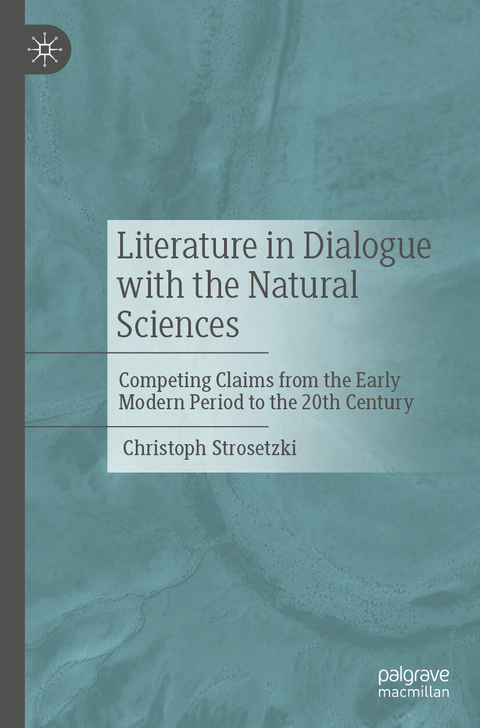
Literature in Dialogue with the Natural Sciences (eBook)
241 Seiten
Palgrave Macmillan (Verlag)
978-3-662-71319-8 (ISBN)
The thesis of the book is that in the early modern period, literature claimed precedence over the observation of nature. There were shifts through phases of temporary parity, the priority of natural sciences in the 19th century, and their critique by literature in the 20th century. These developments are presented in France and the Spanish-speaking world, while also considering Germany and England: While Montaigne, Pedro Mexía, Pérez de Oliva, Vives, and Gracián prioritize literature, Pascal contrasts the "esprit de finesse" with the "esprit de géométrie," opening a controversy that Linnaeus and Buffon continue. Enlightenment thinkers like Voltaire orient themselves toward the English model, where Locke and Hume introduce empirical sciences whose advances Rousseau critiques. In the 19th century, Balzac and Pérez Galdós engage with the natural sciences, with Zola later looking to Darwin and Comte as role models. Finally, the aporias of scientific thinking are highlighted by Ortega y Gasset, Borges, and Sábato.
| Erscheint lt. Verlag | 14.8.2025 |
|---|---|
| Zusatzinfo | X, 241 p. 1 illus. |
| Sprache | englisch |
| Original-Titel | Literatur im Dialog mit den Naturwissenschaften |
| Themenwelt | Geisteswissenschaften ► Geschichte |
| Geisteswissenschaften ► Sprach- / Literaturwissenschaft ► Literaturwissenschaft | |
| Schlagworte | Blaise Pascal • French Literature • Humanities vs. Natural Sciences • Le Roman expérimental • Miguel de Unamuno • novela metafísica • Ortega y Gasset • Positivism • Spanish Literature |
| ISBN-10 | 3-662-71319-5 / 3662713195 |
| ISBN-13 | 978-3-662-71319-8 / 9783662713198 |
| Informationen gemäß Produktsicherheitsverordnung (GPSR) | |
| Haben Sie eine Frage zum Produkt? |
 PDF (Wasserzeichen)
DRM: Digitales Wasserzeichen
Dieses eBook enthält ein digitales Wasserzeichen und ist damit für Sie personalisiert. Bei einer missbräuchlichen Weitergabe des eBooks an Dritte ist eine Rückverfolgung an die Quelle möglich.
Dateiformat: PDF (Portable Document Format)
Mit einem festen Seitenlayout eignet sich die PDF besonders für Fachbücher mit Spalten, Tabellen und Abbildungen. Eine PDF kann auf fast allen Geräten angezeigt werden, ist aber für kleine Displays (Smartphone, eReader) nur eingeschränkt geeignet.
Systemvoraussetzungen:
PC/Mac: Mit einem PC oder Mac können Sie dieses eBook lesen. Sie benötigen dafür einen PDF-Viewer - z.B. den Adobe Reader oder Adobe Digital Editions.
eReader: Dieses eBook kann mit (fast) allen eBook-Readern gelesen werden. Mit dem amazon-Kindle ist es aber nicht kompatibel.
Smartphone/Tablet: Egal ob Apple oder Android, dieses eBook können Sie lesen. Sie benötigen dafür einen PDF-Viewer - z.B. die kostenlose Adobe Digital Editions-App.
Buying eBooks from abroad
For tax law reasons we can sell eBooks just within Germany and Switzerland. Regrettably we cannot fulfill eBook-orders from other countries.
aus dem Bereich