Practical Spanish Grammar (eBook)
845 Seiten
Jossey-Bass (Verlag)
978-1-394-28032-2 (ISBN)

Learn Spanish, as easy as uno, dos, tres!
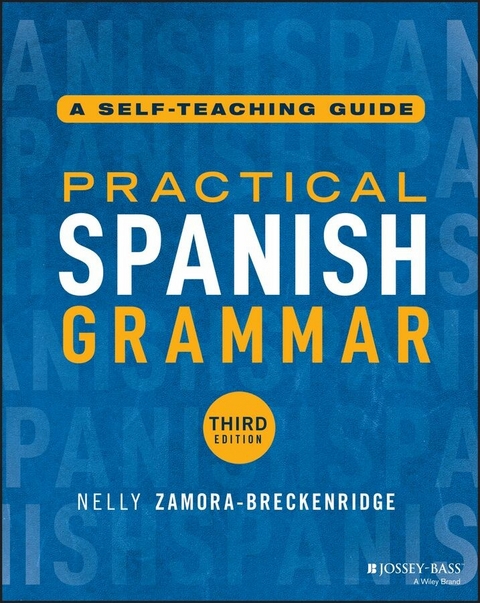
Practical Spanish Grammar, Third Edition, combines the quick-reference virtues of a phrase book with the learning tools of a full-fledged language course. This popular resource has been completely updated and revised for today's Spanish usage so you can be confident that you're not just learning 'textbook Spanish.' Students, jobseekers, and travelers can boost their practical language skills with this self-paced guide.
Why this book? There are many resources online and off that you can use to practice Spanish. All practice is valuable, but when you have a question, you need an authoritative reference that you can turn to for trusted answers. And, when it comes to building your foundational knowledge of Spanish grammar and phrases, there's still no substitute for working through a proven textbook like Practical Spanish Grammar. Written by a professor who taught the Spanish language for more than 30 years, this concise, practical, and easy to follow book helps you easily find the content you need to improve your Spanish skills.
- Follow a proven, interactive approach for teaching yourself at your own pace
- Complete exercises to reinforce what you learn and get answers in the book
- Get clear explanations of Spanish grammar
- Learn more than 1,000 of the most frequently used Spanish words
- Practice sample dialogues with cultural notes and lists of terms
Beginner and intermediate students of the Spanish language will make great progress with Practical Spanish Grammar. Excellent as a textbook and as a self-study guide, this book is a must for Spanish learners.
NELLY ZAMORA-BRECKENRIDGE is a Senior Research Professor of World Languages and Cultures at Valparaiso University with over 30 years of experience teaching Spanish. She received her Ph.D. in Spanish and Literature from the University of Colorado at Boulder. She has post-graduate studies in Hispanic Linguistics and Phonetics from the Instituto Caro y Cuervoin Bogatá and the Instituto de Cooperación Iberoamericanain Madrid.
Learn Spanish, as easy as uno, dos, tres! Practical Spanish Grammar, Third Edition, combines the quick-reference virtues of a phrase book with the learning tools of a full-fledged language course. This popular resource has been completely updated and revised for today's Spanish usage so you can be confident that you're not just learning textbook Spanish. Students, jobseekers, and travelers can boost their practical language skills with this self-paced guide. Why this book? There are many resources online and off that you can use to practice Spanish. All practice is valuable, but when you have a question, you need an authoritative reference that you can turn to for trusted answers. And, when it comes to building your foundational knowledge of Spanish grammar and phrases, there's still no substitute for working through a proven textbook like Practical Spanish Grammar. Written by a professor who taught the Spanish language for more than 30 years, this concise, practical, and easy to follow book helps you easily find the content you need to improve your Spanish skills. Follow a proven, interactive approach for teaching yourself at your own pace Complete exercises to reinforce what you learn and get answers in the book Get clear explanations of Spanish grammar Learn more than 1,000 of the most frequently used Spanish words Practice sample dialogues with cultural notes and lists of terms Beginner and intermediate students of the Spanish language will make great progress with Practical Spanish Grammar. Excellent as a textbook and as a self-study guide, this book is a must for Spanish learners.
Spanish Sounds
There are a few sounds in Spanish that do not exist in English, and vice versa. Some sounds are the same in both languages. An important fact to keep in mind is that in Spanish we run several words together to form what is called a “breath group”; in other words, we link together all the words between pauses. As a result, we omit one of two identical vowels or consonants, and we soften certain consonants (such as b, d, g) within the breath group.
EX: Ella va a ver a mi hijo. (Pronounced as éyabábéramíjo.)
Guidelines on how to pronounce letters of the Spanish alphabet are given below using English words with corresponding sounds.
- Vowels. There are five vowels in Spanish: a, e, i, o, u. Whether stressed or unstressed, the sounds of these vowels are clear, tense, and short. The stress doesn't change a vowel in Spanish the way it does in English. For example, the three a's of Panamá have the same sound.
- In Spanish the letter A is pronounced with the mouth open as in the a of English far.
EXS: mañana, banana, Canadá, habilidad, área
- E is pronounced with the lips stretched and the tongue higher than when pronouncing a, as in the vowel sound of English pet.
EXS: Europa, departamento, vez, perro, excelente
- I and Y are pronounced with the lips very stretched and the tongue nearly touching the roof of the mouth, as in English see, but shorter. When y is by itself, it means and. Y may also appear at the end of a word after another vowel.
EXS: ciudad, sí; Juan y María, soy, ideal
- O is pronounced with the lips rounded as in the o of English for.
EXS: profesor, tonto, solo, octavo, hotel, doctor
- U is pronounced in a very rounded way and its pronunciation formed in the back of the mouth, as in English boot, but shorter.
EXS: tú, Cuba, luna, universidad, Raúl
- Semivowels. Spanish semivowels i, u, are pronounced shorter than i, u, whenever they are unstressed and are directly preceded or followed by another vowel. They are the “weak” part of the two-vowel combination we call diphthong.
EXS: aire [ai], viaje [ia], causa [au], agua [ua], veinte [ei], bien [ie], euro [eu], bueno [ue], boina [oi], violín [io], estadounidense [ou], cuota [uo], ciudad [iu], muy [ui]
- In Spanish the letter A is pronounced with the mouth open as in the a of English far.
- Consonants. In general, Spanish consonants are pronounced with less strength and friction than English consonants, especially b, d, g. The following consonants are used in standard Latin American Spanish. There is an extra consonant sound in Spain, which we will mention at the end.
- The letters b and v in Spanish are pronounced like the letter b in English when they occur at the beginning of a breath group, after a pause, or after a nasal sound. In other cases, they are pronounced softly, with a slight friction between the lower and upper lips. The sound of v in English does not exist in Spanish.
EXS: labio, voz, nuevo, bebida, vida
- The letter c + a, o, u, l, or r and the letter combination qu (with silent u) + e or i are pronounced like the English letter k, but they are never followed by the puff of air heard in the English initial k.
EXS: casa, cosa, cuando, clase, crema; que, Quito, Quijote
The spelling with k is used in a few foreign words such as kilómetro, kiosko, kimono; but even these words can be spelled with qu.
The combination ch in Spanish is pronounced in the same way as the ch letter combination in English words like church. The Real Academia de la Lengua Española stopped considering the combination “ch” as a letter since 1994. It is placed under the letter “c” in any dictionary.
EXS: muchacho, chico, mucho, chofer, Chile
- The letter d is pronounced with the tip of the tongue against the upper teeth at the beginning of a breath group and after an n. Within the breath group, it is pronounced in the same way as the th letter combination in English, as in father and there, but with even less friction.
EX: código, día, debate, doctora, Indiana
- The letter f is pronounced in the same way as the letter f in English. Unlike English, however, this sound in Spanish is never written as ph or ff.
EXS: teléfono, oficina, fax, fósforo, infeliz
- The letter g + a, o, u, r, or l and the letter combination gu + e or i are pronounced like the g in get at the beginning of a breath group or after an n. Otherwise, they are pronounced in a similar way as the sound of g in sugar—softly, and with only a slight friction.
EX: gato, globo; agua, guerra, guitarra
The u of gu is silent. When it is pronounced, it is written with a diaeresis (two dots), as the gü in lingüística and vergüenza.
- The letter h in Spanish is never pronounced.
EX: hablar [aßlár], prohibir [proißír], alcohol [alkól], hospital [ospitál]
- In Spanish the letter j + a, e, i, o, or u and the letter g + e or i are pronounced like the h in hat, but with more friction in the back of the mouth.
EXS: Jalisco, lenguaje, garaje, videojuego; gente, gimnasio, biología
The x of México and Texas is pronounced in the same way as the j or g.
- The letter l is pronounced like the l in English in words like let. The sound of the l at the end of a syllable or word in English is very soft, dark, and relaxed. The sound of the l in Spanish is always clear, high, and tense, with the tip of the tongue touching the roof of the mouth. This sound more than any other will readily betray an English accent.
EXS: los, libro, hotel, mil, luz
The double l (ll) and the y are pronounced in the same way as the y in English, but usually with more friction, depending on the country. The Real Academia de la Lengua Española stopped considering “ll” as a letter since 1994. It is always found under the letter “l” in any dictionary.
EXS: llamar, mayo, lluvia, calle, coyote, collar
In Argentina this sound has a lot of friction, similar to English s in words like pleasure and lesion.
- The letter m is pronounced like the letter m in English. However, this sound in Spanish is never written as mm.
EXS: madre, mesa, inmediato, permiso, comunicación
- The letter n is pronounced the same way as the letter n in English.
EXS: nada, renta, negocio, corazón, nube
- The letter ñ in Spanish is pronounced in the same way as the letters ny and ni in English in words like canyon and onion.
EXS: mañana, España, ñandú, año, cañón
- The letter p in Spanish is pronounced like the English p in spy, and it is never followed by the puff of air heard in the English initial p of pie. You would have a strong English-language accent if you pronounced that puff of air in Spanish words with initial p.
EXS: papa, Pedro, papel, persona, puerta
- The r is pronounced like the t in English in words like water and matter. When the r is at the beginning of a word or after s or n, the sound is like the rolled r (double r).
EXS: pero, para, árbol, comer, caro, Rosa, Israel, honra.
- The double r (rr) has no comparable sound in many forms of English. The tip of the tongue moves quickly five to eight times against the gum ridge. It is a trilled sound.
EXS: perro, arroz, carro, torre, carretera
The single r at the beginning of a word and after n, l, or s is pronounced in the same way as the double r in Spanish.
EXS: rosa [rrosa], rojo [rrójo]; honra [ónrra], alrededor [alrre∂e∂ór], Israel [Isrraél]
- Four different letters in Spanish have the same sound as the s in English. They are: 1) the s in front of any vowel or final syllable (soy, ojos, estoy). 2) in the Americas, the z in front of a, o,...
- The letters b and v in Spanish are pronounced like the letter b in English when they occur at the beginning of a breath group, after a pause, or after a nasal sound. In other cases, they are pronounced softly, with a slight friction between the lower and upper lips. The sound of v in English does not exist in Spanish.
| Erscheint lt. Verlag | 2.9.2025 |
|---|---|
| Sprache | englisch |
| Themenwelt | Schulbuch / Wörterbuch ► Wörterbuch / Fremdsprachen |
| Geisteswissenschaften ► Sprach- / Literaturwissenschaft ► Sprachwissenschaft | |
| Technik | |
| Schlagworte | advanced spanish • beginners Spanish books • beginning spanish • Foreign Language Instruction • learn spanish • modern Spanish grammar • Spanish • Spanish Grammar • spanish grammar book • spanish lessons • spanish textbook • teach yourself spanish |
| ISBN-10 | 1-394-28032-7 / 1394280327 |
| ISBN-13 | 978-1-394-28032-2 / 9781394280322 |
| Informationen gemäß Produktsicherheitsverordnung (GPSR) | |
| Haben Sie eine Frage zum Produkt? |
 EPUB (Adobe DRM)
Kopierschutz: Adobe-DRM
Adobe-DRM ist ein Kopierschutz, der das eBook vor Mißbrauch schützen soll. Dabei wird das eBook bereits beim Download auf Ihre persönliche Adobe-ID autorisiert. Lesen können Sie das eBook dann nur auf den Geräten, welche ebenfalls auf Ihre Adobe-ID registriert sind.
Details zum Adobe-DRM
Dateiformat: EPUB (Electronic Publication)
EPUB ist ein offener Standard für eBooks und eignet sich besonders zur Darstellung von Belletristik und Sachbüchern. Der Fließtext wird dynamisch an die Display- und Schriftgröße angepasst. Auch für mobile Lesegeräte ist EPUB daher gut geeignet.
Systemvoraussetzungen:
PC/Mac: Mit einem PC oder Mac können Sie dieses eBook lesen. Sie benötigen eine
eReader: Dieses eBook kann mit (fast) allen eBook-Readern gelesen werden. Mit dem amazon-Kindle ist es aber nicht kompatibel.
Smartphone/Tablet: Egal ob Apple oder Android, dieses eBook können Sie lesen. Sie benötigen eine
Geräteliste und zusätzliche Hinweise
Buying eBooks from abroad
For tax law reasons we can sell eBooks just within Germany and Switzerland. Regrettably we cannot fulfill eBook-orders from other countries.
aus dem Bereich