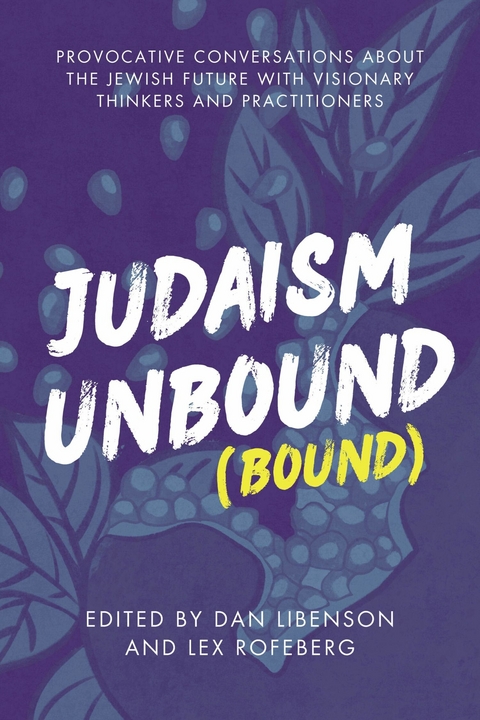
Judaism Unbound (Bound) (eBook)
374 Seiten
Ben Yehuda Press (Verlag)
978-1-963475-80-7 (ISBN)
This book is for those of us who hunger for deep conversations about what Judaism is and what it is for, what Judaism has been and what it might become. Whether you read Judaism Unbound (Bound) on your own or with a book group, in small bursts or in a single sitting, these pages will open your mind to a whole new way of thinking about Judaism. If you have longed for a Jewish life that was more meaningful or for a Jewish community that was more welcoming, you will be amazed and inspired at the creativity and experimentation happening on the cutting edge of Jewish life. You will be empowered to imagine how you might write the next chapter in the Jewish story.
'Those concerned about Judaism's future will find plenty to chew on in these creative and expansive dialogues.'
-Publishers Weekly
This book is for those of us who hunger for deep conversations about what Judaism is and what it is for, what Judaism has been and what it might become. Whether you read Judaism Unbound (Bound) on your own or with a book group, in small bursts or in a single sitting, these pages will open your mind to a whole new way of thinking about Judaism. If you have longed for a Jewish life that was more meaningful or for a Jewish community that was more welcoming, you will be amazed and inspired at the creativity and experimentation happening on the cutting edge of Jewish life. You will be empowered to imagine how you might write the next chapter in the Jewish story."e;Those concerned about Judaism's future will find plenty to chew on in these creative and expansive dialogues."e;-Publishers Weekly
Introduction
Genesis
At this writing, the Judaism Unbound podcast has been listened to over two-and-a-half million times since we released the first episode on March 4, 2016. Because we had a sense that we were starting down a significant road, we titled that first episode “Genesis.” And just as God destroyed the first Creation in a flood, we destroyed our first episode and re-recorded it. Even that early in the history of the podcast, it had already evolved.
In the months before we launched the podcast, we had been putting together an outline for a book we wanted to write about the future of Judaism. By that time, a bunch of relatively small organizations that made up what was being called the “Jewish innovation ecosystem” had been having some success for about a decade with initiatives aimed at engaging “unaffiliated” Jews. The science fiction writer William Gibson once said that “[t]he future is already here—it’s just not very evenly distributed,” and we wondered whether those organizations’ work represented a Jewish future that was in fact already here. Perhaps a book that wove together a theory of the future based on what was gaining traction in the present would help accelerate a process of broader Jewish transformation. A new version of Judaism would emerge, built around a new ecosystem of institutions that would better resonate with what we have called “regular Jews.”
The 2013 Pew Study of Jewish Americans had been published just about two years before we started work on the book. Its blockbuster finding was that 22% of Jewish Americans were what it called “Jews of no religion”—people who answered “none of the above” when asked what religion they were but who had Jewish parentage and/or otherwise considered themselves Jewish. While many Jewish communal professionals expressed concern that this number was so high, we believed it distracted from the much higher number of what might be called “Jews of low religion.” Our hypothesis found substantial support years later in the second iteration of the study, released in 2020, in which additional questions were asked. While the proportion of Jews of no religion had risen to 27%, even more interesting was a finding that an additional 27% claimed that Judaism was their religion but replied “I’m not religious” to a question about why they didn’t attend synagogue. Essentially, 54% of American Jews explicitly stated that they were “not religious,” and most of the rest didn’t seem interested in the offerings of the existing landscape of Jewish organizations.
While Pew’s findings were consistent with our belief that conditions were right for a new version of Judaism to emerge, we decided we weren’t ready to write the book we had envisioned. We knew how we’d frame the book—we were confident about the historical analogies we’d make and the traditional mythic stories from the Jewish tradition we’d invoke. For example, we felt like forty years of wandering in the wilderness was a powerful way to talk about the patience that we would need during a long transition from one version of Judaism to the next. But we had a nagging sense that we didn’t know the details of the contemporary landscape well enough to make strong book-length assertions about whether the new Jewish future was already here yet or still en route.
We decided we needed to do more research, and we thought that if we did our research in the form of a podcast, perhaps scholars and practitioners would be more willing to talk to us. We could tempt them with the possibility that their ideas and projects would reach new audiences who would hear from them directly, in their own voice. We hoped that having these conversations out loud and in public could be a way to gather and catalyze others who were eager to engage in the grand experiment of re-inventing Jewish life in the 21st century.
As it turns out, we were on to something! March of 2016 was still the relatively early days of podcasting, and thanks to a surprising number of downloads in the first few days, Apple featured Judaism Unbound as a “New and Noteworthy” podcast, which helped us gain a substantial listenership right out of the gate. As we write this, we have released over 450 podcast episodes—we have never missed a Friday in over eight years and have also released quite a few bonus episodes—and people collectively spend nearly half a million hours with us every year. Pretty quickly, the podcast became its own thing, and we more or less forgot that it had started as research for a book. Our on-air conversations with the wise and creative guides who have shared their visions and stories have challenged and changed us.
In our first episode (both the original one and the re-recorded one), we talked about the many meanings of “unbound,” including being untethered by geography, by the definitions of what and who is Jewish, and by what a Jewish life is “supposed to” look like. We pointed out that many Jews feel bound to Judaism by accident of birth, not choice. What would a Judaism look like that had the gravitational attraction to re-bind people through choice? The idea of an “unbound” Judaism breaks free from the notion of Judaism as an all-or-nothing bundle. What if some elements speak to you, but others don’t? Does that make you a “bad Jew”? We asserted that, while no one knows what Judaism will look like in 100 years, it will be healthier and more compelling if many more people are involved in the creative process of re-thinking, re-imagining, and experimenting. The podcast was our invitation to “regular Jews” to become part of this new creative class, and now so is this book.
Who and what is this book for?
Though the original book we intended to write remains a project for a future time, we are delighted to offer this book as a fresh version of the journey we have taken together with our podcast listeners—a compilation of some of the highlights from our first 200 conversations. Our intention for this bound version of Judaism Unbound is that it extends the breadth of people reached by these voices, as there are still many people who don’t listen to podcasts.
If you are in the non-listener group, welcome to Judaism Unbound! We think you will find these interview transcripts compelling and personally relevant, just as our listeners have over the past eight years.
For podcast listeners, we hope that the movement of words from the ear to the page gives a new depth of engagement with the ideas we have been exploring together. Being able to annotate the pages, re-read passages that are particularly striking to you, and flip back and forth between thematically connected interviews allows you to grapple with these ideas in a new, more tactile and tangible way.
We have arranged these transcripts in a new order—interviews that took place years apart are now on adjacent pages—that puts podcast guests into conversation with one another. As such, we believe this book is a profoundly new and different experience from the podcast.
How to engage with this book
We hope this this book will look pretty beat up in a year—dog-eared pages where you’ve found quotes to return to, exclamation points and question marks in the margins, coffee rings and wine stains throughout, the odd napkin tucked between the pages covered in doodles and ideas you wrote down during conversations with family and friends.
From the beginning, we meant for Judaism Unbound to empower people to learn what they want to know and experiment in their own Judaism. We wanted it to be an invitation to be part of a community of people grappling with the future of Judaism and their place in it. We always believed that our listeners—and now our readers—didn’t need to or want to be told what to think. Now, with this volume, we are literally putting the future of Judaism in your hands.
You can read this book start to finish, in the order we’ve placed the transcripts, or you can choose your own adventure, reading one or two transcripts at random or because a certain topic came up in conversation at a Passover seder you attended. To spark your personal reflections and catalyze dialogues with others, we’ve included conversation-starter questions throughout the book (after each interview in Part 1 and Part 2, and after each grouping of interviews in Part 3). But if you have other questions, don’t be locked into the ones we have provided. Again, we mean for this book to facilitate your learning journey, not to be our guided tour.
Though we have made the editorial choices around structure and order, we have not attempted to make things linear, nor have we tidied things up to perfectly fit a pre-existing, singular narrative. The greatest joys of these conversations are often the unexpected side-trips, the personal quirks of voice and expression, and the ways in which each guest comes to common themes in their own idiosyncratic way. We’ve worked hard to ensure that these joys are retained in the text, even as we’ve trimmed the verbatim transcripts for readability and thematic foregrounding.
In the introductions to each section, we have provided a few framing ideas, many drawn from the episodes of the podcast where it was just the two of us processing what we were learning, but we have consciously held back from giving you too many of our opinions here. We certainly have opinions, but Judaism Unbound has always been about believing that people can think for themselves and come to their own conclusions, as long as they feel...
| Erscheint lt. Verlag | 2.9.2025 |
|---|---|
| Sprache | englisch |
| Themenwelt | Geisteswissenschaften ► Religion / Theologie ► Judentum |
| Schlagworte | Contemporary Judaism • Jewish innovation |
| ISBN-10 | 1-963475-80-1 / 1963475801 |
| ISBN-13 | 978-1-963475-80-7 / 9781963475807 |
| Informationen gemäß Produktsicherheitsverordnung (GPSR) | |
| Haben Sie eine Frage zum Produkt? |
 EPUB (Ohne DRM)
Digital Rights Management: ohne DRM
Dieses eBook enthält kein DRM oder Kopierschutz. Eine Weitergabe an Dritte ist jedoch rechtlich nicht zulässig, weil Sie beim Kauf nur die Rechte an der persönlichen Nutzung erwerben.
Dateiformat: EPUB (Electronic Publication)
EPUB ist ein offener Standard für eBooks und eignet sich besonders zur Darstellung von Belletristik und Sachbüchern. Der Fließtext wird dynamisch an die Display- und Schriftgröße angepasst. Auch für mobile Lesegeräte ist EPUB daher gut geeignet.
Systemvoraussetzungen:
PC/Mac: Mit einem PC oder Mac können Sie dieses eBook lesen. Sie benötigen dafür die kostenlose Software Adobe Digital Editions.
eReader: Dieses eBook kann mit (fast) allen eBook-Readern gelesen werden. Mit dem amazon-Kindle ist es aber nicht kompatibel.
Smartphone/Tablet: Egal ob Apple oder Android, dieses eBook können Sie lesen. Sie benötigen dafür eine kostenlose App.
Geräteliste und zusätzliche Hinweise
Buying eBooks from abroad
For tax law reasons we can sell eBooks just within Germany and Switzerland. Regrettably we cannot fulfill eBook-orders from other countries.
aus dem Bereich