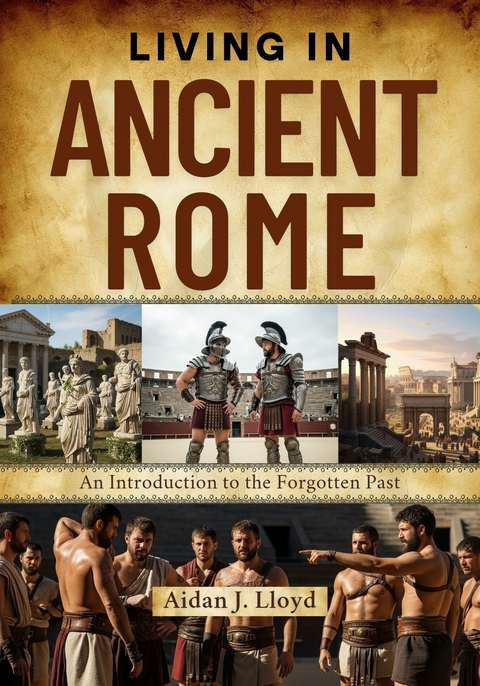
Living in Ancient Rome (eBook)
240 Seiten
Seahorse Pub (Verlag)
978-0-00-103600-0 (ISBN)
Step beyond the marble statues and political intrigue to uncover the authentic voices of ordinary Romans who built history's most enduring civilization. 'Living in Ancient Rome' transforms our understanding of the ancient world by revealing the daily experiences of merchants, soldiers, slaves, and families whose lives shaped an empire spanning three continents.
Through groundbreaking archaeological discoveries and forgotten personal accounts, historian Aidan J. Lloyd brings to life the bustling streets of Pompeii, the frontier settlements of Britain, and the diverse communities that made Rome truly cosmopolitan. From a Celtic blacksmith earning Roman citizenship to a Syrian merchant navigating Mediterranean trade routes, these untold stories illuminate how millions of people from vastly different cultures became Romans while maintaining their unique identities.
This comprehensive journey spans over eight centuries, from Rome's humble beginnings as an Italian city-state through its transformation into a global superpower. Discover how revolutionary citizenship laws created history's first truly multicultural society, explore the sophisticated economic networks that connected Britain to Egypt, and witness the religious diversity that flourished within Roman borders long before Christianity's rise.
Lloyd masterfully weaves together archaeological evidence, personal inscriptions, and historical documents to reveal how ordinary people experienced major historical events. Learn about the veteran colonies that spread Roman culture, the mystery religions that offered spiritual alternatives, and the complex social dynamics that held this vast empire together.
Perfect for history enthusiasts and casual readers alike, this engaging narrative challenges everything you thought you knew about ancient Rome. Rather than focusing solely on emperors and battles, 'Living in Ancient Rome' celebrates the human stories that created Western civilization's foundations.
Experience history as it was truly lived - through the eyes of the people who made it.
Chapter 1
"Before Rome Was Rome" (753-509 BCE)
In 2019, archaeologists working beneath the Roman Forum made a discovery that would reshape our understanding of Rome's origins. Drilling through layers of imperial marble and republican tufa, they uncovered evidence of settlements that predated the traditional founding date by nearly two centuries. The carefully stratified deposits revealed ceramic fragments, post holes, and refuse pits from the 9th century BCE—silent testimony to communities that thrived along the Tiber's banks long before Romulus supposedly plowed his sacred furrow.
This archaeological revelation strikes at the heart of one of history's most enduring myths. For over two millennia, Romans and their admirers have recounted the tale of twin brothers suckled by a she-wolf, raised by shepherds, and destined to found the greatest city the ancient world would know. Romulus kills Remus in a fraternal dispute over walls and boundaries, becoming Rome's first king on April 21, 753 BCE. The story resonates with themes of divine providence, sibling rivalry, and urban planning—a perfect foundation myth for a civilization that would come to rule the Mediterranean.
Yet the Palatine Hill tells a different story. Recent excavations have revealed not the planned city of mythical twins, but the gradual coalescence of Iron Age villages. The earliest structures consist of simple oval huts with thatched roofs, their foundations cut directly into the hill's volcanic tufa. Pottery sherds scattered around these dwellings bear striking similarities to materials found throughout central Italy, suggesting that early Rome emerged not from divine intervention, but from the broader patterns of settlement and cultural exchange that characterized the region.
The landscape these early settlers encountered differed dramatically from the monumental cityscape that would later define Rome. The seven hills rose from marshy valleys frequently flooded by the Tiber. Patches of dense forest provided timber and hunting grounds, while the river itself served as both highway and barrier. Salt pans near the coast generated trade goods, and the presence of easily worked volcanic stone offered building materials. This was not the virgin territory of foundation myths, but a contested landscape where Latin-speaking communities competed with Etruscan city-states and Greek traders for control of vital resources.
Archaeological layers beneath the Forum Romanum preserve evidence of this prehistoric occupation. Carbon dating of organic materials consistently places the earliest permanent structures in the 9th century BCE, with evidence of seasonal occupation extending back another century. The material culture—bronze fibulae, coarse pottery, iron tools—matches contemporary sites throughout Latium, undermining claims of Rome's unique origins. Instead, the archaeological record suggests that Rome began as one settlement among many, distinguished perhaps by its strategic location but not by divine favor or heroic founders.
Ω∑Ύ
The 8th century BCE Mediterranean world in which Rome emerged was characterized by unprecedented connectivity and cultural exchange. Greek city-states had begun establishing colonies throughout southern Italy and Sicily, bringing new technologies, artistic styles, and urban planning concepts to indigenous populations. Phoenician traders established networks stretching from Carthage to the Levant, introducing coinage, alphabetic writing, and sophisticated maritime technology. In this cosmopolitan environment, the communities along the Tiber found themselves positioned at the intersection of multiple cultural spheres.
Etruscan civilization dominated central Italy during this period, with sophisticated city-states like Veii, Caere, and Tarquinia controlling trade routes and natural resources. Archaeological evidence from Etruscan tombs reveals a society of remarkable wealth and artistic achievement. Elaborate frescoes depict banqueting scenes, athletic competitions, and religious ceremonies that would later influence Roman practices. The Etruscans possessed advanced metallurgical techniques, producing bronze and iron goods that were traded throughout the Mediterranean. Their political organization, based on loose confederations of autonomous cities, provided a model that would profoundly influence early Roman governance.
The Etruscan influence on early Rome extended far beyond material culture. The very concept of the city as a sacred space, defined by religious boundaries and protected by divine favor, derived from Etruscan precedent. Archaeological evidence suggests that Etruscan craftsmen and religious specialists worked in early Rome, contributing to the development of distinctive Roman traditions. The practice of augury—interpreting divine will through the flight patterns of birds—came directly from Etruscan religion, as did the elaborate rituals surrounding the foundation of new settlements.
Latin-speaking tribes occupied the hills and valleys of central Italy alongside their Etruscan neighbors. Archaeological surveys reveal hundreds of small settlements scattered throughout the region, most consisting of clusters of simple dwellings surrounded by agricultural land. These communities practiced mixed farming, growing cereals and legumes while raising cattle, sheep, and pigs. Social organization centered on extended kinship groups, with leadership roles rotating among prominent families. Burial practices varied considerably, with some communities practicing cremation while others preferred inhumation, suggesting diverse cultural traditions within the broader Latin-speaking population.
Greek colonization of southern Italy, beginning in the 8th century BCE, introduced new cultural elements that would profoundly influence Roman development. The Greeks brought with them sophisticated urban planning concepts, monumental architecture, and complex religious systems. Perhaps most importantly, they introduced alphabetic writing, adapted from Phoenician script, which would become the basis for the Latin alphabet. Greek pottery, metalwork, and decorative arts found their way northward through trade networks, exposing Latin communities to new aesthetic possibilities and technical innovations.
Trade networks connected these various Mediterranean peoples in complex webs of exchange. Archaeological evidence from early Roman sites includes Greek pottery from Corinth and Athens, Etruscan bronze work, and amber from the Baltic regions. This material culture testifies to the sophisticated commercial relationships that characterized the 8th century BCE Mediterranean world. Rome's position along the Tiber provided access to both inland and maritime trade routes, positioning the emerging city to benefit from this expanding commercial activity.
The religious landscape of central Italy during this period was characterized by diversity and syncretism. Indigenous Latin deities were gradually supplemented by Greek and Etruscan religious concepts, creating a complex spiritual environment that would later crystallize into the Roman pantheon. Archaeological evidence from sanctuary sites reveals the gradual monumentalization of religious spaces, with simple altars and grove shrines giving way to more elaborate temple complexes. The introduction of anthropomorphic representations of deities, borrowed from Greek artistic traditions, marked a significant shift in religious practice and artistic expression.
Climate and environmental conditions during the 8th century BCE created both opportunities and challenges for early Roman communities. The Mediterranean experienced a period of relative stability, with reliable rainfall patterns supporting agricultural productivity. However, the Tiber's periodic flooding created marshlands that harbored disease vectors while simultaneously depositing fertile alluvium that enriched agricultural land. The management of water resources became a central concern for early Roman communities, leading to the development of drainage techniques and flood control measures that would later characterize Roman engineering expertise.
Ω∑Ύ
Archaeological investigations on the Palatine Hill have revolutionized our understanding of Rome's earliest development. Excavations directed by Andrea Carandini and his team have uncovered evidence of permanent settlement dating to the 9th century BCE, including post holes from oval huts, storage pits, and defensive earthworks. The material culture recovered from these contexts—handmade pottery, bronze fibulae, iron knives and spearheads—provides a detailed picture of daily life in pre-urban Rome. Carbon dating and ceramic typology have established a reliable chronological framework that challenges traditional dating based on literary sources.
The transformation from scattered villages to unified settlement occurred gradually over several centuries. Archaeological evidence suggests that separate communities on the Palatine, Capitoline, and Aventine hills began coordinating their activities during the 8th century BCE. Shared pottery styles, similar burial practices, and evidence of common defensive works point to increasing political and cultural integration. The construction of the earliest Forum Romanum, a paved meeting space in the valley between hills, represents a crucial step in this urbanization process. Recent excavations have revealed successive phases of paving and drainage, indicating sustained community investment in shared infrastructure.
Social organization in early Rome reflected broader patterns common throughout central Italy. Extended kinship groups, or gentes, formed the basic units of social organization. Archaeological evidence from cemetery sites reveals pronounced social stratification, with some...
| Erscheint lt. Verlag | 28.8.2025 |
|---|---|
| Sprache | englisch |
| Themenwelt | Geschichte ► Allgemeine Geschichte ► Altertum / Antike |
| ISBN-10 | 0-00-103600-9 / 0001036009 |
| ISBN-13 | 978-0-00-103600-0 / 9780001036000 |
| Informationen gemäß Produktsicherheitsverordnung (GPSR) | |
| Haben Sie eine Frage zum Produkt? |
 EPUB (Adobe DRM)
Größe: 2,8 MB
Kopierschutz: Adobe-DRM
Adobe-DRM ist ein Kopierschutz, der das eBook vor Mißbrauch schützen soll. Dabei wird das eBook bereits beim Download auf Ihre persönliche Adobe-ID autorisiert. Lesen können Sie das eBook dann nur auf den Geräten, welche ebenfalls auf Ihre Adobe-ID registriert sind.
Details zum Adobe-DRM
Dateiformat: EPUB (Electronic Publication)
EPUB ist ein offener Standard für eBooks und eignet sich besonders zur Darstellung von Belletristik und Sachbüchern. Der Fließtext wird dynamisch an die Display- und Schriftgröße angepasst. Auch für mobile Lesegeräte ist EPUB daher gut geeignet.
Systemvoraussetzungen:
PC/Mac: Mit einem PC oder Mac können Sie dieses eBook lesen. Sie benötigen eine
eReader: Dieses eBook kann mit (fast) allen eBook-Readern gelesen werden. Mit dem amazon-Kindle ist es aber nicht kompatibel.
Smartphone/Tablet: Egal ob Apple oder Android, dieses eBook können Sie lesen. Sie benötigen eine
Geräteliste und zusätzliche Hinweise
Buying eBooks from abroad
For tax law reasons we can sell eBooks just within Germany and Switzerland. Regrettably we cannot fulfill eBook-orders from other countries.
aus dem Bereich