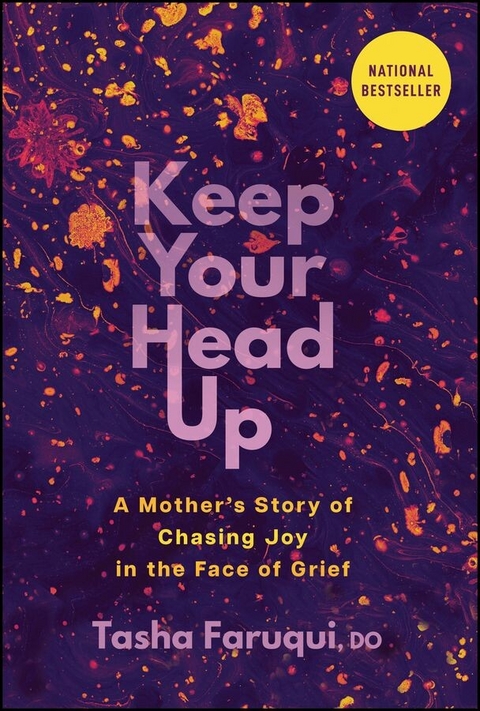
Keep Your Head Up (eBook)
279 Seiten
Jossey-Bass (Verlag)
978-1-394-35877-9 (ISBN)
A testament to the depth of familial love and our ability to endure in the face of childhood terminal illness
Keep Your Head Up is the incredible tale of one family's path to perseverance in the face of devastating odds. When author Tasha Faruqui gave birth to her second daughter, Soraya, she knew immediately that something was wrong. Yet as years passed and every medical test for Soraya came back normal or inconclusive, Tasha began to realize that science doesn't always have the answers, and there are some issues in life that simply cannot be fixed. Yet, we can continue to find happy moments and celebrate the beauty of what we have.
This story gives a voice to parents and loved ones of terminally ill children, illuminating the way to comfort, community, and unbreakable hope. This book discusses terminal illness with raw honesty, demonstrating how families can provide transparency to life-limited children around a terminal diagnosis, comfort them when they are afraid of what comes next, and continue to embrace life despite ongoing challenges. With beautiful narration and a heartfelt perspective, Keep Your Head Up testifies to the true depth of familial love and the hard things we can endure with grace and resilience.
This book:
- Provides guidance, hope, and understanding to parents and caregivers of terminally ill children
- Tells a story that will resonate with families facing elusive diagnoses, fickle healthcare systems, and emotional turmoil
- Offers hope that it is possible to find joy in the face of tragedy and give sick children the gift of a fully lived life
- Presents the balanced and relatable perspective of an award-winning pediatrician and parent to a child in hospice
Parents, family, and friends of terminally ill children, as well as healthcare professionals and educators, will appreciate Keep Your Head Up for its candor and its value as a guide to moving through a situation no family should have to face.
DR. TASHA FARUQUI is a pediatrician, public speaker, medical advocate, and author. She's passionate about helping parents of children with complex medical conditions and reduced life expectancy. She was named a top doctor by Cincinnati Magazine in 2022 and 2024. She continues to share her family's journey on Instagram (thefaruqui5).
A testament to the depth of familial love and our ability to endure in the face of childhood terminal illness Keep Your Head Up is the incredible tale of one family's path to perseverance in the face of devastating odds. When author Tasha Faruqui gave birth to her second daughter, Soraya, she knew immediately that something was wrong. Yet as years passed and every medical test for Soraya came back normal or inconclusive, Tasha began to realize that science doesn't always have the answers, and there are some issues in life that simply cannot be fixed. Yet, we can continue to find happy moments and celebrate the beauty of what we have. This story gives a voice to parents and loved ones of terminally ill children, illuminating the way to comfort, community, and unbreakable hope. This book discusses terminal illness with raw honesty, demonstrating how families can provide transparency to life-limited children around a terminal diagnosis, comfort them when they are afraid of what comes next, and continue to embrace life despite ongoing challenges. With beautiful narration and a heartfelt perspective, Keep Your Head Up testifies to the true depth of familial love and the hard things we can endure with grace and resilience. This book: Provides guidance, hope, and understanding to parents and caregivers of terminally ill children Tells a story that will resonate with families facing elusive diagnoses, fickle healthcare systems, and emotional turmoil Offers hope that it is possible to find joy in the face of tragedy and give sick children the gift of a fully lived life Presents the balanced and relatable perspective of an award-winning pediatrician and parent to a child in hospice Parents, family, and friends of terminally ill children, as well as healthcare professionals and educators, will appreciate Keep Your Head Up for its candor and its value as a guide to moving through a situation no family should have to face.
Chapter 1
Waving Through a Window
Looking back, there have been three major themes in my life: expectations (both those placed on me and those I've projected onto my future), fierce independence (despite what was expected of me), and fitting in (or not). In my more myopic moments, I see these as a direct result of being the child of immigrants, but when I zoom out, I can appreciate that, while the journey has been specifically mine, the feelings are universal. After all, who doesn't bristle at the expectations of others, believe their lives “should” go a certain way, long to express their authentic selves, and yearn for belonging? I'd venture to say every single one of us does. That's humanity for you.
My story starts, I suppose, when my mom emigrated from Bangladesh at 16, arriving in the United States with a limited education, even more limited English skills, and a new husband she barely knew. In our culture, it's common to get married at an early age—my grandmother was married at 12 and my aunt at 14—so my mom was just following tradition. In opposition to it, though, she'd entered into a “love” marriage instead of having an arranged one, the only one of the six kids in her family to do so. Let's just say their “love” didn't last long.
Mom married him because he'd kissed her on the cheek. Having no knowledge otherwise, she thought that kiss meant she was going to get pregnant—and if they were having a child, she'd better become his wife. As you might imagine, it wasn't the best foundation for a long-term relationship.
By 17, she gave birth to my sister. By 21, she had me. And by the time she was 26, my dad dropped the three of us from Mississippi to Illinois to my uncle's house, told her he wanted a divorce, and walked out of our lives. He left us essentially homeless and with only two weeks' worth of clothing.
Thankfully, my uncle offered to let us stay with him and his family while my mom took odd jobs and tried to save money to get us a place of our own. She worked as a waitress. A babysitter. A nursing assistant. A garment maker. We all slept in the same room, in the same bed.
After two years, she'd earned enough to move us into a decent apartment located in a Community Housing project. As much as she appreciated her brother's help, my mom wanted to prove she could make it on her own. That meant working more hours than ever, along with taking night classes at the community college. It wasn't the best recipe for being a mother to two young girls, but it would have to do.
A stream of less-than-reliable babysitters followed, and my sister and I were often left to our own devices. By kindergarten, I had my own key to our place and knew to walk myself to the bus stop when Bozo's grand prize game started on TV. Mom had already drilled into our little heads that we needed an education, so we'd always be able to stand on our own feet, and I never lingered longer despite missing the exciting ending of the show because I understood school was of the utmost importance.
I also understood that our situation was unique, and I started feeling like a live action version of that song on Sesame Street: “One of these things is not like the others.” My friends never had to live in their uncle's house or share a bed with their mother and sister. They were escorted to the bus stop instead of walking alone, signaled by a certain segment of a TV show. In kindergarten, I was told to watch The Bozo Show and when Bozo (the clown) introduced “The Grand Prize Game” that was my cue to turn off the TV, lock the door, and go to my bus stop. The contrast remained for after school as well, where other children were let into their houses instead of letting themselves in with a key attached to their backpack. They always had a parent home, or at the very least a dependable babysitter, instead of being on their own or left with random people who might or might not show up on any given day.
For obvious reasons, the local Bangladeshi community started pushing my mom to find a new husband. Their view was You're a single woman with no college education. You have two kids and you're dirt poor, so you need to find somebody to take care of you. Family, friends, and friends of friends scoured their contacts for eligible bachelors.
They soon located a single surgeon who lived in rural Michigan. It was considered a perfect match for many reasons: first, he was also from Bangladesh, although he'd grown up in a small village as opposed to a city like my mom. Second, as the eldest son in his family, he'd taken on financial responsibility for his 10 siblings and their children(!) after his father died, so his fiscal life was in order. Finally, and probably most important, he was divorced, and he needed someone who would understand and accept his situation—maybe even someone who'd found herself in the same situation.
On coming to the States, he fell in love with an American nurse who was both Caucasian and Christian (unlike him, my mom, my bio dad, and most people from Bangladesh, who are Muslim). They got married, had three children, and then divorced when she cheated on him. Worried about his newly wifeless status, his family quickly arranged for a second marriage with a woman from his village in Bangladesh. This second wife found living in the rural United States more isolating than she could handle, so they promptly divorced, and she went back home.
Although he was still considered an extremely eligible bachelor due to his status as a physician, he was hesitant to marry another woman from Bangladesh, knowing how difficult the cultural transition had been for his second wife. Ideally, he wanted to find a traditional Bangladeshi woman who already lived in America. Enter my mom.
Being Bangladeshi, Muslim, divorced, and in the Midwest, my mom ticked every box as a potential new spouse for him. Everyone decided it was an ideal partnership, despite the 18 years separating them—my mom was 28 and he was 46 at the time—so they talked a bit over the phone, then met in person at a community picnic. I remember running up to him that day and asking if I could call him Dad. He, of course, said yes, and from then on, he's always been Dad to me. Although love at first sight would be something of an overstatement, if you asked him today, he'd tell you he fell in love as soon as he saw me and my sister. It also doesn't hurt that my mother is beautiful.
As for Mom, it was almost like she reverted from love marriage to an arranged marriage. This wasn't a foreign concept, and it seemed to work for a lot of people in our culture. She knew she'd made a mistake the first time around and was willing to sacrifice anything and everything to make our lives better. Besides, she could see positive characteristics in Dad that my biological father hadn't possessed, like a good job, a good head on his shoulders, and a willingness to be a loving father who actually enjoyed the role. To be honest, she also appreciated that he was a physician who owned a house and had all sorts of things that we didn't at the time.
It was a done deal. They got married, my sister and I got a new father, and we all got a new lease on life. As for our biological father, he made increasingly rare appearances after that. Most of our scheduled supervised visitations ended up being playdates with my uncle because bio dad never showed up. He once started a custody battle with my mom but then barely attended any of the hearings. Before long, my sister and I came to understand that we shouldn't ask to see or even mention bio dad because it would be disrespectful and hurtful to our new dad.
A giant perk of our new life was that Dad was much more “Americanized” than Mom. Instead of using the Bengali words Abbu, Amma, and Apa for father, mother, and sister, we now used the American terms. We ate with utensils instead of using our hands. Dad stocked root beer (so cool! pop!) in the fridge for me and my sister, and my mom tried her first sip of alcohol—a glass of wine on their honeymoon. My much older stepbrothers and stepsister were being raised Christian, so we celebrated Christmas and Easter along with Ramadan. I was thrilled. As a kid you don't want to be different; you want to assimilate. I assimilated quickly.
In Dowagiac, Michigan, Dad was one of two doctors in our new hometown of less than 6,000 people. He practiced as both a family practitioner and surgeon, doing everything from annual exams and sick visits to total hip replacements, C-sections, and appendectomies. Essentially, his services ran the gamut from birth to death. If patients couldn't afford their bills, Dad would often accept an Afghan blanket or other homemade treasure as payment.
The community was friendly and family-oriented, and Dad had chosen to settle there because it reminded him of his village back home. In our tiny Michigan town, a very small percentage of people ever moved away, only a third or so went on to college, and many married young. For the most part, it was an idyllic place to grow up.
We were big fish in a tiny pond, always in the spotlight. Everybody in the town knew who we were because of my dad's status as a doctor, and my dad knew everyone and everything going on because more than half the town were his patients. If a boy liked me, Dad always got the scoop before I did. “I heard from his mom that...
| Erscheint lt. Verlag | 27.8.2025 |
|---|---|
| Sprache | englisch |
| Themenwelt | Geisteswissenschaften ► Religion / Theologie ► Christentum |
| Schlagworte | childhood cancer • childhood illness • children in hospice • Difficult Diagnosis • parent hospice • parents terminally ill child • rare childhood disease • Terminal Diagnosis • terminal disease • terminal illness • terminally ill child • undiagnosed children |
| ISBN-10 | 1-394-35877-6 / 1394358776 |
| ISBN-13 | 978-1-394-35877-9 / 9781394358779 |
| Informationen gemäß Produktsicherheitsverordnung (GPSR) | |
| Haben Sie eine Frage zum Produkt? |
 EPUB (Adobe DRM)
Kopierschutz: Adobe-DRM
Adobe-DRM ist ein Kopierschutz, der das eBook vor Mißbrauch schützen soll. Dabei wird das eBook bereits beim Download auf Ihre persönliche Adobe-ID autorisiert. Lesen können Sie das eBook dann nur auf den Geräten, welche ebenfalls auf Ihre Adobe-ID registriert sind.
Details zum Adobe-DRM
Dateiformat: EPUB (Electronic Publication)
EPUB ist ein offener Standard für eBooks und eignet sich besonders zur Darstellung von Belletristik und Sachbüchern. Der Fließtext wird dynamisch an die Display- und Schriftgröße angepasst. Auch für mobile Lesegeräte ist EPUB daher gut geeignet.
Systemvoraussetzungen:
PC/Mac: Mit einem PC oder Mac können Sie dieses eBook lesen. Sie benötigen eine
eReader: Dieses eBook kann mit (fast) allen eBook-Readern gelesen werden. Mit dem amazon-Kindle ist es aber nicht kompatibel.
Smartphone/Tablet: Egal ob Apple oder Android, dieses eBook können Sie lesen. Sie benötigen eine
Geräteliste und zusätzliche Hinweise
Buying eBooks from abroad
For tax law reasons we can sell eBooks just within Germany and Switzerland. Regrettably we cannot fulfill eBook-orders from other countries.
aus dem Bereich