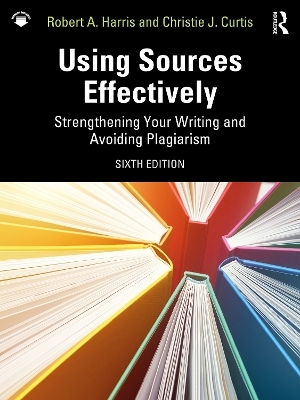
Using Sources Effectively
Routledge (Verlag)
978-1-032-64379-3 (ISBN)
- Lieferbar (Termin unbekannt)
- Versandkostenfrei
- Auch auf Rechnung
- Artikel merken
The sixth edition of Using Sources Effectively targets the two most prominent problems in current research-paper writing: the increase in unintentional plagiarism and the ineffective use of research source material.
Designed as a textbook for both undergraduate and graduate courses, this book will help every student who uses research in writing. It was written to give students the knowledge and tools you can use to make your research-based writing more powerful and effective. The book includes Mini-Research Projects at the end of each chapter to sharpen your research and evaluation skills; a set of practical, useful rhetorical devices to help improve the clarity and impact of your writing; instruction in close reading to help you better grasp what an author is discussing or arguing; and strategies for organizing and positioning your sources to strengthen your central argument. The new edition has been thoroughly updated to cover developments in AI and ChatGPT, critical thinking, and digital developments in relation to social media.
With updated online resources, including lecture PowerPoints, an instructor’s guide, a quiz bank, and digital figures, as well as new “sidebar” and learning objective features in the book, this is an essential textbook for students across a range of disciplines who need a guide to research and writing and who are taking courses on academic writing.
Robert A. Harris (PhD, University of California, Riverside) taught English at college and university level for more than 25 years. He has also worked in the area of instructional design. Dr. Harris' other books include The Plagiarism Handbook and Writing with Clarity and Style: A Guide to Rhetorical Devices for Contemporary Writers. Christie J. Curtis (PhD, Interim Dean, Graduate Studies Chair, Professor, Biola University, La Mirada, California) has been teaching writing and grammar skills for more than 25 years. She currently chairs the committees of many graduate students as they seek to complete their theses. Dr. Curtis is the coauthor of the Grammar and Writing Series (Grades 3–8), which includes student texts (writing and grammar), student workbooks (writing and grammar), teacher’s guides, and online resources.
Preface to the Sixth Edition
Chapter 1: The Importance of Using Sources Effectively
1.1 Why Learn to Write Well?
Writing Is a Thinking Process
Writing Is a Learning Process
Writing Develops Lifelong Skills
1.2 Why Learn Research-Based Writing
Research Makes Writing Easier
Research Writing Allows You to Contribute to the Great Conversation
1.3 Why Use Sources in Papers?
Research Sources Provide Context
Sources Strengthen Argument
Sources Add Interest to Your paper
Sources Provide You With New Ideas
Sources Keep You Up-to-Date
Sources Reveal Controversies
Sources Help You Understand How Reasoned Argument Works
1.4 Why Use Sources Effectively?
Effective Use Instills Trust
Effective Use Aids Persuasion
Effective Use Shows Engagement
1.5 Why Cite Them All?
Cite to Help Your Reader
Cite to Show Respect for Fellow Knowledge Workers
Cite to Avoid Plagiarism
1.6 Are Sources the Whole Idea?
Your tTinking Is the Star
Sources Need Something to Support
Sources Need Interpreting
It's the Great Conversation Again
Review Questions
A Little Rhetoric: How Much Emphasis?
Now You Try
Chapter 2: Finding, Choosing, and Evaluating Sources
2.1 Start by Understanding the Assignment
What Is the Purpose of the Paper?
What Are the Specific Requirements for the Paper?
Who Is Your Audience?
2.2 Select the Kinds of Sources You Need
Choose the Kind of Information You Need
Take a Shortcut to Selection
Choose Sources of Appropriate Scholarship
Choose Appropriate Primary and Secondary Sources
Avoid Choosing a Source Only Because You Agree With It
Avoid Quoting Standard Dictionaries
2.3 Search Strategies
Consider the Variety of Sources
Keep Track of Your Searches
Looking Online
Phrase the Search Terms Effectively
Go Beyond the Internet
2.4 Using and Abusing Internet Sources
Search for Reliable Sites
Looking Deeply into the Results
Understand the Context of Individual Pages
Use the Invisible Web
2.5 Evaluating Sources
Expertise
Accuracy
Reliability
Review Questions
A Little Rhetoric: Anaphora
Now You Try
Chapter 3: Preparing Your Sources
3.1 Collecting Sources
Save Your Sources
Get the Full, Exact Bibliographic Information the First Time
Save the Way Back
3.2 Keep Sources Organized
Start a Bibliography
3.3 Use Close Reading to Understand Your Sources
What Is the Purpose of the Information?
What Is the Level of Objectivity?
Analyze the Argument
Notice the Images and Analogies
Check Word Meanings for Accuracy
So What?
What Is Each Source Saying?
3.4 Take Careful Notes
Use a Labeling System
Quote Exactly
Keep a Quotation File
Keep Copies of Each Source With Your Notes
3.5 Positioning Your Sources
Purpose Indicators
Relationships of Sources
Create an Outline of Possible Source Uses
3.6 Protect Yourself Against a False Charge of Plagiarism
Protect Your Data and Passwords
Do Not Lend Your Paper to Someone Else
Report Any Theft Immediately
Save All Drafts and Notes
Save All Sources
Be Proactive
Review Questions
Mini-Research Project Controversies
A Little Rhetoric: Conduplicatio
Chapter 4: Quoting Effectively
4.1 Quoting Use and Abuse
When to Choose Quotation
Cautions About Quoting
Avoid the Fallacy of Vicious Abstraction
4.2 Introductory Strategies
Introduce Your Sources
Choose Introductory Verbs to Create Guiding Lead-In or Signal Phrases
Use Introductory Sentences With a Colon
Use an Introductory Phrase
Use the Appropriate Tense in Your Introductory Phrases for APA Style
Use Both Set-Off and Built-In Quotations
Use the Historical Present Tense for MLA-Style Papers
4.3 Quoting Strategies
Interrupt Quotations
Leave Out Some Words
Quote Phrases
4.4 Punctuating Quotations
General Conventions
Ellipsis
Square Brackets
Review Questions
Mini-Research Project: Misattributed Quotations
A Little Rhetoric Analogy
Now You Try
Chapter 5: Paraphrasing and Summarizing
5.1 Paraphrasing
What Is a Paraphrase?
Why and When to Paraphrase
Paraphrasing Ground Rules
How to Paraphrase
Cautions About Paraphrasing
5.2 Summarizing
What Is a Summary?
Why and When to Summarize
How to Summarize
Cautions About Summarizing
Source Limitations on Summarizing
5.3 Deciding Whether to Quote, Paraphrase, or Summarize
5.4 Beware of Thesaurusitis
Review Questions
Mini-Research Project: Comparing Summaries
A Little Rhetoric: Metabasis
Now You Try
Paraphrasing and Summarizing Activity
Chapter 5 Review: Acceptable Use or Plagiarism?
Potential Use 1
Potential Use 2
Potential Use 3
Potential Use 4
Potential Use 5
Potential Use 6
Chapter 6: Avoiding Plagiarism
6.1 What Is Plagiarism?
A Working Definition of Plagiarism
Intentional Plagiarism
Unintentional Plagiarism
The Fine Print
Self-Recycling
6.2 Why You Should Avoid Intentional Plagiarism
Intentional Plagiarism Harms Your Character
Follow the Golden Rule
Intentional Plagiarizers Cheat Themselves
Intentional Plagiarizers Never Know When They Will Be Caught
6.3 Guidelines for Citation
What Needs to Be Cited?
Do You Ever Have to Cite Yourself?
What About Common Knowledge?
Will My Paper Be Nothing but Citations?
6.4 Myths and Facts About Citing
The Public Domain Myth
The World Wide Web Myth
The Fair Use Myth
The Encyclopedia Myth
The Paraphrased Paper Myth
The Friend’s Permission Myth
The Named Source Myth
The Converted Words Myth
The Tiny Theft Myth
The Background Information Myth
Review Questions
Mini-Research Project: Famous Plagiarism Cases
Bonus Search
A Little Rhetoric: Rhetorical Question
Now You Try
Chapter 7: Putting It Together
7.1 The Simple Rule: Mark the Boundaries
Marking the Boundaries of Short Quotations
Marking the Boundaries of Long Quotations
Marking the Boundaries of an Unquoted Source
7.2 Marking the Boundaries in Problem Cases
How to Create a Second Boundary Marker
Marking the Boundaries for Non-Text Information
Review Questions
A Little Rhetoric: Hypophora
Now You Try
Chapter 7 Review: Boundary Markers
Source Text
Potential Use 1, APA Style
Potential Use 2, APA Style
Potential Use 3, MLA Style
Potential Use 4, MLA Style
Potential Use 5, APA Style
Chapter 8: Effective Use
8.1 Introduce the Source Thoroughly
Establish the Credibility of the Source
Provide Needed Background or Context
Recommend the Source
8.2 Discuss or Apply the Source
The Purpose of a Source Is Not Always Self-Evident
Explain the Source Beginning With an Interpretive Lead-In
Be Reasonable About the Effect of the Source
Provide an Example to Clarify the Source’s Point
8.3 Blend in Your Sources
Work Your Sources Into the Discussion
Combine Quoting With Summarizing
Use One Long, Many Short for Powerful Persuasion
8.4 Avoid Ineffective Use
Beware of Long Quotations
Avoid Overusing One Source
Begin and End Each Paragraph With Your Own Words
Be Sure Citations Match the References
8.5 Working With Sources That Disagree or Conflict
Identify the Source of Disagree
Criticizing Opposing Sources
Avoid Criticizing a Source Unfairly
Review Questions
Matching Exercise
Mini-Research Project: Logical Fallacies
A Little Rhetoric: Procatalepsis
Now You Try
Chapter 8 Review: Effectiveness
Chapter 9: Editing for Accuracy
9.1 Why Cleanup Is Crucial
9.2 Check Your Spelling
Check for Ordinary Misspellings
Check for Autocorrect Errors
Check for Confused Words
Use American Spelling
9.3 Watch Your Grammar
Comma Splice
Fused Sentence
Sentence Fragment
9.4 Watch Your Pronouns
Pronoun Agreement
Pronoun Reference
Indefinite Pronouns
Avoid the Ambiguous You
9.5 Check for Common Errors
Possessives
Subject-Verb Agreement
Dangling Modifier
Misplaced Modifier
Affect and Effect
Informality
Review Questions
A Little Rhetoric: Distinctio
Chapter 9 Review: Error Check
Chapter 10: Jump-Starting Your Writing
10.1 Synthesis Writing
A Definition of Synthesis Writing
Tapestry Versus Quilt Writing
Tapestry Weaving and Your Reader
10.2 Steering Wheels
Parataxis and Hypotaxis
Transitions
Transitions of Logic
Transitions of Focus
Transitions of Thought
Keyword Repetition
Synonyms
Pronouns and Possessive Pronouns
Demonstrative Pronouns and Adjectives
10.3 Using Flow Patterns
Patterns With Because
Conditional (If-Then) Patterns
Concession Patterns
10.4 Using Patterns with Sources
Use Scholarly Phrasing
The Source Supports Your Position
You Agree With the Source
The Source Disagrees With Your Position
You Rebut a Source That Opposes Your View
You Respond to a Source That Presents an Incontrovertible Objection
The Source Implies Something Without Stating It
The Source Makes an Unstated Assumption
Introducing Common Knowledge
Introducing Conflicting Views
Review Questions
Chapter 10 Activity: Synthesis Exercise
Chapter 10 Activity: True or False
Chapter 10 Activity: More Flow Patterns
A Little Logic: Conditional Syllogisms
| Erscheinungsdatum | 16.12.2025 |
|---|---|
| Zusatzinfo | 39 Tables, black and white; 6 Line drawings, black and white; 6 Illustrations, black and white |
| Verlagsort | London |
| Sprache | englisch |
| Maße | 210 x 280 mm |
| Gewicht | 453 g |
| Themenwelt | Geisteswissenschaften ► Psychologie |
| Geisteswissenschaften ► Sprach- / Literaturwissenschaft ► Literaturwissenschaft | |
| Sozialwissenschaften ► Kommunikation / Medien ► Kommunikationswissenschaft | |
| ISBN-10 | 1-032-64379-X / 103264379X |
| ISBN-13 | 978-1-032-64379-3 / 9781032643793 |
| Zustand | Neuware |
| Informationen gemäß Produktsicherheitsverordnung (GPSR) | |
| Haben Sie eine Frage zum Produkt? |
aus dem Bereich