


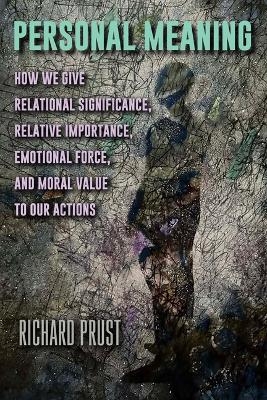
Personal Meaning
How We Give Relational Significance, Relative Importance, Emotional Force, and Moral Value to Our Actions
Seiten
2026
State University of New York Press (Verlag)
979-8-8558-0602-1 (ISBN)
State University of New York Press (Verlag)
979-8-8558-0602-1 (ISBN)
- Titel nicht im Sortiment
- Artikel merken
The personal meaning of our action reveals who we are: understanding how that disclosure is possible enables us to describe our self-awareness more accurately and solve a raft of intellectual puzzles about our values and relationships.
Much of our action has personal meaning, meaning others are not entirely privy to. Our relationships can have a great deal of meaning or they can be of little meaning. Some of our actions register as important, others relatively unimportant. Sometimes we act in loving ways; sometimes we act out of fear. Sometimes we mean to do something with special moral value. Personal Meaning accounts for how we construct these features of our actions' meaning. It shows how we make sense of our relationships, our priorities, our emotions, and our morality in ways that can be reasonable or unreasonable. By laying out how we reason when we are being reasonable about personal matters, we discover what author Richard Prust calls the "character logic" of personal meaning. Appreciating its governance gives us two advantages: it lets us describe our lives more accurately than we can using the causal languages of science, and it enables us to find philosophical solutions to the issues discussed under these topics.
Much of our action has personal meaning, meaning others are not entirely privy to. Our relationships can have a great deal of meaning or they can be of little meaning. Some of our actions register as important, others relatively unimportant. Sometimes we act in loving ways; sometimes we act out of fear. Sometimes we mean to do something with special moral value. Personal Meaning accounts for how we construct these features of our actions' meaning. It shows how we make sense of our relationships, our priorities, our emotions, and our morality in ways that can be reasonable or unreasonable. By laying out how we reason when we are being reasonable about personal matters, we discover what author Richard Prust calls the "character logic" of personal meaning. Appreciating its governance gives us two advantages: it lets us describe our lives more accurately than we can using the causal languages of science, and it enables us to find philosophical solutions to the issues discussed under these topics.
Richard Prust is Professor Emeritus of Philosophy at St. Andrews University. He is coauthor, with Jeffery Geller, of Personal Identity in Moral and Legal Reasoning.
Acknowledgments
Introduction
1. Individual Meaning
2. Relational Significance
3. Relative Importance
4. Emotional Force
5. Moral Value
6. The Meaning of Life
Glossary
Notes
Bibliography
Index
| Erscheint lt. Verlag | 1.3.2026 |
|---|---|
| Reihe/Serie | SUNY series in American Philosophy and Cultural Thought |
| Verlagsort | Albany, NY |
| Sprache | englisch |
| Maße | 152 x 229 mm |
| Gewicht | 363 g |
| Themenwelt | Geisteswissenschaften ► Philosophie |
| Geisteswissenschaften ► Psychologie ► Sozialpsychologie | |
| ISBN-13 | 979-8-8558-0602-1 / 9798855806021 |
| Zustand | Neuware |
| Informationen gemäß Produktsicherheitsverordnung (GPSR) | |
| Haben Sie eine Frage zum Produkt? |
Mehr entdecken
aus dem Bereich


aus dem Bereich
ein Praxismanual zur Unterstützung von Menschen in herausfordernden …
Buch | Hardcover (2023)
Springer Fachmedien Wiesbaden GmbH (Verlag)
CHF 69,95
Buch | Softcover (2024)
Heyne (Verlag)
CHF 16,80


