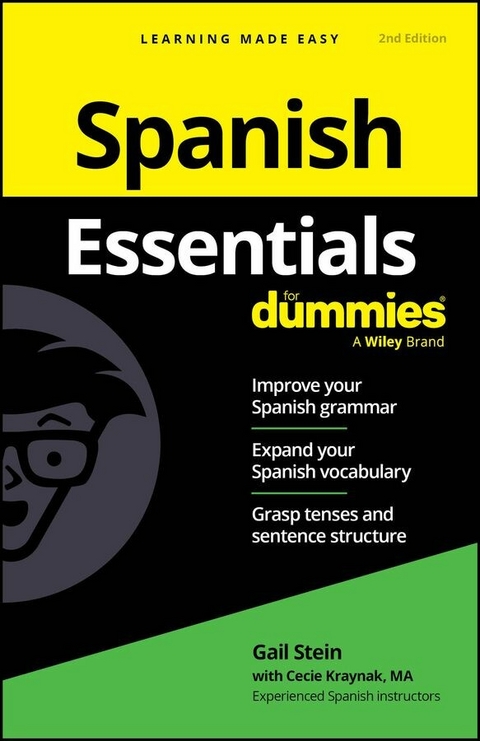
Spanish Essentials For Dummies (eBook)
231 Seiten
For Dummies (Verlag)
978-1-394-37326-0 (ISBN)
The perfect guide for new Spanish learners and anyone looking for an expert refresher
Interested in a fast and effective guide to learning Spanish that avoids fluff and focuses on key concepts that you need to know to improve your ability to speak, write, and understand the language? Spanish Essentials For Dummies, 2nd Edition walks you through Spanish fundamentals you can use for at-home, solo learning, to supplement your progress in a Spanish class, or as a companion to language instruction.
Inside:
- Get practical tips on Spanish grammar, pronunciation, and sentence structure
- See conversational Spanish examples to amplify your learning
- Understand all the core concepts taught and tested in a typical introductory Spanish course
Perfect for Spanish students looking for a quick reference to supplement classroom or app-assisted Spanish learning, Spanish Essentials For Dummies, 2nd Edition is a great resource for everyone looking to brush up on their conversational Spanish.
Gail Stein, MA has more than 30 years' experience teaching languages in New York City public junior and senior high schools. She is also the author of Spanish Workbook For Dummies.
Cecie Kraynak, MA has taught and tutored Spanish for more than 30 years. She is the author of Spanish For Dummies, Spanish Verbs For Dummies, and Spanish All-In-One For Dummies.
The perfect guide for new Spanish learners and anyone looking for an expert refresher Interested in a fast and effective guide to learning Spanish that avoids fluff and focuses on key concepts that you need to know to improve your ability to speak, write, and understand the language? Spanish Essentials For Dummies, 2nd Edition walks you through Spanish fundamentals you can use for at-home, solo learning, to supplement your progress in a Spanish class, or as a companion to language instruction. Inside: Get practical tips on Spanish grammar, pronunciation, and sentence structure See conversational Spanish examples to amplify your learning Understand all the core concepts taught and tested in a typical introductory Spanish course Perfect for Spanish students looking for a quick reference to supplement classroom or app-assisted Spanish learning, Spanish Essentials For Dummies, 2nd Edition is a great resource for everyone looking to brush up on their conversational Spanish.
Chapter 1
Brushing Up on the Basics
IN THIS CHAPTER
Perfecting your pronunciation
Counting with cardinal and ordinal numbers
Expressing dates
Telling time
Reviewing parts of speech
Pronouncing the language correctly, knowing numbers, expressing dates, relating the time of day, and recognizing parts of speech are essential Spanish skills you need in everyday life. Surely, the ability to communicate numbers, times, and dates is completely indispensable to you on a daily basis. Determining the correct part of speech to use helps you perfect your oral and written Spanish.
Pronouncing Properly
Naturally, when you speak Spanish, you want to sound as authentic as possible. The good news is that Spanish is quite easy to pronounce because it’s a phonetic language. What does that mean? Simply say each word exactly as you see it and put on your best Spanish accent. Chances are you’ll sound more like a native speaker than you could imagine.
The Spanish alphabet contains all the letters of the English alphabet plus ñ, which follows the letter n.
Voicing vowels
Unlike in English, each Spanish vowel is pronounced consistently. This table breaks down the basics:
| Vowel | English Sound | Spanish Example |
|---|
| a | ah as in spa | papa (pah-pah) (potato) |
| e | eh as in red | ella (eh-yah) (she) |
| i | ee as in key | idea (ee-deh-yah) (idea) |
| o | oh as in no | ojo (oh-hoh) (eye) |
| u | oo as in do | uno (oo-noh) (one) |
Practicing diphthongs and vowel combinations
Confronting diphthongs, or a combination of two vowels, gets a little tricky. Use this table to put your concerns to rest:
| Diphthongs/Vowels | English Sound | Spanish Example |
|---|
| ae, ai, ay | ahy as in eye | aeropuerto (ahy-roh-pwehr-toh) (airport) aire (ahy-reh) (air) ayudo (ahy-oo-doh) (help) |
| au | ow as in owl | autor (ow-tohr) (author) |
| ea | eh-ah | fea (feh-ah) (ugly) |
| ei, ey | a as in day | seis (say-s) (six) rey (rray) (king) |
| eo | eh-oh | leo (leh-oh) (I read) |
| eu | eh-oo | Europa (eh-oo-roh-pah) (Europe) |
| ia | ee-ah | seria (seh-ree-ah) (serious) |
| ie | ee-eh | siete (see-eh-teh) (seven) |
| io | ee-oh | avión (ah-bee-ohn) (airplane) |
| iu | ee-oo | ciudad (see-oo-dahd) (city) |
| oa, ua | wah as in watch | toalla (toh-wah-yah) (towel) agua (ah-gwah) (water) |
| oe, ue | weh as in wet | oeste (wehs-teh) (west) cuento (kwehn-toh) (tale) |
| oi, oy | oy as in boy | oigo (oy-goh) (I hear) soy (soy) (I am) |
| ui, uy | wee as in we | cuido (kwee-doh) (I take care of) muy (mwee) (very) |
| uo | woh as in woe | cuota (kwoh-tah) (quota) |
Verbalizing consonants
Consonants are a snap to master because most are pronounced exactly the same as they are in English. They are b, d, f, k, l, m, n, p, s, t, w, y. Note the exceptions in the following table.
Castilian Spanish (spoken in Spain) pronounces the letters c before e or i and z as th. In Latin America, however, c before e and i and z are pronounced as s. The following table shows the differences.
| Consonant | English Sound | Spanish Example |
|---|
| c | th in Spain s in Latin America k elsewhere | centro (thehn-troh) (sehn-troh) (center) cinco (seen-koh) (five) casa (kah-sah) (house) |
| ch | ch as in chair | chico (chee-koh) (boy) |
| g | h before e and i hard g elsewhere | gente (hehn-teh) (people) gira (hee-rah) (tour) gordo (gohr-doh) (fat) |
| h | silent | hora (oh-rah) (hour) |
| j | h | junto (hoon-toh) (together) |
| ll | y | llama (yah-mah) (llama) |
| ñ | ni as in onion | niño (nee-nyoh) (child) |
| r | slightly rolled r | oro (oh-roh) (gold) |
| rr | rolled 2 or 3 times at the beginning of the word and after l, n, or s | carro (kah-rroh) (car) rico (rree-koh) (rich) alrededor (ahl-rreh-deh-dohr) (around) Enrique (ehn-rree-keh) (Henry) Israel (ees-rrah-ehl) (Israel) |
| v | similar to b | vaca (bah-kah) (cow) |
| x | s followed by a consonant ks followed by a vowel | extra (ehs-trah) (extra) exacto (ehks-ahk-toh) (exact) |
| z | th in Spain s in Latin America | zoo (thoh)(zoo) zoo (soh) (zoo) |
Understanding stress and diacritical marks
In Spanish, words are pronounced just like they sound. Take note of the following rules for how words are stressed:
- Words ending in a vowel, an n, or an s are stressed on the next to the last syllable:
- libro (lee-broh) (book)
- bajan (bah-hahn) (they go down)
- cuadernos (kwah-dehr-nohs) (notebooks)
- Words ending in a consonant (except n or s) are stressed on the last syllable:
- felicidad (feh-lee-see-dahd) (happiness)
- hablar (ah-blahr) (to speak)
- When the preceding rules aren’t followed, use an accent:
- canción (kahn-see-ohn) (song)
These diacritical marks help with stress and pronunciation:
- An acute accent (′), the most common, indicates that you put more stress on the vowel of the syllable containing the accent:
- interés (een-teh-rehs) (interest)
- A tilde (~) is only placed above an n (which is...
| Erscheint lt. Verlag | 26.8.2025 |
|---|---|
| Co-Autor | Cecie Kraynak |
| Sprache | englisch |
| Themenwelt | Schulbuch / Wörterbuch ► Wörterbuch / Fremdsprachen |
| Geisteswissenschaften ► Sprach- / Literaturwissenschaft ► Sprachwissenschaft | |
| Technik | |
| Schlagworte | beginning spanish • easy Spanish • learning spanish • spanish book • Spanish examples • spanish for beginners • spanish fundamentals • Spanish Grammar • Spanish help • spanish pronunciation • Spanish sentence structure • Spanish tips • spanish tutorial |
| ISBN-10 | 1-394-37326-0 / 1394373260 |
| ISBN-13 | 978-1-394-37326-0 / 9781394373260 |
| Informationen gemäß Produktsicherheitsverordnung (GPSR) | |
| Haben Sie eine Frage zum Produkt? |
 EPUB (Adobe DRM)
Kopierschutz: Adobe-DRM
Adobe-DRM ist ein Kopierschutz, der das eBook vor Mißbrauch schützen soll. Dabei wird das eBook bereits beim Download auf Ihre persönliche Adobe-ID autorisiert. Lesen können Sie das eBook dann nur auf den Geräten, welche ebenfalls auf Ihre Adobe-ID registriert sind.
Details zum Adobe-DRM
Dateiformat: EPUB (Electronic Publication)
EPUB ist ein offener Standard für eBooks und eignet sich besonders zur Darstellung von Belletristik und Sachbüchern. Der Fließtext wird dynamisch an die Display- und Schriftgröße angepasst. Auch für mobile Lesegeräte ist EPUB daher gut geeignet.
Systemvoraussetzungen:
PC/Mac: Mit einem PC oder Mac können Sie dieses eBook lesen. Sie benötigen eine
eReader: Dieses eBook kann mit (fast) allen eBook-Readern gelesen werden. Mit dem amazon-Kindle ist es aber nicht kompatibel.
Smartphone/Tablet: Egal ob Apple oder Android, dieses eBook können Sie lesen. Sie benötigen eine
Geräteliste und zusätzliche Hinweise
Buying eBooks from abroad
For tax law reasons we can sell eBooks just within Germany and Switzerland. Regrettably we cannot fulfill eBook-orders from other countries.
aus dem Bereich