


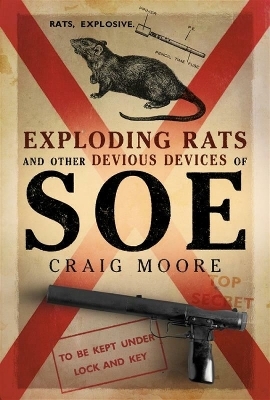
Exploding Rats and Other Devious Devices of SOE
The Camouflage Section 1941–1945
Seiten
2025
Fonthill Media Ltd (Verlag)
978-1-78155-965-9 (ISBN)
Fonthill Media Ltd (Verlag)
978-1-78155-965-9 (ISBN)
- Noch nicht erschienen (ca. Dezember 2025)
- Portofrei ab CHF 40
- Auch auf Rechnung
- Artikel merken
James Bond has Q Branch to supply him with ingenious equipment to use on his missions; during the Second World War, SOE field agents had the Camouflage Section.
The men and women of the Section, hailing from a variety of trades and professions, turned everyday items into concealment devices to carry weapons, ammunition, film, radios, false documents, microfilm and codes. These vessels ranged from oil cans, firewood and ornamental clocks, to record players, water bottles and tubes of toothpaste. Explosives and incendiary devices for industrial and military sabotage were concealed in dead rats, hollowed-out pieces of coal, books, torches, statues and suitcases. Convincing disguises were created to ensure that field agents would pass as locals in whatever region they were parachuted into. Essentially the Camouflage Section was responsible for keeping SOE agents behind enemy lines safe in the most nerve-wracking of circumstances—when under the suspicious gaze of the Gestapo.
After the war, SOE’s Camouflage Section was dissolved, but not before its work was collated and published in a secret document. That document remained classified for thirty years. This is the first time it has been presented in book form to the general public.
The men and women of the Section, hailing from a variety of trades and professions, turned everyday items into concealment devices to carry weapons, ammunition, film, radios, false documents, microfilm and codes. These vessels ranged from oil cans, firewood and ornamental clocks, to record players, water bottles and tubes of toothpaste. Explosives and incendiary devices for industrial and military sabotage were concealed in dead rats, hollowed-out pieces of coal, books, torches, statues and suitcases. Convincing disguises were created to ensure that field agents would pass as locals in whatever region they were parachuted into. Essentially the Camouflage Section was responsible for keeping SOE agents behind enemy lines safe in the most nerve-wracking of circumstances—when under the suspicious gaze of the Gestapo.
After the war, SOE’s Camouflage Section was dissolved, but not before its work was collated and published in a secret document. That document remained classified for thirty years. This is the first time it has been presented in book form to the general public.
Craig Moore has had a passion for military history since he was child. He is chiefly interested in the two world wars, in which eight of his close relatives fought and two died. One of his uncles lost a leg in Normandy in 1944 when his Sherman tank was hit by a shell. In 2010 Craig retired from London’s Metropolitan Police after 30 years of service. He lives in south-west London where he makes regular contributions to military history magazines. He also often visits museums and military events around the world. This is his ninth book on topics pertaining to the world wars.
| Erscheint lt. Verlag | 30.12.2025 |
|---|---|
| Zusatzinfo | 213 mono, 47 colour |
| Sprache | englisch |
| Maße | 172 x 246 mm |
| Themenwelt | Geschichte ► Allgemeine Geschichte ► 1918 bis 1945 |
| Geschichte ► Teilgebiete der Geschichte ► Militärgeschichte | |
| ISBN-10 | 1-78155-965-1 / 1781559651 |
| ISBN-13 | 978-1-78155-965-9 / 9781781559659 |
| Zustand | Neuware |
| Informationen gemäß Produktsicherheitsverordnung (GPSR) | |
| Haben Sie eine Frage zum Produkt? |
Mehr entdecken
aus dem Bereich

aus dem Bereich
Deutschland 1933 bis 1945
Buch | Hardcover (2025)
S. Fischer (Verlag)
CHF 47,60
ein Psychologe erlebt das Konzentrationslager
Buch | Hardcover (2024)
Kösel (Verlag)
CHF 30,80


